Chapter 3
Subsections of Frameworks and Standards
Enterprise Architecture Framework
Enterprise Architecture is a discipline that provides a holistic and integrated view of an organisation’s strategy, processes, information, and technology. This enterprise approach enables the alignment of various components of the business to work cohesively towards common goals. Within the Enterprise Architecture Framework, ‘enterprise’ can be understood in two key contexts:
- The broad spectrum of the enterprise, inclusive of all people, processes, and technology
- A particular domain within the enterprise, such as a specific business unit or functional area.
In both scenarios, the architecture spans multiple of systems and encompasses numerous departments within the organisation. When the objective is to create a cohesive network that includes the extended enterprise, it involves not only the internal divisions but also external entities such as partners, suppliers, and customers.
The aim of enterprise architecture as a framework is to optimise the often-fragmented legacy of processes across the enterprise (both manual and automated) into an integrated and secure environment that is responsive to changes and supportive of the delivery of the business strategy.
This section provides a reference framework to governing bodies and top management of regulated and critical sector entities to establish ‘due diligence’ on the use of IT in their respective entities. It describes the Enterprise Architecture Framework (EAF) at two levels, viz:
- Enterprise Business Architecture Framework (EBAF).
- Enterprise Technology Architecture Framework (ETAF).
The business architecture context is about how the organisation delivers value to its stakeholders. The technology architecture frameworks are about using technology to support the business mission, goals, objectives, and functions.
Enterprise Business Architecture Framework
Overview
The Enterprise Business Architecture Framework (EBAF) presents an end-to-end methodology that strategically aligns an organisation’s goals with its operational activities. Serving as an architectural blueprint, it guides leaders in shaping the processes, systems, and data flows central to the enterprise’s functioning. By integrating various components of business—ranging from customer interactions to technological infrastructure—EBAF aims to create an environment that is both streamlined and agile, fostering a business structure that is efficient and swiftly responsive to evolving demands.
At its core, the purpose of EBAF is to provide a structured yet flexible means for articulating and implementing a business’s architecture that resonates with its strategic imperatives. This involves offering clear guidance for continuous improvement of operational processes, aligning every business move with strategic goals. Beyond merely enhancing operational effectiveness, the framework serves as a catalyst to reduce process redundancies and drive enterprise-wide efficiency, ensuring that all actions taken are deliberate and goal-oriented.
Incorporating a strong emphasis on security, EBAF also propels organisations to proactively address potential risks and integrate robust security measures into their business architecture. This security-minded approach is essential in safeguarding critical information and systems, ensuring resilience against threats, and maintaining trust with stakeholders. To reinforce business resilience and foster innovation, EBAF pursuits with compliance and governance, permitting the safe exploration of new technologies and practices within a secure architectural landscape. Effectively, EBAF not only ensures that organisations meet regulatory requirements but also establish a secure foundation for growth and transformation.
The Business Ecosystem
The business ecosystem of an entity describes its environment in terms of its functions and activities in relation to and with the participation of other entities and national bodies. The business ecosystem of an entity can also be described in terms of the use of IT in the provisioning and consumption of business services, the underlying business processes and information flows between the entity and its users, customers, partners, service providers and national bodies.
Business ecosystem of regulated and critical sector entities in Indian context is pictorially shown here.
Enterprise Technology Architecture Framework
The federated digital ecosystem of a CSE is manifested through an information infrastructure that runs the business, industrial and operational processes. Most of the currently available technical literature and knowledge focuses on differentiating the characteristics and technical architectures of IT, OT, IIoT and Information Security systems and networks. In contrast, this documentation attempts to synergise and harmonise the differentiated concepts and frameworks into a common representation that can help in better communication amongst the business, non-technical and technical stakeholders, both within and outside the organisations.
The enterprise technology architecture framework outlined in this section offers a unified reference for top and senior management of organisations and national nodal bodies. It is designed to facilitate informed decision-making on leveraging technology to achieve desired business results, establish best practices, and provide comprehensive guidance on functional, performance, operational, managerial, and security considerations. It may be noted that the word “technology” here refers specifically to IT, OT, and Information Security related technology, as well as IIoT technology used for physical access control and monitoring (e.g., smart cards, biometrics, CCTVs etc).
Concepts
Requirements for use of Technology
The enterprise technology architecture framework of organisations should address the following requirements so that IT and OT are used efficiently, effectively, safely and securely:
Functional: Deliver the business and industrial objectives through functions, processes, operations, and services.
Quality: Deliver the required quality of systems and software.
Performance: Deliver required performance of the functions and processes.
Trustworthiness: Assurance that the functionality is implemented and configured correctly and is operating as intended.
Cybersecurity: There are no weaknesses and vulnerabilities in hardware/ firmware/ software that could be exploited by malicious actors to cause harm.
Confidentiality: The information and data are handled as per its security classification.
Integrity: The data and processes are trustable.
Availability: The functions and performance are available to the users at required levels of availability.
Safety: Specific to OT and IIoT, the assurance that the operational processes are safe for humans and the environment.
Privacy: Privacy of individuals and organisations is maintained, with regard to sensitive and private information.
Supply chain: Assurance that the entire supply chain is secure and not exploitable for causing harm.
Management: People, process, and technology governance, which oversees and assures that the above parameters are consistently achieved throughout the life cycle.
Ecosystem: The organisation’s digital infrastructure does not cause harm to other organisations that are part of the federated digital ecosystem.
Architectural Principles
The IT, OT and IS infrastructure implementation is based upon a common set of engineering and architectural principles, namely:
Segmentation: Zoning of assets, network, and resources (security by design, security in implementation).
Multi-layered security: Implementing a layered security cover to achieve defence in depth.
Reliability: Ability to assure a required level of functionality and performance in normal circumstances.
Robustness: Ability to deliver a minimum level of functionality and performance in the face of adversity.
Resilience: Ability to prevent the degradation of functions, performance, and trustworthiness; ability to minimise the impact of degradation (if it occurs) and ability to quickly recover from a degraded condition to the normal condition.
Patterns of a CSE’s Information Infrastructure
Almost all CSEs implement their information (IT, OT and IS) infrastructure through separate projects. Typical elements of an CSE’s information infrastructure, its operation, management, and use are described below:
A common information infrastructure across the entity, whose elements include hardware and software (end-user devices, mail, web, and portal servers), network and security systems, and information services (email, portal, common user applications, databases etc). The in-store and in-use assets are usually managed through ERP/ ITAM/ ITOM/ CMDB platforms.
The common information infrastructure is managed through pan-organisation IT Operations/ Service management (ITOM/ ITSM) and Information Security management systems (ISMS).
The platforms have their own IT infrastructure, viz, devices and runtime platforms to carry out IT and IS management functions related to asset configurations, availability and performance, patches and upgrades, compliance to hardening baselines, identity and access, authentication and authorisation, systems and network management, security management, logs and audit trails (evidence management), vulnerability and compliance management, security incident and event management (SIEM), incident response management, (IR, EDR/ XDR, SOAR), analytics etc.
Devices, systems, platforms, networks, security, applications, and databases of critical processes are usually segregated into secure logical or physical (air-gapped) high-trust zones.
Air-gapped high-trust zones would typically have their own management systems, while non-air-gapped high-trust zones may be managed through the pan-organisation management systems.
Integration of the security related components of physical infrastructure, viz physical access control (biometrics and smart cards), physical surveillance (CCTV networks) and management of critical non-IT asset dependencies (BIMS, UPS, Generators etc) of data centres.
Workforce required to operate, manage, and secure the information infrastructure.
Users, both humans and machines, who access the information infrastructure for i) consuming services, ii) carrying out system administration and management, or iii) providing service, such as technical support or customer service.
A generic deployment is pictorially represented below. It depicts the computer resources and management/ operational platforms of an entity’s IT/ OT/ IIoT infrastructure. The terms ‘non-critical’ and ‘critical’ are only indicative of how entities classify their processes and thereby, the underlying IT/ OT/ IIoT infrastructure of the processes.
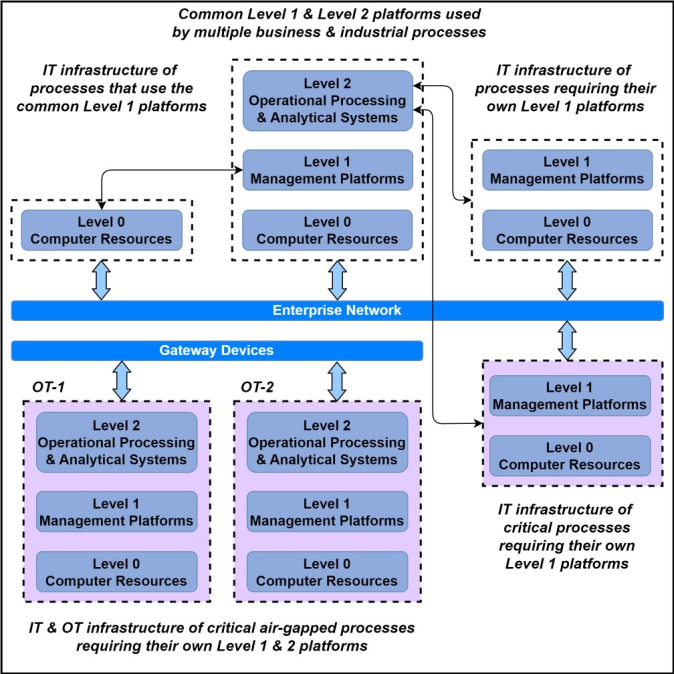
The “levels” in the diagram represent the functional aspect of the infrastructure components, as tabulated below.
| Level | Description | Reference IT, OT Elements | Reference IS Elements |
|---|---|---|---|
| 0 | Systems, which carry out specific functions by themselves. They do not manage any other computer resources. In physical terms, these are computer resources, typically specific hardware/ appliance/ software application. | IT systems, OT devices, applications, networks elements, data repositories | Security systems like Firewall, HIPS, NIPS, IDS, Endpoint Agents |
| 1 | Platforms, which carry out management functions, viz, manage the functions of or by L0 systems. Management functions are typically restricted to one class. In physical terms, a platform is typically an integration of more than one computer resource, such as hardware, OS, web server, app server, database server, portal etc. | IT-GRC, ITAM, ITOM, CMDB, DNS, DHCP, Domain Controllers, Patch Managers, SCADA, DCS, Data Historians, OT HMI | IdAM, Policy, Certificate & Key Management, NAC, EPP, EDR, AV Manager, Syslog Aggregator |
| 2 | Platforms, which enable an entity to carry out operational processing and analytics on short-term data and information from L0 and L1 systems/ platforms. Key differentiators between L1 and L2 are: a) L2 platforms enable automation of processes at the entity level. b) L2 platforms have a richer variety of integration mechanisms with different L0 systems, L1 platforms and external systems/ feeds etc. In physical terms, these platforms comprise of a set of computer resources, viz hardware and software applications. | NMS and EMS IT Service Management (ITSM) Incident Response (IR) Management System Business Continuity Management System (BCMS) | SIEM and SOAR Information Security Management System (ISMS) Cyber Security Incident Response Management System Threat Intelligence Platform (TIP) |
| 3 | Platforms, which enable an entity to carry out deep analytics using statistical and AI/ML techniques on long-term data and information from L0 to L2 systems/ platforms. Key differentiators between L2 and L3 are: a) L2 platforms are focused on providing operational analytics, while L3 platform focusses on strategic and long-term analytics. b) L3 platform can carry out some functions of L2 platform, in case L2 platform is not available. For example, SIEM analytics and SOAR functions. In physical terms, these platforms comprise of a set of computer resources, viz hardware and software applications. | Enterprise Datawarehouse and Analytical Processing Systems, without or with AI and ML capabilities | Enterprise Security Data Lake and Security Analytics Systems, without or with AI and ML capabilities |
Terms and Definitions
The following terms and definitions are used in this document to describe an entity’s enterprise-wide information infrastructure in a generalised manner.
Resources: These are the physical and logical assets that are in-use by an entity or user for computing, storage, networking and other IT, OT and IS functions. It corresponds to the term “Computer Resource” in the IT Act 2000 (revised 2008).
Data Centre premises: a generic term to describe a geographical site, which hosts the computing, storage, internal networking, and other resources that an entity uses to deliver business services and carry out its business functions and operations. Server rooms are equivalent to micro data centres.
User premises: a generic term to describe a geographical site, which hosts the computing, storage, internal networking, and other resources that are used by users (human and machine) to connect to the data centres to access services. Users may be consumers of service, systems administrators, or providers of service. The providers of service include technical support and customer service teams etc.
Data Centre constituents: a generic term to describe the different constituents of a typical data centre, such as the property on which the data centre is built, the data centre facility, non-IT and IT constituents within the data centre and connectivity from/to the data centre. Typically, each of the constituents are evaluated when strategic decisions are taken regarding the data centres.
Network Infrastructure Resources: the in-use network infrastructure resources can be described on the basis of the following characteristics:
- Communication media: copper, optical fibre (OFC), power line carrier communication (PLCC), Optical Power Ground Wire (OPGW) on power transmission lines, HF/ VHF/ UHF, microwave, and satellite links.
- WAN communication protocols: PDH, SONET/ SDH, Metro Ethernet, xDSL, AON/PON, MPLS, IP, power sector communication protocols like IEC 60870 and 61850 series/ DNP/ Modbus/ RTU, OSGP, Low Power Wide Area (LPWA), GPRS, 4G, 5G.
Network topologies: point to point, point to multipoint star, mesh, or bus topology.
Network device functions: transmission, switching, routing, element and network management, network security etc.
Network Provider infrastructure: a generic term to describe one or many geographical sites, which hosts the network infrastructure resources that lies outside of the data centre and user premises. The network infrastructure is owned by a network provider entity (TSP, ISP). The data centre and user premises use customer premises equipment (CPEs) to connect to the network provider infrastructure. The CPEs themselves may be customer-owned or provider-owned.
Zone: a generic term zone is defined as a grouping of logical or physical assets that share common security requirements based on factors such as criticality and consequence. This definition has been generalised in this document to describe groups of in-use IT, OT and IS resources within data centre or user premises, the physical or logical grouping being done as per functional, operational, management or security requirements.
Perimeter: a physical or logical boundary wall between two zones, which also has access controls (gates) for ingress into and egress out of the zones. Physical access control is relevant for premises, while logical access controls are relevant for systems and networks.
Conduit: a generic term conduit is defined as grouping of assets dedicated exclusively to communications and which share the same security requirements. In this document it describes the communication channels connecting the zones and also the tunnels through the perimeter that separates two zones. Examples of the latter are VPN tunnels and data diode.
Ontology of Tags for Enterprise Information Infrastructure
Governing bodies, top and senior management and the technical heads in entities are provided with a common vocabulary to represent the use of IT within the entity. The ontology for tagging an enterprise’s information infrastructure has three tag-groups, viz resource categorisation tag group, hierarchical level tag group and trust level tag group.
The ontology is technologically agnostic so that it can understood by both business and technical persons. The tags are meant to be used in architecture diagrams and presentations of business and technical management to describe the use of IT, both for their internal decision processes and for communication with external entities. The tagging enables non-technical personnel to assimilate the context and participate in decision-making.
Resource Categorisation Tags
The resource categorisation tags help the stakeholders to represent the ownership and control that an entity has over its information infrastructure elements. The following tags are in this group:
- Resource zones - central (S) or end-user (U).
- In-use resources purpose and use – functional (FS, FU) or governance/ management/ administration (GS, GU).
- Connectivity zones (V).
- Data centre ownership (SA, SB, SC, SD).
- Connectivity ownership (VA, VB, VC, VD).
- Connectivity purpose and use (XA, XB, XC, XD).
- End user resource ownership (UA, UB, UC, UD).
- End user role (NU, OU).
- Control over human workforce (WA, WB, WC, WD).
- Services (DC, IS, OS, TS, SS, FM).
- Service ownership (JA, JB, JC, JD).
- Data centre segmentation (ML1 to ML4).
- Cloud services segmentation (YL0 to YL4)
Sample Use Case for Resource Categorization Tags
Scenario:
A CSE wants to implement a new Enterprise Architecture Framework (EAF) to streamline its IT infrastructure, operations, and governance.
Challenge:
The organisation’s resources are diverse and distributed across various departments, zones, and functions. The complexity of managing these resources often leads to inefficiencies, lack of clarity in ownership, and difficulty in governance. There is an immediate need for a system that can simplify the categorisation and understanding of these resources for all relevant stakeholders, while also supporting the implementation of the new EAF.
Solution:
To address this challenge, the organisation decides to employ a set of resource categorization tags within their EAF. These tags act as labels that allow for easy identification and categorisation of resources, helping stakeholders to better understand the purpose, ownership, governance and threat modelling of each resource within the enterprise infrastructure.
Implementation:
Resource Zones Tags: Tags like ‘Central (S)’ for shared resources and ‘End-User (U)’ for individual user-specific resources simplify the location and accessibility of resource classification for stakeholders.
Purpose and Use Tags: Tags such as ‘functional (FS, FU)’ for operational resources and ‘governance/management/administration (GS, GU)’ for resources related to the oversight and control efficiently distinguish between the functional aspects of resources and their governance.
Connectivity and Ownership Tags: Tags like ‘Connectivity zones (V)’ and ‘Data centre ownership (SA, SB, SC, SD)’ offer clarity on the connective infrastructure and its proprietors, expediting responsibility allocation and incident resolution. Similarly, ‘Connectivity ownership (VA, VB, VC, VD)’ and ‘End user resource ownership (UA, UB, UC, UD)’ tags provide precise ownership details.
Purpose Specific Tags: With the inclusion of ‘Connectivity purpose and use (XA, XB, XC, XD)’ and ‘End user role (NU, OU)’ tags, the utility function and user role associated with the resources are effortlessly communicated, ensuring right access and use.
Workforce and Services Tags: Tags regarding ‘Control over human workforce (WA, WB, WC, WD)’ denote the degree of control and structure within the workforce, while ‘Services (DC, IS, OS, TS, SS, FM)’ and ‘Service ownership (JA, JB, JC, JD)’ deliver insights regarding the service allocation and control, amplifying the operational management.
Segmentation Tags: Finally, tags related to ‘Data centre segmentation (ML1 to ML4)’ and ‘Cloud services segmentation (YL0 to YL4)’ offer clear distinctions within data management and cloud service levels, promoting effective and secured data governance.
Benefits:
Clarity and Control: The tags provide clear direction on resource governance, enabling stakeholders to make informed decisions regarding the resources they oversee.
Streamlined Infrastructure Management: The use of tags streamlines the complexity associated with managing an extensive array of resources.
Effective Governance: With tags categorising resources based on their purpose and governance, it becomes easier to enforce policies and maintain compliance.
Enhanced Stakeholder Communication: Tags serve as a common language simplifying communication between technical and non-technical stakeholders regarding resource management.
Agile Resource Allocation: Tags enable agile and accurate resource allocation, matching resources to needs more effectively.
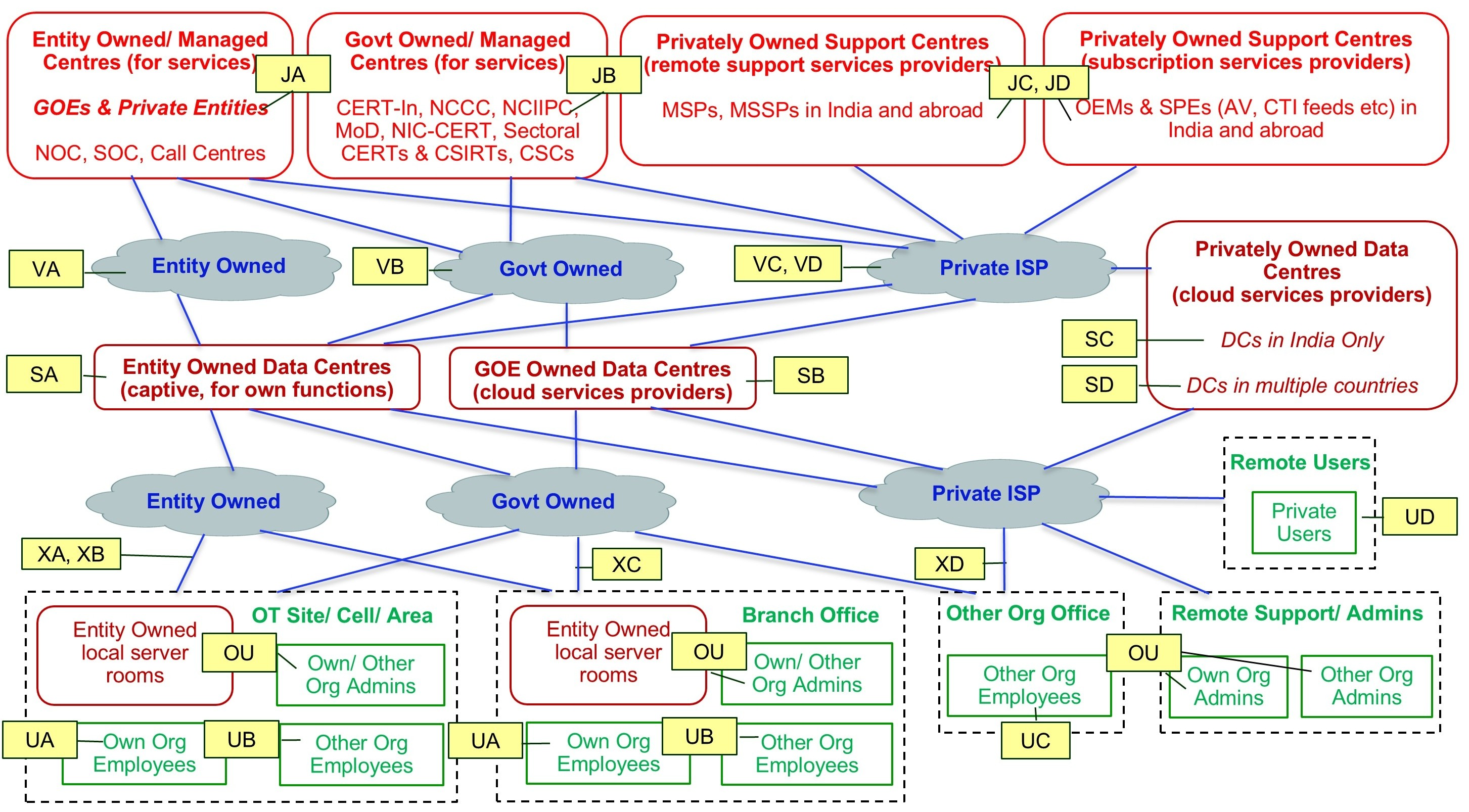
An illustrative use of resource categorisation tags is given below.
Hierarchical Level Tags
The hierarchical level tags are designed to have a common classification of the information infrastructure into well-defined hierarchical zones. Appropriate trust levels can be assigned to the zones. This will help the project design and engineering teams, procurement, and provisioning teams, IT and information security operations management teams and the service providers in better risk analysis and allocation of various resources. The following tags are in this group:
- Central resource hierarchy of zones (HL0 to HL5).
- Perimeter zones between hierarchical zones (PHL1 to PHL4.5).
- Perimeter zones in data centre segments (PM1 to PM4).
- Perimeter zones in cloud environment (PYL0 to PYL4).
Sample Use Case for Hierarchical Level Tags
Scenario:
An organisation is in the process of adopting a new Enterprise Architecture Framework (EAF) to bolster its IT and OT infrastructure’s efficiency, security, and governance. A key challenge they face in this deployment is managing the complexity and diversity of their information infrastructure, which includes various hierarchical zones, data centre segments, and cloud environments.
Challenge:
Project design and engineering teams, alongside procurement, provisioning, IT and OT operations management, and service providers, struggle with conducting effective risk analysis and resource allocation due to the intricate nature of the infrastructure layout and the varying levels of trust associated with each zone. The IT and OT teams must also be able to converge onto a common representation of their respective hierarchies.
Solution:
In addressing these challenges, the organisation opts to implement hierarchical level tags within their EAF. These tags help to classify the information infrastructure into hierarchical zones with assigned trust levels. This tagging enables the stakeholders to clearly segment the IT and OT resources, aiding in threat modelling, risk analysis and the strategic allocation of resources across zones.
Implementation:
Central Resource Hierarchy Tags: Tags ranging from ‘Central resource hierarchy of zones (HL0 to HL5)’ clearly delineate the core infrastructure zones, establishing a graded structure of trust and access controls that escalate with each hierarchy level.
Perimeter Zone Tags: ‘Perimeter zones between hierarchical zones (PHL1 to PHL4.5)’ tags facilitate a distinct border identification between hierarchical zones, serving as checkpoints for security assessments and transitions in trust levels.
Data Centre and Cloud Perimeter Tags: Tags like ‘perimeter zones in data centre segments (PM1 to PM4)’ and ‘perimeter zones in cloud environment (PYL0 to PYL4)’ categorize resources within data centres and cloud segments. These tags help stakeholder teams evaluate and address specific security concerns more accurately within these venues based on the designated trust levels.
Benefits:
Improved Risk Management: Hierarchical tags aid in identifying and managing potential risks associated with the varying zones, thus enhancing the overall security posture.
Streamlined Resource Deployment: The tags create an organized structure that simplifies the understanding of where resources reside and their respective trust levels.
Informed Decision-Making: Teams gain insights into infrastructure vulnerabilities and strengths, enabling them to make more strategic decisions about resource deployment and protection.
Effective Collaboration: A common classification system assists diverse teams in synchronizing their efforts, thus facilitating collaboration, and reducing inconsistencies.
Enhanced Security Profiles: Each resource carries a clear security profile through tagging, accommodating tailored security measures.
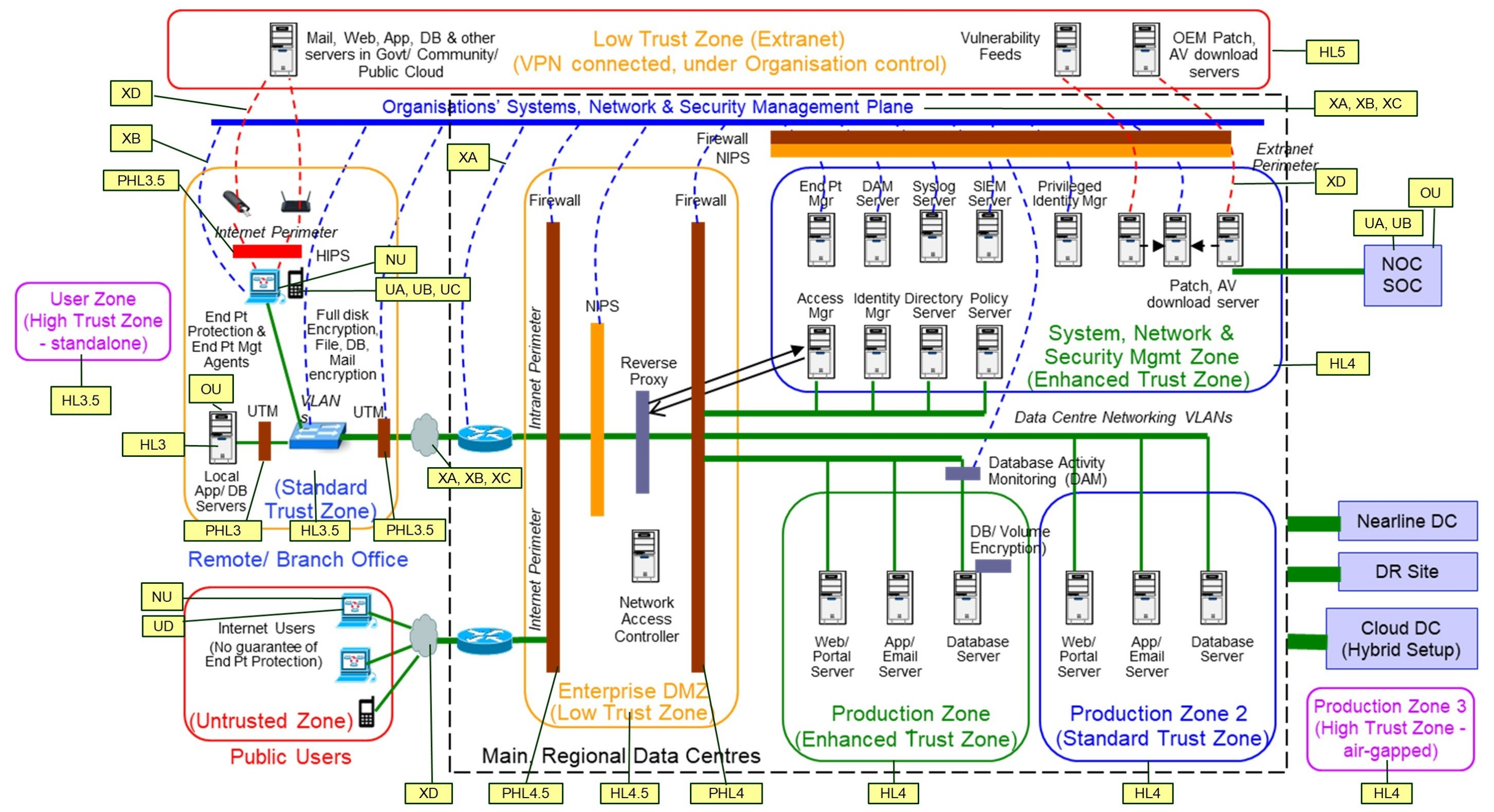
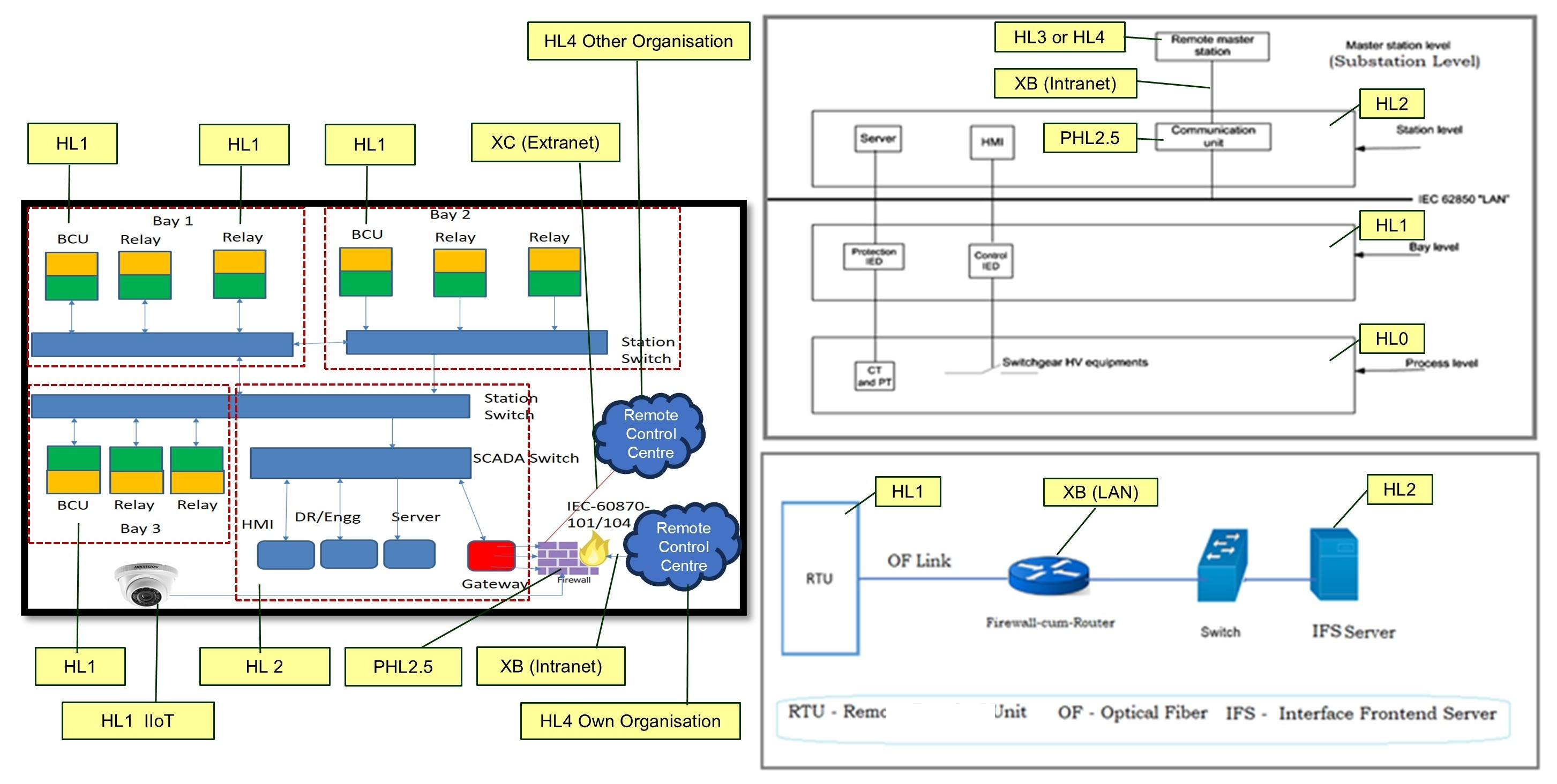
An illustrative use of resource categorisation tags is given below.
Trust Level Tags
The trust level tags represent the level of trust that can be assigned to a zone. This will help the project design and engineering teams, IT and information security operations management teams and the service providers to design, implement, operate and manage zoning, segmentation and zero trust architecture. The following tags are in this group:
‒ Trust level (TL0 to TL5)
Sampe Use Case for Trust Level Tags
Overview:
An organization plans to implement zero trust in its enterprise IT. Stakeholders include IT architects, security officers, network administrators, and management teams who must understand and enforce the security policies, zoning and segmentation within the organization’s operations effectively.
Challenge:
Varied levels of data sensitivity and diverse IT systems across the enterprise create a complex security landscape that requires a clear and uniform approach to managing trust and control levels. Stakeholders require a reliable method for identifying, at a glance, the security trust levels and enforcement strength for each zone to correctly implement and adhere to security policies, controls, and compliance requirements.
Solution:
Trust level tags serve as a simple and effective way to categorise and label the components of the organisation’s resource and connectivity zones based on defined security policies and the level of control the entity has or requires. These tags help stakeholders instantly recognise the importance and sensitivity of each zone, ultimately guiding their risk management and policy enforcement actions.
Implementation:
Defining Trust Levels: Categorise and define security trust levels ranging from TL0 to TL5. Establish criteria for each level based on the level of control the entity has/ can have over the zone
Evaluating and Tagging Resource Zones: Assess each resource zone within the organisation and determine the appropriate trust level. Apply the respective trust level tag to systems, databases, and networks accordingly.
Evaluating and Tagging Connectivity Zones: Analyse network segments and connectivity frameworks for security enforcement capability and requirements. Assign trust level tags that match their security policy framework.
Incorporating into EAF documentation: Update all related architecture diagrams, policies, and procedural documents with the applied trust level tags to create a standard reference across the organisation, ensuring coherence and mutual understanding among all stakeholders responsible for zero trust.
Benefits:
Enhanced Risk Management: Trust levels guide stakeholders toward adequately securing each zone according to its criticality and the organization’s risk tolerance.
Clear Communication: The standardized tagging system reduces complexity and eases the communication of security and compliance statuses across departments and teams.
Streamlined Policy Enforcement: Clearly identified trust levels support consistent application of security measures and rapid adjustment to evolving threats.
Efficient Compliance Monitoring: Tags make it easier to monitor adherence to internal and external compliance standards, enabling swift corrective measures as needed.
Optimized Security Investments: By identifying zones with higher trust levels, the organization can prioritize security investments and focus resources where they are most impactful.
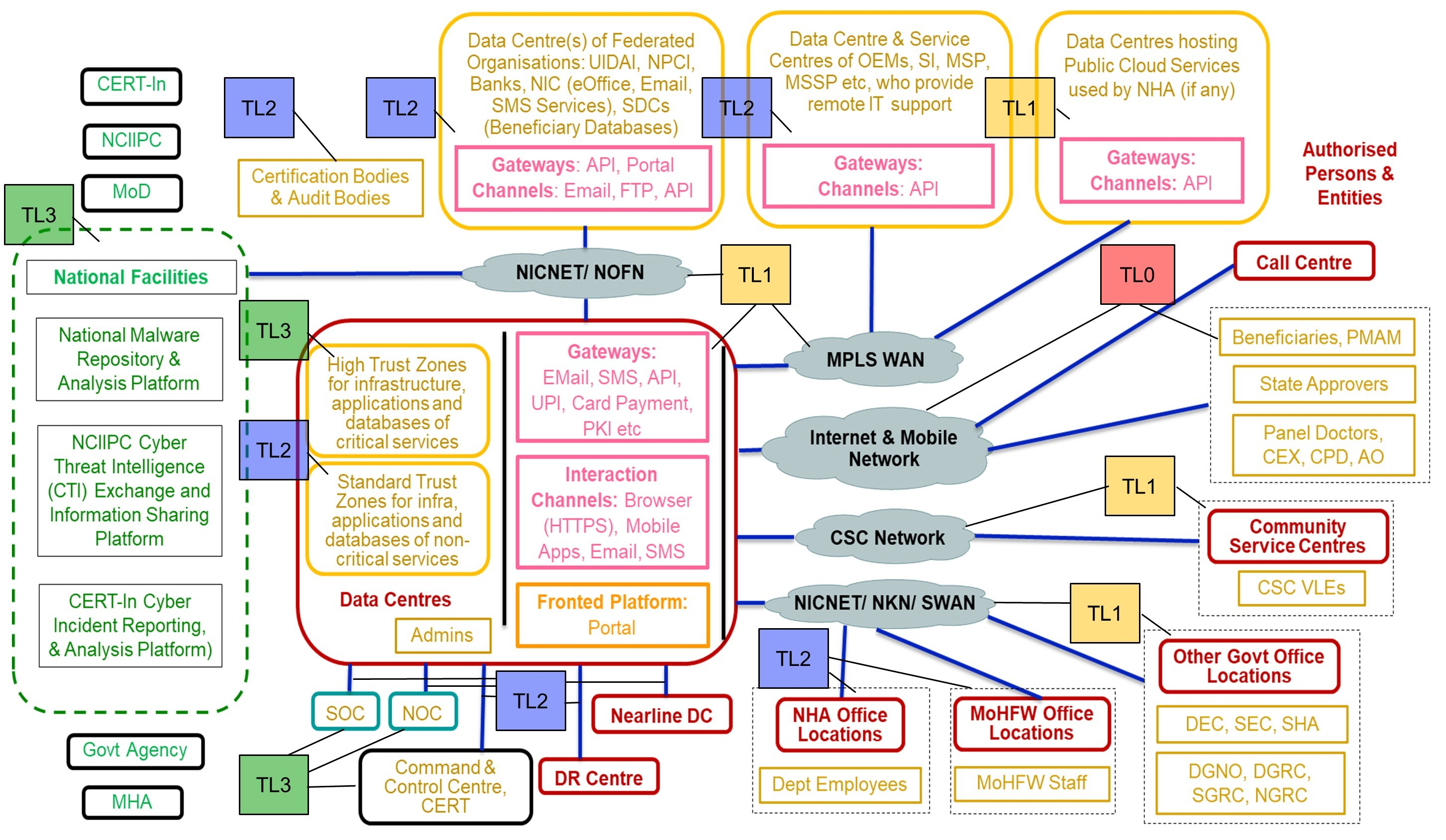
An illustrative use of trust level tags in a business ecosystem diagram is given below. The trust level tags can be similarly used in a federated digital ecosystem diagram.
Ontology of Tags
Business and technical stakeholders, both within and outside the CSEs, need a common vocabulary to describe different perspectives of IT and cybersecurity within the national cyberspace. This section defines an ontology of tags that categorises various characterstiscs of a federated digital ecosystem. The tags will enable a common specification, representation and communication of the use of IT and cybersecurity amongst the governing bodies, top and senior management and technical teams, both within entities and the external organisations interacting with the entities.
Three tag-groups are defined, as under:
A. Resource categorisation
B. Hierarchical level
C. Trust level
The ontology is designed in a technology-agnostic manner so that it can understood by both business and technical persons. The tags are meant to be used in architecture diagrams and presentations to give the business and technical management a common mechanism to specify the characteristics of IT and cybersecurity elements in the federated digital ecosystem. They are also to be used in discussions with external organiations. The objective is to facilitate common understanding of situations and enable appropriate decision-making.
A. Resource Categorisation Tags
The resource categorisation tags are designed for use by the technology level practitioners to establish a common understanding with the goveranance and business levels about the type and level of control they have over their information infrastructure elements. The list of tags in this group are as under:
- Resource zones - central (S) or end-user (U).
- In-use resources purpose and use – functional (FS, FU) or governance/ management/ administration (GS, GU).
- Connectivity zones (V).
- Data centre ownership (SA, SB, SC, SD).
- Connectivity ownership (VA, VB, VC, VD).
- Connectivity purpose and use (XA, XB, XC, XD).
- End user resource ownership (UA, UB, UC, UD).
- End user role (NU, OU).
- Control over human workforce (WA, WB, WC, WD).
- Services (DC, IS, OS, TS, SS, FM).
- Service ownership (JA, JB, JC, JD).
- Data centre segmentation (ML1 to ML4).
- Cloud services segmentation (YL0 to YL4)
Resource Zones
The resource zones are of two types:
Central Resource Zones (S Zones): These zones host the in-use operating resources (servers, applications, databases) of different business processes and management systems, as well as the local networking and security infrastructure. The central zones are located physically within the data centres or the local server rooms in regional/ branch offices. These zones are tagged as System or ‘S’ zones.
End User Resource Zones (U Zones): These zones host the in-use operating resources (computing devices, applications, data repositories) of end users and their local networking and security infrastructure. The users may be human or machine and are typically identified by their credentials (user and machine ids) that are linked to centrally managed user and system accounts. The user zones are generally located physically within the office premises of organisations or work/ home premises of remote users. These zones are tagged as User or ‘U’ zones.
In-Use Resources
Computer resources (assets) of entities may lie in the store or be deployed for use. The resources deployed and in-use in central and end-user zones can be categorised as under, based on their purpose and use. The tags are derived from the primary tag ‘S’ or ‘U’:
| Tag | Resource Use Type | Resource Use Description |
|---|---|---|
| FS, FU | Functional Use | The resources are used for business functions, services, operations, and analytics. These include computer resources (web servers, app servers, db servers, etc) of different critical business/ industrial processes. |
| GS. GU | Governance, Management and Administration Use | The resources are used for governance, management, and administration. These include computer resources to configure, manage, monitor, control, analyse and report the functional, performance and cybersecurity aspects of the computer resources deployed in the operational zones. |
Notes:
Typically, the resources used for operational and management functions are physically and logically segmented into separate sub-zones within the hierarchical levels described in later sections.
The in-use computer resources (assets) of an organisation can be categorised and tagged based on their functions and capabilities, as well as by the zones in which they are deployed. The tags can be used to apply detailed guidance on the information security imperatives and requirements of each in-use resource based on its function and the zone in which it is deployed.
Types of Functional Resources (FS, FU Tag)
The detailed categorisation of computer resources based on the functions and capabilities is described in a separate section. The in-use computer resources can usually be tagged as under.
End User Resources:
- User and machine credentials stored in smart cards, USB tokens or 2FA through mobile devices.
- Endpoint computing devices (desktop, laptop, tablet, mobile)
- Audio and video conferencing devices
- Wired and wireless network access devices, Bluetooth, Zigbee, WLAN
- SSL VPN termination, VPN clients
- Applications and data repositories
- Endpoint agents installed on compute devices.
Cloud Services and Resources:
- Subscription Services: Cloud Access Security Broker (CASB), As-a-Service Applications (email, portal, eOffice etc), CTI Feeds.
Perimeter Devices:
- Perimeter zones will have connectivity devices that provide physical and logical conduit between the two zones and physical (human) and logical (network) ingress/ egress control devices (gateway), data diode.
- Firewall, IDS, IPS, UTM, NAC appliance, Router, switch, VPN gateway, SSL terminator, communication network termination device, OT: GPRS modem, FO modem, smartcard/ biometric readers, network taps, IPSEC/ SSL VPN termination points.
Data Centre Resources:
- Web Proxy, Email Proxy, API gateway, Load Balancer, Data Leakage Protection, Content Disarm & Reconstruct (CDR), Switch
- Enterprise Zone Data Centre (segmented into multiple trust zones (VLANs), based on functional and security design): server cluster, server farm, VMs and containers, storage, consoles, SW stack, business systems (ERP)
- Datacentre network (DCN), compute, VMs and containers.
Zones specific to OT and IIoT:
- OT supervisory L2: Industrial PCs, SCADA, DCS, HMI, FEP, Historian, Engineering Workstation, switch
- OT basic control L1: PLC, RTU, IED, BCU
- IIoT edge devices L1: surveillance cameras, biometric and smart card readers
- OT L0: relay, sensor, actuator, generic OT process devices
Types of Governance and Management Resources (GS Tag)
These resources can be broadly categorised as:
- Platforms that discover, provision, configure, monitor, manage functionality, performance, and security, visualise, control, analyse, govern, and report the trustworthiness (functionality and assurance) of operational systems (computer resources).
- Cloud Services Management (Infrastructure, Platforms, Software, Security, Backup, BCP, DR services), Domain management, SMIME/ SSL certificate management, email, and web services.
- Subscription feeds: OEM Patches and Feeds, OEM telemetry collectors, AV/ EPP management, Domain manager, Certificate Authority, OAuth IdPs.
- Datacentre network (DCN) management: physical access control, CCTV monitoring, BIMS, UPS & Generators DNS, DHCP, RADIUS, network access control (NAC) management.
- Management platforms and tools: IT/OT asset management (ITAM), asset configuration management (CMDB), asset discovery, IdAM (AD) & privileged identity and access management, LDAP, credential management, API secrets management, certificate management, NMS/EMS, patch management, vulnerability & compliance management, database activity monitoring (DAM), key lifecycle management (KLM), policy management, SSH management, log & flow collectors, SIEM, EDR, NDR, XDR, SOAR, endpoint/ AV protection (EPP), forensic tools, ITSM, ISMS, BCMS, data backup.
- Log collection from all in-use computer resources and flow collection from all networks.
Connectivity Zones
These zones host the Wide Area Network (WAN) network provider infrastructure that provide the conduits for voice, video, and data connectivity between the resource zones. The connectivity zones are usually owned and managed by TSPs and ISPs and are accessed by means of customer premises equipment (CPE) that are installed in the resource zones connecting to the WAN. These zones are tagged as ‘V’ zones, say Connectivity Zone.
The connectivity (V) zone of an entity is, in effect, a resource (S) zone of the TSP and ISP.
Data Centre Ownership
All data centres and server rooms hosting the central resources are categorised as under, based on their ownership. The tags are derived from the primary tag ‘S’:
| Tag | Data Centre Type | Data Centre Description |
|---|---|---|
| SA | Entity Owned | Captive data centres and server rooms owned by the entity. |
| SB | GOE Owned | Data centres of Govt Owned Entity (NIC, SDCs, PSUs). |
| SC | Privately Owned | Data centres of Privately Owned CSP, India based DC facilities. |
| SD | Privately Owned | Data centres of Privately Owned CSP, multi country DC facilities. |
Notes:
The above categorisation helps the governing bodies and top management of entities to evaluate the governance, risk and compliance aspects of data centre and cloud service providers, while providing strategic direction to the use of IT. For example, the risk of non-compliance of data localisation requirement is higher in the case of Type SD as compared to Type SC.
Tag SA entity owned private cloud is exclusive to the organisation, which may be hosted on-premises or in a site hired from a property owner. This corresponds to the pattern where an organisation provides its own captive cloud services.
Tag SB GOE owned cloud is typically mandated for almost all the critical business functions of CSEs. Many common services like email, portals, eOffice and other IaaS/ PaaS/ SaaS/ DRaaS are provided as cloud services to the Govt Community.
Tag SC private cloud service providers with India-only data centres are easily able to comply with data localisation requirements that can be verified using lower levels of audit effort. Such CSP data centres are preferable when data localisation requirement as well as control over data storage outside of India is of high priority.
Tag SD private cloud service providers with multi-country data centres include the i) the likes of global CSPs like AWS, Azure, GCP, IBM, Oracle, SAP; ii) OEM service management related to OEM patches, vulnerability feeds and sending system telemetry back to the OEMs, specifically relevant to OT OEM support services that are provided from OEM support cloud installations.; iii) third-party managed services (MSPs and MSSPs) covering both Indian and non-Indian ownership and control; iv) content delivery network (CDN) providers; v) domain name providers, digital certificate issuers, PKI management providers like DigiCert, DNS and other security service providers like Cloudflare etc.
The key advantages of tag SD CSPs are that they can provide very high levels of infrastructure scaling, availability, and business continuity. A large pool of trained and experienced professionals is also available for such CSPs, and these professionals can be easily hired to manage and secure the zones implemented in these CSP data centres. These CSPs can comply with data residency within the Indian geography but cannot easily prove compliance that data is not also residing outside of India. Significant audit effort is required to verify the same. Hence, such CSP data centres are relevant when an organisation requires very high and dynamic scalability or has to provide its services beyond the national boundaries or when there are no major concerns related to copies of data being stored outside of India.
Connectivity Ownership
These zones host the Wide Area Network (WAN) network provider infrastructure that provide the conduits for voice, video, and data connectivity between the resource zones. These zones are tagged as ‘V’ zones.
The connectivity providers are categorised as under, based on their ownership. The tags are derived from the primary tag ‘V’:
| Tag | Connectivity Type | Connectivity Description |
|---|---|---|
| VA | Entity Owned | Captive WAN and mobile networks owned by the entity. |
| VB | GOE Owned | WAN and mobile networks of Govt Owned Entity (NICNET, NKN, PSUs). |
| VC | Privately Owned | Networks of Private TSP/ ISP, managed from India based facilities (Airtel, Reliance, Vodafone-Idea). |
| VD | Privately Owned | Networks of Private TSP/ISP managed from outside India. Example, global satellite communication providers. |
Notes:
The above categorisation helps the governing bodies and top management of entities to evaluate the governance, risk, and compliance aspects of connectivity providers (TSPs/ ISPs), while providing strategic direction to the use of IT. For example, the national security risk due to misuse of the monitored traffic patterns is higher in the case of Type VD as compared to Types VA, VB, or VC.
Connectivity Use
The connectivity can be categorised as under, based on the purpose and use. The tags are derived from the primary tag ‘X’, to identify the network topography:
| Tag | Characteristics of Connectivity |
|---|---|
| XA | Closed user group (CUG). |
| XB | Intra-organisation: Intranet (WAN), local area network (LAN), data centre networking (DCN). |
| XC | Inter-organisation: Extranet (WAN). |
| XD | Public: Internet. |
Tag XA is typically used for high security closed user groups, which use captive networks or encryption devices on less secure networks. Entities also use VPN to create closed user groups for privileged users, who typically have to connect to the data centres to provide remote support.
Tag XB is typically used for intranet connectivity of regional and branch offices through MPLS Cloud, Leased Lines or Site-to-Site VPNs. This also includes remote OT cells/ areas within an OT Site that typically connect to the OT site operations/ DMZ on wired LAN.
Tag XC is typically used for extranet connectivity through MPLS Cloud, Leased Lines or Site-to-Site VPNs. Examples are RBI Infinet, NIC NKN, Power sector grid operation networks between substations and control centres etc.
Tag XD is typically used for internet connectivity through wired/ wireless broadband and mobile networks provided by the Internet Service Providers (ISPs).
End User Resource Ownership
The end user resource ownerships are categorised as under, based on the organisation to which the human user or machine belongs. The tags are derived from the primary tag ‘U’:
| Tag | User Org Type | User Organisation Description |
|---|---|---|
| UA | Own Organisation | Human user or machine belongs to the entity itself. |
| UB | Other Organisation | Human user or machine belongs to another entity with which there is a formal and established relationship. |
| UC | Other Organisation | Human user or machine belongs to another entity with which there is no formal or established relationship. |
| UD | No Organisation | Human user or machine does not belong to any entity, viz a private individual or his machine. |
Notes:
The above categorisation helps
- the design and implementation teams and the operations managers to establish and ensure appropriate controls in different end user zones.
- the top and senior management to monitor the risks.
- the audit teams to check policy non-compliances.
Entities have a high level of control over tag UA resources, whether they are used for connecting through the Internet or Intranet. The organisation can enforce that the end-user devices must have adequate endpoint protection (AV, anti-malware etc) and comply with organisational policies (patches/ updates, upgrades, password policy enforcement, authorised applications, VPN usage etc). These controls can even be enforced and centrally managed on the Bring Your Own Device (BYOD) of remote workers.
Entities have a lower level of control over tag UB, UC resources that belong to other Organizations. In most cases, the user’s organisation is responsible for configuring, securing, and managing the end user resources. Other organisation’s users (humans and machines) typically connect to one’s own organisation’s information infrastructure through the Extranet. Other organisation users may also connect using IPSEC or SSL VPNs over the Internet. One’s own organisation must depend upon the other organisation’s policies and processes of control over the end-user devices in terms of their endpoint protection and compliance to policies. Formal and established relationships between entities help to increase the trust in the human users and machines of the other entities.
Entities do not have any control over tag UD resources, the end-user devices of public users, who connect to organisation’s information infrastructure through the Internet, typically using browser or mobile applications. Machine to machine connections from public users/ Organizations to an organisation’s systems are generally API-based.
End User Role
The end user resources are categorised as under, based on the role of the human user or machine. The tags are derived from the primary tag ‘U’:
| Tag | User Role Type | User Role Description |
|---|---|---|
| NU | Normal User | Human user or machine carries out normal functions and activities. |
| OU | Privileged User | Human user or machine carries out privileged functions and activities. These include all types of administrators, service accounts, remote support providers etc. Business users with high levels of decision and approval powers can also be called privileged users. |
Notes:
End user zones with privileged users (OU) are a higher risk to the entity than those with normal users (NU) only. Such zones therefore need to be governed and managed with greater focus and may call for increased surveillance and compliance.
Privileged Users (OU) can be grouped as
- technical persons and machines (administrators, OEM remote support etc).
- business and special users accessing sensitive information (e.g., regulatory & statutory auditors).
Human Workforce Control
The human workforce for operating and managing the central resources and connectivity of entities are categorised as under, based on the entity’s level of control on the technical, administrative, physical and IT access control aspects of the workforce. The tags are derived from the primary tag ‘W’:
| Tag | Workforce Type | Workforce Technical, Administrative and Access Control |
|---|---|---|
| WA | Entity’s own employees | Technical functions: controlled by the entity Administrative functions: controlled by the entity Physical & IT access: controlled by the entity |
| WB | Workforce hired/ contracted by the entity | Technical functions: controlled by the entity Administrative functions: controlled by the HR supplier Physical & IT access: controlled by the entity |
| WC | Workforce of outsourced services providers (OEM Partners and SI Support Teams) | Technical functions: controlled by the service provider Administrative functions: controlled by the service provider Physical & IT access: controlled by the entity within the entity’s premises. |
| WD | Workforce of OEM and Managed Services Providers (providing remote services) | Technical functions, administrative functions and IT access to the entity resources are all controlled by the OEM or the Managed Services Provider (MSP, MSSP). Physical entry into the entity’s premises is not required for this workforce since all work is done remotely. |
Notes:
The technical functions related to the workforce covers aspects of skill assessment and verification during workforce hiring, tasking of individuals, leave management and management of replacements during leave or exit. This is done by the organisation themselves for resource categories WA and WB or by the service provider for resource categories WC and WD. Some Organizations also invest into the technical skill development of their WB resources (contractual employees).
The administrative functions related to the workforce covers aspects of skill verification and documentation during workforce onboarding, contract management, compliance to laws and regulation. This is done by the organisation itself for its own employees under resource category WA or by the resource/ service provider for resource categories WB, WC, and WD. Some Organizations manage the compensation payments and payment of GST for resource categories WB by themselves, while others let the workforce resource provider do the same.
The physical and IT access control of the workforce covers aspects of physical entry into the organisation’s premises and places of work within the organisation. It also covers access to IT and OT resources, both on-premises and remotely through the network. All Organizations control the physical access of people resources under resource categories WA, WB, and WC. The Organizations also control the IT access of people resources under resource categories WA, WB, and WC when they are on the organisation’s premises. In case of remote working of WC and WD category workforce, the service providers decide which person is assigned to remotely manage their customer organisation’s IT / OT infrastructure and further controls the IT access of the assigned resource as per the SLAs signed with the customer organisation.
The above workforce control categorisation helps the governing bodies and top management of entities to evaluate and provide strategic direction on the governance, risk, and compliance aspects of i) the workforce employed to operate and manage their central resources in data centres, and ii) the workforce employed by their outsourced and managed service providers (WC and WD).
For example, the risk of data leakage is higher from those providers of outsourced and managed services (WC, WD), who do not have good due diligence processes to hire, train and monitor their own and contractual employees, or they are further outsourcing the work to second tier service providers. Due diligence is especially important for workforce having privileged user (OU) rights.
A strategic assessment of the level of control available to an entity with regard to the outsourced workforce (WC and WD) operating and managing its resource and connectivity zones would help the entity identify the SLAs that should be in place with the outsourced and managed service providers. The SLAs should especially cover the control, monitoring, and oversight on the privileged users (OU) of the service providers since these highly skilled users generally work remotely.
Service Ownership
The modern federated digital ecosystem is largely driven by services. In general, a Service Provider Entity (SPE) delivers a service to a Customer Entity (CE), who acquires the service. The relationship between the SPE and the CE may be formal, semi-formal or informal, depending upon the type of service agreements that exist between them.
The services related to IT, OT and Information Security infrastructure are categorised as under:
- Data Centre Services (DC): These are typically provided by Cloud Service Provider Entities (CSP).
- Telecom and Internet Services (IS): These services include voice, video and data communication services that are provided by telecom and internet service provider entities (TSP, ISP).
- Operation Support Services (OS): These services include NOC, SOC, call centres, customer service centres etc.
- Technology Support services (TS): These services include L1 to L3 support services and managed services that are usually provided by second- or third-party entities such as OEMs and/or their partners, SIs, MSPs, MSSPs etc. These services are usually contracted with formal service level agreements between the customer (CE) and the service provider entity (SPE).
- Subscription services (SS): These services include all types of subscriptions and are typically in the form of cyber threat intelligence (CTI) feeds, vulnerability, and compliance (SCAP) feeds, open-source intelligence (OSINT) feeds, remote health monitoring service etc. These services may either be i) contracted by the CE with formal service level agreements with the SPE, or ii) non-contracted best effort services that have no formal SLAs between the CE and the SPE. The SPEs themselves may be source (feed) owners or feed aggregators.
- Non**-IT Facility Management Services** (FM): These services include power supply, site, and facility management (physical security, non-IT infrastructure) services etc.
In the modern federated digital ecosystem, the SPE and the CE may be different entities by themselves or may be different business units within large Organizations and the Government (e.g. NIC and SDCs are SPEs to govt departments (CEs)).
The SPEs are categorised as under, based on their ownership and location. The tags are derived from the primary tag ‘J’:
| Tag | SPE Type | Service Provider Entity Description |
|---|---|---|
| JA | Entity Owned | Services owned, managed, and consumed by the entity itself (captive). |
| JB | GOE Owned | Services owned, managed, and delivered by Govt Owned Entity. |
| JC | Privately Owned | Services delivered by Private SPEs from India based facilities. |
| JD | Privately Owned | Services delivered by Private SPEs from outside India facilities. |
Notes:
Tag JA SPE corresponds to the pattern where an entity has its own captive services.
Tag JB SPEs usually provide DC, IS, OS, TS, SS and FM services by government owned entities to CSEs.
Tag JC SPEs deliver their services from India based facilities.
Tag JD SPEs deliver their services from outside India facilities.
The above categorisation helps the governing bodies and top management of entities to evaluate the governance, risk, and compliance aspects of service provider entities, while providing strategic direction to the use of IT, OT, and Information security services. For example, the risk of disruption of service caused by changes in the local country regulations is higher in the case of type JD as compared to type JC, while it is very low for types of JA and JB.
Many Govt owned SPEs (tag JB) such as CERT-In, NCIIPC, CSIRTS etc provide Cyber Threat Intel feeds that are aggregated and enhanced by them.
Segmentation of Data Centres
It is evident that data centres and server rooms of entities are the most critical elements of an entity’s use of IT for achieving business objectives.
Data centre premises and contents can be segmented, based on the legal ownership of the i) physical property that hosts the data centre, usually managed by the property manager (FM-SPE), ii) the data centre facility or site itself, including the IT and non-IT infrastructure installed in the facility and owned by the Data Centre Service Provider Entity (DC-SPE), iii) supporting infrastructure of the facility (power, telecom, physical security) provided by the Facility Management Service Provider Entity (FM-SPE), and iv) platforms and services provided by the DC-SPE to the customers and users (CE). The segmentation levels are defined in the table below. The levels are prefixed with the tag ‘ML’.
| Tag | Segmentation Level Type and Description |
|---|---|
| ML1 | Physical property hosting the DC - buildings, civil infrastructure |
| ML2 | Physical DC site premises - IT and non-IT infrastructure |
| ML3 | Support facilities - power, telecom, physical security |
| ML4 | Customer owned resources within the DC – co-located resources and subscribed resources |
In almost all cases, the legal owners are responsible for the operations, management, security, legal and regulatory compliance functions of their segments. They are also responsible for the workforce handling these functions. For example,
ML1 is owned, operated, managed, and secured by the Property Manager (FM-SPE), who is responsible for ingress/ egress control into the property, campus security and safety. The workforce handling these functions are contract workforce (WB) or outsourced services (WC).
ML2 is owned by the DC-SPE and managed by the DC Site Manager, who is responsible for DC operations and management. The workforce handling these functions are a mix of the DC-SPE’s own employees (WA), contract workforce (WB) or outsourced services (WC).
ML3 is owned by the FM-SPE, who are responsible for operations and management of their services. The workforce handling these functions are a mix of the FM-SPE’s own employees (WA), contract workforce (WB) or outsourced services (WC).
ML4 is owned by the Customer Entity (CE), who is responsible for the operations and management of their platforms and subscribed services. The workforce handling these functions are a mix of the CE’s own employees (WA), contract workforce (WB) or outsourced services (WC).
In the case of entity owned data centres and server rooms (SA), the entity is both the DC-SPE and the CE. In case the entity also owns the inter-data centre and customer connectivity (VA), then the entity is also the IS-SPE for its intranet connectivity facilities.
In other cases (SB, SC, SD), there is a supplier and acquirer relationship between the DC-SPE and CE regarding the provisioning and use of cloud services. Cloud service customers can also consider multiple cloud service providers together as a cloud services supply chain.
The IS/ISO/IEC 27036: Part 4:2016 provides guidance on supplier relationship between the cloud service customer (acquirer) and the cloud service provider (supplier). IS/ISO/IEC 27002 clause 15 “Supplier relationships” provides controls, implementation guidance and other information for managing information security in supplier relationships. IS/ISO/IEC 27017:2015 provides guidelines on information security controls suitable for cloud services provision and usage, that can provide guidance to the DC-SPE and the CE. The DC-SPEs also obtain certification of compliance to various standards that are applicable to cloud services, such as IS/ISO/IEC 20000-1, SOC-2 etc. These standards are described in the compendium.
As per industry practice, the resource provisioning and orchestration functions are carried out by the DC-SPE. However, the responsibility of operation, management and security of customer subscribed data centre resources is shared between the DC-SPE and CE based on the type of cloud computing model that the CE has subscribed to from the DC-SPE. These are broadly classified into IaaS, PaaS, SaaS, XaaS etc. NIST SP 800-145, SP 500-292, and SP 500-332 provide detail guidance on cloud computing models.
Segmentation of Cloud Services
The cloud computing resource types given in the table below are adapted from the industry practice in a manner that it can also be applied to entity-owned captive data centres and GOE owned data centres. The tags are derived from the primary tag ‘Y’.
| Tag | Cloud Computing Resource Type & Description |
|---|---|
| YL4 | Function as a Service (backup, disaster recovery, virtual desktop, business continuity etc) |
| YL3 | Software as a service |
| YL2 | Platform as a service |
| YL1 | Infrastructure as a service |
| YL0 | Co-location service (using the data centre premises for locating customer resources) |
B. Hierarchical Level Tags
The hierarchical level tags are designed to provide a common classification mechanism for different zones of the information infrastructure. This will help the project design and engineering teams, procurement, and provisioning teams, IT and information security operations management teams and the service providers in better risk analysis and allocation of various resources. The tags in this group are as under:
- Central resource hierarchy of zones (HL0 to HL5).
- Perimeter zones between hierarchical zones (PHL1 to PHL4.5).
- Perimeter zones in data centre segments (PM1 to PM4).
- Perimeter zones in cloud environment (PYL0 to PYL4).
Central Resource Zones
The central resource zones can be categorised into different hierarchical levels, which correspond to the hierarchy defined in the Purdue Enterprise Reference Architecture (PERA) and other models. The hierarchical levels defined in the table below. The levels are prefixed with the tag ‘HL’.
| Tag | Hierarchical Level Type | Hierarchical Level Characteristics |
|---|---|---|
| HL5 | Enterprise Systems Zone | This level is physically or logically segmented into multiple operational, analytics and management zones, based on functional and security design. |
| HL4.5 | Enterprise DMZ | Typically, the DMZs are physically or logically separate for the Internet, Intranet and Extranet zones |
| HL4 | Enterprise Systems Zone | This level is physically or logically segmented into multiple operational, analytics and management zones, based on functional and security design. The tag may also be used to identify segmented IT operation zones and management zones inside the enterprise HL4 operations zone. |
| HL3.5 | OT Site DMZ Branch Office IT DMZ | The OT DMZs typically host systems for controlled exchange of data between the level 3 site operations zone and the organisation’s level 4 enterprise zones, as well as with control centres established by other Organizations. The IT DMZs function similar to level 4.5 enterprise DMZ |
| HL3 | OT Site Operations Zone Branch Office Server Zone | The OT zone typically hosts systems for OT Site operations. The server (IT) zone is similar to level 4 enterprise zone. The tag may also be used to identify segmented OT site operation zones and management zones within the OT site. |
| HL2.5 | OT Cell/Area DMZ | The OT DMZ typically host systems for controlled exchange of data between the level 2 cell/ area and the level 3 site operations zone. |
| HL2 | OT Cell/Area Operations Zone | Hosts the supervisory control resources like SCADA systems of the OT Cell/Area. |
| HL1 | OT Cell/Area Operations Zone IIoT Edge Zone | Hosts the basic OT control resources like PLCs, RTUs, BCUs. Hosts the IIoT edge devices like CCTV cameras, biometric & smart card readers, BIMS edge devices, relays etc |
| HL0 | OT Process Zone | Hosts the OT process devices like sensors, actuators. |
Notes:
The hierarchical level tags can be used to tag various zones in system and network diagrams to establish a common framework for analysis and discussion on the IT, OT and IS aspects.
The Industrial IoT Reference Architecture (IIRA)1 is one of the foundational documents published by the Industry IoT Consortium (IIC) that describes the business & technology perspectives in the IIoT industry. Typically, IIoT system implementation is done in a generic three-tier architectural pattern that comprises of edge, platform, and enterprise tiers.
The tags described above can be broadly applied to the IIoT-based physical access control and monitoring setup in different entities as under:
- HL4 – enterprise tier, typically located in a separate zone within the entity’s central data centre.
- HL3 -platform tier, typically located in a separate zone within the entity’s OT site/ branch office.
- HL2 – edge tier, typically located within the entity’s area that is being secured and/ or observed.
- HL1/HL0 – edge nodes (IIoT devices like CCTV cameras, biometric and smart-card readers etc), typically located within the entity’s area that is being secured and/ or observed.
- XB - proximity network, typically the OT cell/ area/ site LAN or branch LAN
- XB, XC, XD – access network and service network, typically the intranet, extranet, internet
Perimeter Zones between Hierarchical Levels
Perimeter zones lie between two resource zones or between a resource zone and a connectivity zone. The perimeter zones host the security devices and systems (L3 and L7 firewalls, IDS, IPS), which control the network (electronic) and the physical ingress and egress through conduits between the two zones separated by the perimeter zone. These perimeter zones are tagged as ‘P’ zones.
The network perimeter zones typically host VPN gateways, jump servers, bastion servers and other systems that secure the electronic conduits established through the perimeter zones.
The physical perimeter zones typically host IT-enabled and IT-managed access control systems, such as biometric and smart-cards, for securing the physical ingress and egress of users and external devices into the operational resource zones.
Perimeter zones can be tagged based on different aspects of their deployment characteristics.
Perimeter tags defined below are in the context of separation between zones at different hierarchical levels or within the same hierarchical level. The PHLx.y tag indicates that the perimeter is of the zone at hierarchical level HLx.y, towards a zone that is of a higher level or same level.
| Perimeter Location Tag | Perimeter Description |
|---|---|
| PHL4.5 | Perimeter of HL4.5 resource zone. This perimeter typically separates the enterprise DMZ from the Intranet (XB), Extranet (XC) and Internet (XD) connectivity zones. This perimeter zone usually controls the conduits that provide network ingress/ egress to systems and users of own organisation (UA), other Organizations (UB, UC) and public users (UD). |
| PHL4 | Perimeter of HL4 resource zone. This perimeter separates the enterprise DMZ from the enterprise level IT operation zone(s). The tag may also be used to identify logical perimeters between segmented IT operation zones and management zones inside the enterprise HL4 operations zone. |
| PHL3.5 | Perimeter of HL3.5 resource zone. This perimeter typically separates the OT site DMZ or the branch office IT DMZ from the Intranet (XB), Extranet (XC) and Internet (XD) connectivity zones. This perimeter zone usually controls the conduits that provide network ingress/ egress to systems and users of own organisation (UA), other Organizations (UB, UC) and public users (UD). In a few cases PHL3.5 of an OT site or a branch office is an air-gapped perimeter does not allow any network access, only physical access into the HL3 zone. |
| PHL3 | Perimeter of HL3 resource zone. This perimeter separates the OT site/ branch office DMZ from the OT site / branch office operation zone(s). The tag may also be used to identify logical perimeters between segmented OT site operation zones and management zones within the OT site. |
| PHL2.5 | Perimeter of HL2.5 resource zone. This perimeter separates the OT cell/ area DMZ from the OT site operation zone(s). This perimeter zone usually controls the conduits that provide both physical and network ingress/ egress to operational and management systems, as well as normal (NU) and privileged (OU) users, the latter including remote OEM support teams. PHL2.5 is a very critical perimeter in OT environments since it protects the highly sensitive HL2 OT cell/ area operations zone by strictly controlling access to the OT systems in the zone. In many cases PHL2.5 of an OT cell/ area is an air-gapped perimeter does not allow any network access, only physical access into the HL2 zone. |
| PHL2 | Perimeter of HL2 resource zone. In an OT deployment, this tag represents the physical and network perimeter between HL2 and HL2.5 zones. The HL2 zone hosts the supervisory control resources like SCADA systems |
| PHL1 | Perimeter of HL1 resource zone. In an OT deployment, this tag represents the physical or network perimeter of an OT zone (e.g. bay) that hosts the basic control resources (PLCs, RTUs, BCUs, relays) and the process devices (sensors, actuators). |
Notes:
Remote management of in-use resources is unavoidable in case service availability and uptime is of the order of 99.9% or higher. Modern best practices for OEM remote support focus on having well-designed and secure perimeters at different HLs and privileged access management processes that i) enforce compliance by the OEM support teams to the agreed remote management terms and conditions, ii) authenticate and authorise the OEM support teams to access the zones requiring remote support, iii) closely observe and record all the remote management activities of the OEM support teams, and iv) quickly respond to any anomalous behaviour.
Perimeter Zones in Data Centre Segments
Perimeter tags defined below are in the context of the data centre segment (ML) in which it exists, physical or logical.
| Perimeter Management Tag | Perimeter Tag Description |
|---|---|
| PML1 | Physical property perimeter, managed by PO |
| PML2 | Physical DC site perimeter, both IT and non-IT, managed by DC-SPE |
| PML3 | Support facilities perimeter, managed by SP-SPE |
| PML4 | Customer owned perimeter within the DC, both co-located resources and subscribed resources, managed by CE |
Perimeter Zones in Cloud Environment
Perimeter tags defined below are in the context of the cloud computing management.
| Perimeter Management Tag | Cloud Computing Resource Perimeter Tag & Description |
|---|---|
| PYL4 | Perimeter of Function as a Service - backup, disaster recovery, virtual desktop, business continuity, Content Delivery (CDN), DNS, HTTPS (TLS) etc |
| PYL3 | Perimeter of Software as a service |
| PYL2 | Perimeter of Platform as a service |
| PYL1 | Perimeter of Infrastructure as a service |
| PYL0 | Perimeter of Co-location service |
Notes:
Perimeters in the cloud environment are usually configured, secured, and managed by the organisation responsible for the same.
Zone-based Tags for Resources
The in-use computer resources (assets) of an organisation can also be categorised and tagged based the zones in which they are deployed. This tagging can be used to apply the detailed guidance on the information security imperatives and requirements of each in-use resource based on the zone in which it is deployed. A sample table for tagging of computer resources based on their zones of deployment is given below.
| Tag | Zone Type | Typical in-use resources deployed in the zone |
|---|---|---|
| U | User Zone (UA, UB, UC, UD, NU, OU) | Functional resources: desktops, laptops, tablets, mobile devices, wired/ wireless LAN, CPEs (modems/dongles), biometric/ smart card readers, user identity certificates, audio & video conferencing devices. Management resources: endpoint agents, device management |
| X | Connectivity zone (XA, XB, XC, XD) | TSP and ISP resources (last-mile connectivity, MPLS/ mobile network cloud, management systems) |
| HL5 | As-a-Service subscriptions (provided by OEMs and other providers) | Functional resources: Caching (CDN), CASB Management resources: Domain management, DNS, TLS/SMIME certificate management, CTI feed subscriptions, OEM patch, update and upgrade management, OEM telemetry, anti-virus subscriptions, EPP/ EDR/ XDR subscriptions |
| PHL4.5 | Data Centre External Perimeter | Functional resources: firewalls, IDS, IPS, UTMs, access/ edge routers, VPN gateways, SSL terminators, CPEs (Optimux, xDSL modems, wireless modems) Management resources: log and flow collectors |
| HL4.5 | Enterprise DMZ | Functional resources: web proxy server, email proxy server, API gateway, load balancer, data leakage protection (DLP) Management resources: log and flow collectors |
| PHL4 | Data Centre Internal Perimeter | Functional resources: firewalls, IDS, IPS, UTMs, L3 core switch, network access control (NAC) appliance Management resources: log and flow collectors |
| HL4 | Enterprise Systems | Functional resources: server clusters, server farms, VMs & containers, VLAN zones, storage, local consoles, software stack, packaged software (e.g. ERP), audio and video conferencing systems Management resources: data centre network (DCN) & VLAN management, VM and container orchestration, DNS & DHCP servers, domain controllers, LDAP servers, IdAM, data backup, credentials/ certificates / API secrets management, privileged access management, asset management (ITAM), configuration management (CMDB), service management (SMS), system and network security management, physical access control management, CCTV management |
| PHL3.5 | Site/ Branch Office External Perimeter | Functional resources: firewalls, IDS, IPS, UTMs, access/ edge router/ switch, VPN gateways, SSL terminators, CPEs (Optimux, xDSL modems, GPRS/5G/5G modems) Management resources: log and flow collectors, network taps, physical access control systems |
| HL3.5 | OT Site DMZ Branch Office IT DMZ | Functional resources: L2 switch, OT gateway server, web proxy server, content disarm and reconstruct (CDR) system. Management resources: log and flow collectors |
| PHL3 | Site/ Branch Office Internal Perimeter | Functional resources: firewalls, IDS, IPS, UTMs, L2 switch, wired/ wireless LAN, network access control (NAC) appliance. Management resources: log and flow collectors |
| HL3 | OT Site Operations Rooms Branch Office Server Rooms | Functional resources: local servers, local storage, local applications like web server, database server Management resources: site/ BO system & LAN management, patch server, AV/ EPP server, log, and flow collectors |
| PHL2.5 | OT Cell/Area External Perimeter | Functional resources: firewall/ UTM, OT site network/ WAN connection (edge router, L3/L2 switch), CPEs (GPRS modem), data diode Management resources: active and passive log and flow collectors, network taps, physical access control systems |
| HL2.5 | OT Cell/Area DMZ | Functional resources: Servers, OT software applications Management resources: active and passive log and flow collectors |
| PHL2 | OT Cell/Area Operations Perimeter | Functional resources: L2 switch, data diode Management resources: network taps, physical access control systems |
| HL2 | OT Cell/Area Operations | Functional resources: industrial PCs, SCADA, DCS, HMI, FEP, historian, engineering workstations Management resources: local management tools, passive log, and flow collectors |
| PHL1 | OT Cell/Area Operations Perimeter | Functional resources: L2 switch, data diode Management resources: network taps, physical access control systems |
| HL1 | OT Cell/Area Operations IIoT Edge | Functional resources: PLCs, RTUs, IEDs, BCUs, IIoT surveillance cameras, biometric/ smart card readers Management resources: local management tools, passive log, and flow collectors |
| HL0 | OT Process | Functional resources: sensors, actuators, relays. |
C. Trust Level Tags
The trust level tags are designed to provide a common classification mechanism for evaluating and assigning a trust level to each zone of the information infrastructure. This will help the project design and engineering teams, cybersecurity experts, service providers, regulators and national bodies to converge on defining and ensuring a trustworthy digital ecosystem. The tags in this group are as under:
- Trust level (TL0 to TL5)
The resource and connectivity zones can be categorised into different trust levels based on
- the level of control an entity requires on a zone, or
- the level of control that an entity can assuredly implement on the resources within a zone.
The trust levels are defined in the table below. The levels are prefixed with the tag ‘TL’.
| Tag | Trust Level Type | Trust Level Characteristics |
|---|---|---|
| TL5 | Very High Trust | Resource Zone: entity defines a maximal set of endpoint and network security policies for users, systems and data transfer in this Zone that should be complied with to be permitted to operate within the Zone. Connectivity Zone: entity defines a maximal set of network security policies for the network that will be applied to users and systems while connecting through the Zone to other resource zones of the entity. |
| TL4 | High Trust | Same as TL5. |
| TL3 | Enhanced Trust | Resource Zone: entity defines an enhanced set of endpoint and network security policies for users and systems in this Zone to comply with to be permitted to operate within the Zone. Connectivity Zone: entity defines an enhanced set of network security policies for the network that will be applied to users and systems while connecting through the Zone to other resource zones of the entity. |
| TL2 | Standard Trust | Resource Zone: entity defines a mandatory set of endpoint and network security policies for users and systems in the Zone to comply with, to be permitted to operate within the Zone. Connectivity Zone: entity defines a mandatory set of network security policies for the network that will be applied to users and systems while connecting through the Zone to other resource zones of the entity. |
| TL1 | Low Trust | Resource Zone: entity defines a minimal set of endpoint and network security policies for users and systems in the Zone to comply with to be permitted to operate within the Zone. Connectivity Zone: entity defines a minimal set of network security policies for the network that will be applied to users and systems while connecting through the Zone to other resource zones of the entity. |
| TL0 | No Trust | Resource Zone: entity has no control on enforcement of any endpoint and network security policies over the users and systems in the Zone. Connectivity Zone: both the entity and the network connectivity provider have no control on enforcement of any network security policies in the Zone. |
Notes:
The trust level tags can be used to tag various zones in the functional, system and network diagrams to establish a common framework for analysis and discussion on IS aspects.
Colour tagged table of trust levels may be downloaded here.
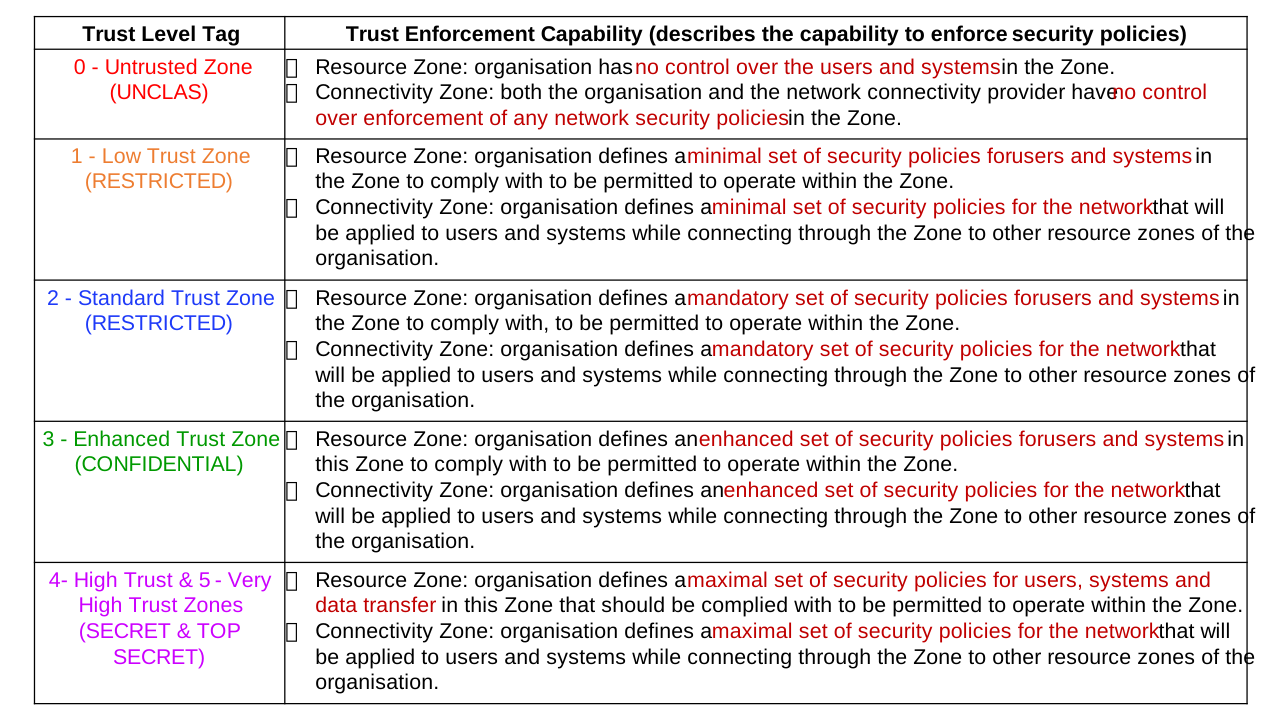
Categorisation of Zones based on Trust Levels
Each Resource and Connectivity Zone described above can be assigned a Trust Level. The characteristics of trust that is applicable to a resource or connectivity is described below along with examples of the same.
Every computer resource has to:
- be configured for functionality, performance, and assurance (controls)
- provide visibility and observability.
- be controlled.
- be governed through org policies.
The trust level is a function of the ability of an entity to execute the above requirements.
Characteristics of Trust Levels
Untrusted Zone
Characteristics:
When applied to a Resource Zone, it indicates that the organisation has no control over the users and systems in the Zone.
When applied to a Connectivity Zone, it indicates that both the organisation and the network connectivity provider have no control over enforcement of any security policies in the Zone.
Applicable to:
Public users and systems connecting through public networks. The organisation cannot enforce security policies on the users and systems. Neither the organisation nor the ISP can enforce any security policies for network traffic that passes through the public network.
Examples:
Public users anonymously accessing an organisation’s website over the Internet or mobile network.
Low Trust Zone
Characteristics:
When applied to a Resource Zone, the organisation defines a minimal set of security policies that users and systems in the Resource Zone should comply with to be permitted to operate within the Zone. Typically, no anonymous access is provided, and all users and systems must be registered with an organisation, using their username & password or allocated API secret.
When applied to a Connectivity Zone, the organisation defines a set of security policies for the network that will be applied to users and systems while connecting through the Zone to other resource zones of the organisation. Typically, this would be in the form of VPNs controlled by the organisation or a trustworthy network connectivity provider, who has well defined network security policies for the Connectivity Zone.
Applicable to:
External users and systems that can connect to an organisation’s zone after pre-registration and through session-based authentication, they are also required to use browser-based (https) or client-based VPNs, which are controlled by the organisation and governed by the organisation’s security policies.
External users and systems of other Organizations connecting through trusted extranet connectivity providers.
Examples:
Public users connecting to an organisation’s website through the Internet or mobile network using a browser or app-based SSL VPN and further logging into their user account before doing any further activity.
Applications on the devices of public users and Organizations, which connect to an organisation’s API gateways by using registered API secrets.
NICNET and NKN based extranets that provide network interconnectivity between different Organizations. The network connectivity provider defines the set of security policies that the organisational users and systems should comply with when they are connected to the network.
Remote management and support provided by OEMs, System Integrators, Managed Service Providers (MSPs & MSSPs) from their support zones, which are governed by their own security policies. In these cases, the remote support providers either connect through VPN clients installed on their devices or there would be well-managed site-to-site VPNs between the customer and support provider Organizations.
Standard Trust Zone
Characteristics:
When applied to a Resource Zone, the organisation defines a mandatory set of security policies that users and systems in the Resource Zone should comply with, to be permitted to operate within the Zone. Typically, the organisation has mechanisms to verify that the systems are compliant to the mandatory set of policies (systems are patched, have anti-virus software with latest update, username and password are as per security policy etc) before they are permitted to access other Resource Zones.
When applied to a Connectivity Zone, the organisation defines a mandatory set of security policies for the network that will be applied to users and systems while connecting through the Zone to other resource zones of the organisation. Typically, these well-defined network security policies are implemented and continuously verified for compliance either by the organisation or by a trusted network connectivity provider.
Applicable to:
Internal users and systems of the organisation connecting through the organisation’s Intranet, which may be managed by the organisation itself or by trusted network connectivity providers.
Users and systems of different Organizations connecting through trusted network, all of which are governed by a common set of security policies.
Examples:
Organisation’s Intranet for its own users and systems.
INFINET, a Closed User Group network governed and secured by RBI.
Enhanced Trust Zone
Characteristics:
When applied to a Resource Zone, the organisation defines an enhanced set of security policies that users and systems in this Resource Zone should comply with to be permitted to operate within the Zone. Typically, the users and systems are in a Closed User Group (CUG) with extended control and monitoring of their activities.
When applied to a Connectivity Zone, the organisation defines an enhanced set of security policies for the network that will be applied to users and systems while connecting through the Zone to other resource zones of the organisation. Typically, this would be in the form of highly secure VPNs and well-defined network security policies that are implemented and continuously verified for compliance either by the organisation or by a trusted network connectivity provider.
In general, the resource zones connected through an enhanced trust connectivity zone should themselves have enhanced trust.
Applicable to:
Internal users and systems of the organisation operating within Closed User Groups.
Users and systems of different Organizations connecting through trusted network, all of which are governed by a common set of enhanced security policies.
Examples:
Organisation’s privileged users like system administrators managing the IT and OT resources.
Internal LANs for high security operations, systems, and network administration.
Some Government and Defence captive networks.
High Trust Zone
Characteristics:
When applied to a Resource Zone, the organisation defines a maximal set of security policies that users and systems in this Resource Zone should comply with to be permitted to operate within the Zone. The organisation also specifies physical security and access controls for this zone and usually enforces network airgap for high security. All activities in this zone are monitored closely for any policy violation.
When applied to a Connectivity Zone, the organisation defines an enhanced set of security policies for the network that will be applied to users and systems while connecting through the Zone to other resource zones of the organisation. Typically, this would be in the form of highly secure VPNs and well-defined network security policies that are implemented and continuously verified for compliance either by the organisation or by a trusted network connectivity provider. Data diodes may be used for one-way communication from/to lower trust zones.
In general, the resource zones connected through a high trust connectivity zone should themselves have high trust and vice versa.
Applicable to:
Internal high security users and systems of the organisation operating within Closed User Groups.
High security users and systems of different Organizations connecting through high trust network, all of which are governed by a common set of enhanced security policies.
Examples:
Some Government and Defence Organizations’ high security operations.
High trust zones for ensuring the integrity and privacy of critical databases, such as Aadhaar demographic data, PKI infrastructure, HSMs etc.
Very High Trust Zone
Characteristics:
When applied to a Resource Zone, the organisation defines a maximal set of security policies that users and systems in this Resource Zone should comply with to be permitted to operate within the Zone. The organisation also specifies physical security and access controls for this zone and always enforces network airgap for high security. All activities in this zone are monitored closely for any policy violation.
When applied to a Connectivity Zone, the organisation defines a maximal set of security policies for the network that will be applied to users and systems while connecting through the Zone to other resource zones of the organisation. Typically, this would be in the form of custom hardware-based VPNs and detailed network security policies that are implemented and continuously verified for compliance either by the organisation or by a trusted network connectivity provider. Data diodes may be used for one-way communication from/to lower trust zones.
In general, the resource zones connected through a very high trust connectivity zone should themselves have very high trust and vice versa.
Applicable to:
Internal high security users and systems of the organisation operating within Closed User Groups.
High security users and systems of different Organizations connecting through high trust network, all of which are governed by a common set of enhanced security policies.
Examples:
Government and Defence Organizations’ very high security operations.
Very High trust zones for ensuring the integrity and privacy of extremely critical databases, such as Aadhaar biometric data, CCA and CA root certificates etc.
Using Trust Level Tags
The trust levels can be applied to various tags so as to establish a common understanding between different teams and organisational hierarchies. Examples are given below.
Data Centre and OT Zones
| Zone Type | Zone Description |
|---|---|
| DC Zone HL5 | Untrusted Resource Zone, Eg outside the external perimeter |
| DC Zone HL4.5, HL3.5 | Low Trust Resource Zone, Eg DMZ |
| DC Zone HL4, HL3, OT Zone HL3 | Standard Trust Resource Zone, hosting non-critical resources |
| OT Zone HL2.5, IIoT Edge Zone HL1 | Enhanced Trust Resource Zone, hosting critical operation and management resources |
| OT Operations Zone HL2, HL1, HL0 | High Trust Resource Zone, hosting critical OT supervisory and basic control systems and process systems that cannot be hardened to required extent |
Notes:
Data centre, remote/ branch office and cloud setups are typically segmented into multiple resource zones, each with its own trust level tag. Resource zones can be Operation zones or Management zones. Connectivity between DC zones is configured, secured & managed via DC networking infrastructure.
Colour tagged table of trust levels may be downloaded here.
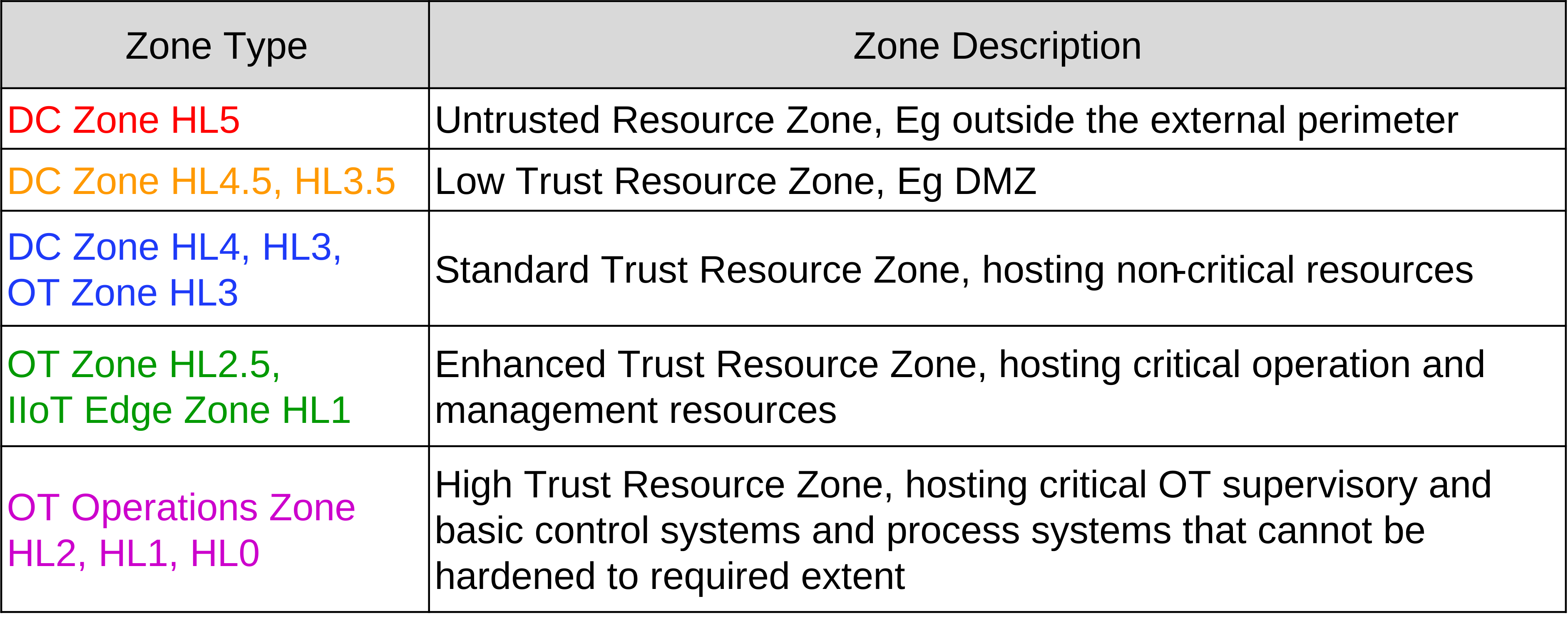
End User Zones
| Zone Type | Zone Description |
|---|---|
| End User UD, UC | Public Users (both humans and machines) |
| End User UB | Other Organisation Users (both humans and machines) |
| End User UA, OU | Own Organisation Users (both humans and machines) |
| End User UA, UB, OU | Privileged Users (Administrators, Service Accts, Remote Support etc) both human & machine |
Notes:
Resources in User zones are typically configured, secured, and managed by the organisation/ user owning the resource (user account and/ or device).
Colour tagged table of trust levels may be downloaded here.
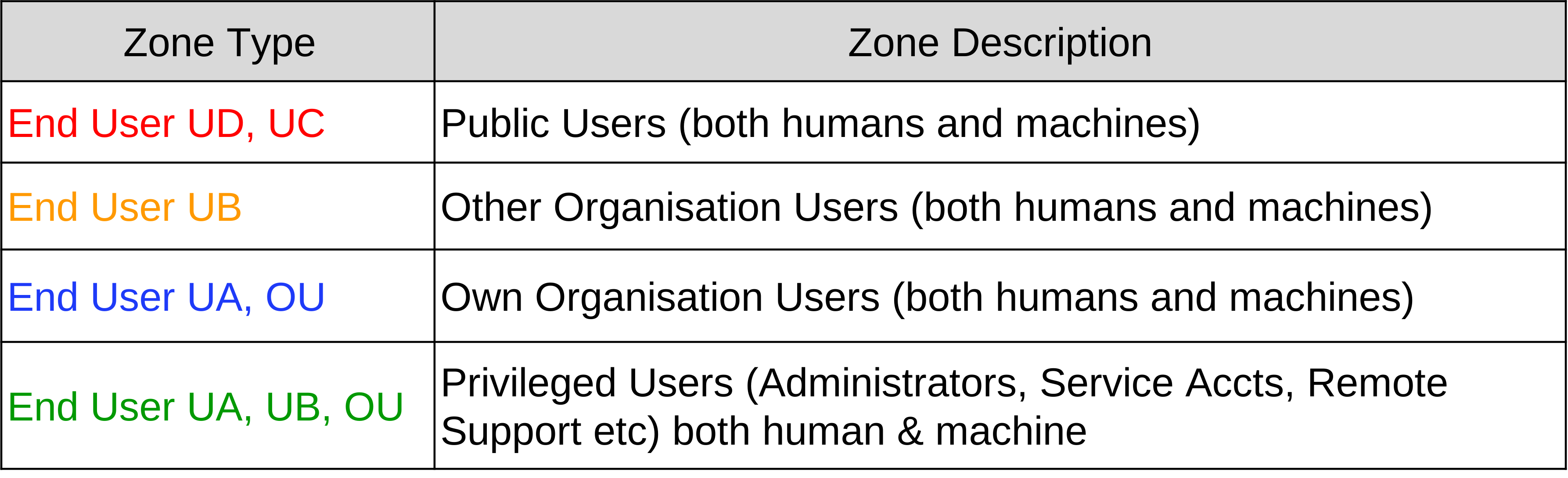
Connectivity Zones
| Zone Type | Zone Description |
|---|---|
| Connectivity VD, XD | Untrusted Connectivity Zone, Private owned, Public Internet |
| Connectivity VC, XC | Low Trust Connectivity Zone, Private owned, Extranet |
| Connectivity VB, XB | Standard Trust Connectivity Zone, GOE owned, Intranet, DC networking |
| Connectivity VA, XA | Enhanced Trust Connectivity Zone, Entity owned, Closed Group Network |
Notes:
A connectivity zone is typically configured, secured, and managed by the network provider, data centre provider or, in some cases, by the organization.
Colour tagged table of trust levels may be downloaded here.

Perimeter between Trust Zones
Perimeter tags defined below are in the context of separation between trust zones (tagged with the higher trust zone)
| Tag | Tag Description |
|---|---|
| PTL1 | Ingress into/ egress from a low trust zone |
| PTL2 | Ingress into/ egress from a standard trust zone |
| PTL3 | Ingress into/ egress from an enhanced trust zone |
| PTL4 | Ingress into/ egress from a high trust zone |
| PTL5 | Ingress into/ egress from a very high trust zone |
It may be noted that Critical Information Infrastructure (CII) of entities should typically be in Resource zones with trust levels TL3, TL4 or TL5. Also, they should never be connected directly through a Connectivity Zone with trust level TL0.
Perimeters between zones with different trust levels should implement security policies that are aligned with the required trust levels of the separated zones.
Colour tagged table of trust levels may be downloaded here.
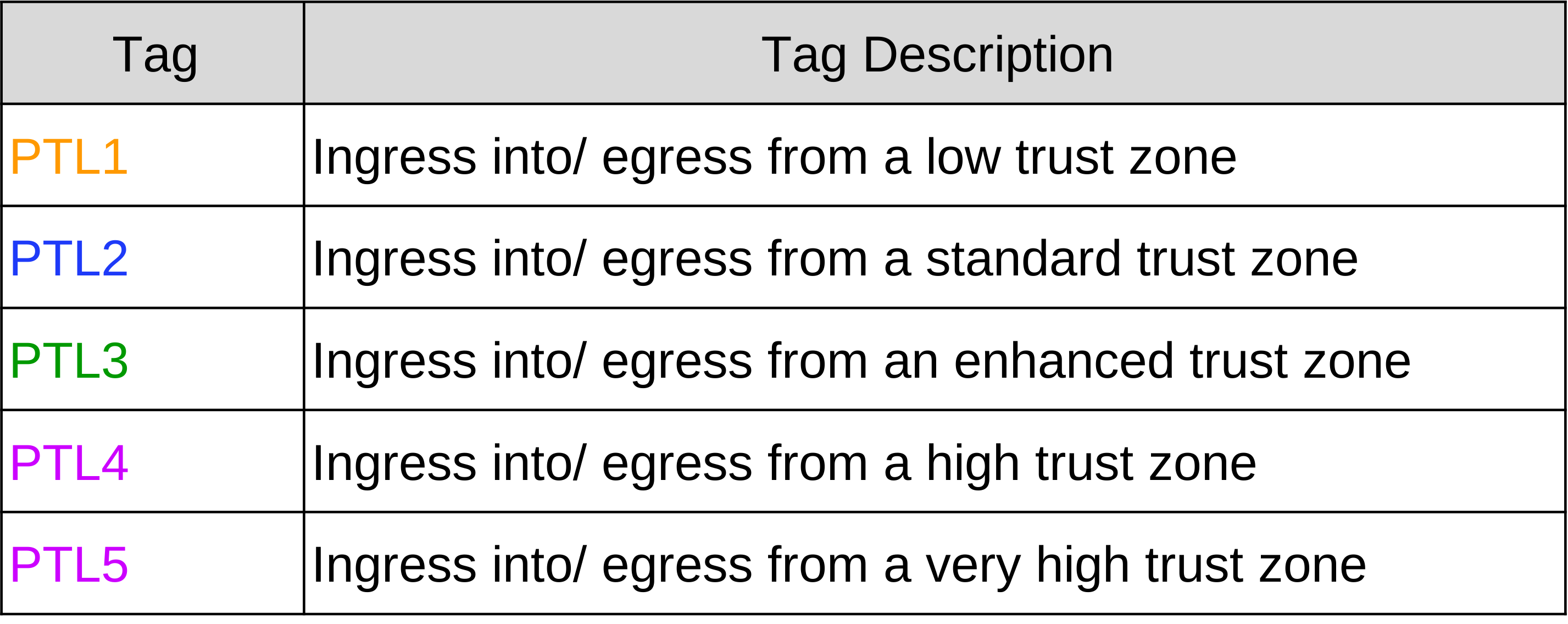
Mapping Trust Levels to Government Classification
The Ministry of Home Affairs has defined the following security classification tags:
- Top Secret: Information, unauthorized disclosure of which could be expected to cause exceptionally grave damage to the national security or national interest. This category is reserved for nation’s closest secrets and is to be used with great reserve.
- Secret: Information, unauthorized disclosure of which could be expected to cause serious damage to the national security or national interest or cause serious embarrassment in its functioning. This classification should be used for highly important information and is the highest classification normally used.
- Confidential: Information, unauthorized disclosure of which could be expected to cause damage to the security of the organisation or could be prejudicial to the interest of the organisation or could affect the organisation in its functioning. Most information, on proper analysis, will be classified no higher than confidential.
- Restricted: Information, which is essentially meant for official use only and which would not be published or communicated to anyone except for official purpose.
- Unclassified: Information that requires no protection against disclosure. e.g. public releases.
Government organisations may want to establish a standardised mechanism to map classification tags to trust levels of resource and connectivity zones in government IT infrastructure. A sample mapping is illustrated below:
| # | Zone Type | Trust Level of Resource Zone | Govt Data Classification |
|---|---|---|---|
| 0 | UD, NU | Untrusted | UNCLASSIFIED |
| 1 | UC, NU, HL4.5, HL3.5 | Low Trust | RESTRICTED |
| 2 | UB, NU, OU | Standard Trust | RESTRICTED |
| 3 | UA, NU, OU, L4, L3, L2, L1, L0 | Enhanced Trust | CONFIDENTIAL |
| 4 | UA, UB, SA, SB, OU | High Trust | SECRET |
| 5 | UA, SA, OU | Very High Trust | TOP SECRET |
| # | Zone Type | Trust Level of Connectivity Zone | Govt Data Classification |
|---|---|---|---|
| 0 | VC, VD, XD | Untrusted | UNCLASSIFIED |
| 1 | VC, VD, XC | Low Trust | RESTRICTED |
| 2 | VA, VB, VC, VD, XB | Standard Trust | RESTRICTED |
| 3 | VA, VB, VC, VD, XB | Enhanced Trust | CONFIDENTIAL |
| 4 | VA, VB, WA, XA, WA Use of Data Diode | High Trust | SECRET |
| 5 | VA, WA, XA, WA Use of Air Gap, Data Diode | Very High Trust | TOP SECRET |
Capability Maturity Models
Capability development is not a point in time activity. It must be sustained and improved throughout the life of an organisation. This requires mechanisms for continually monitoring and measuring the capability maturity of the organisation. A mature governance framework enables the leadership to set objectives, monitor performance, match performance with internal and external drivers and constraints to derive future projections.
A capability maturity model typically comprises of a set of characteristics, attributes, indicators, or patterns that represent capability and progression in a particular discipline. Principally, the models must be able to provide insights to some of the concerns of CSEs and national bodies, as listed below:
What are the maturity levels of CSEs in comparison with established benchmarks in governance, risk management, enterprise architectures, system lifecycle management, IT and infosec capabilities, technology implementations, operations and support processes, workforce characteristics?
What must be improved?
What needs to be measured and assessed to enable improvement?
How comprehensive are the enterprise policies, practices and processes?
How good is the visibility, oversight, and control across the enterprise on the compliance to policies?
In general, CMMs have the following characteristics:
collect the best practices.
are developed by a collaboration of experts from diverse backgrounds.
consider the dispersion in size, knowledge, skills, abilities, and experience of organisations that use the model.
take a life cycle and continuous improvement approach.
There are prominent capability maturity models in the domains of cybersecurity and SOC operations, which are described below.
Capability Maturity Modelling (CyberCMM)
Cybersecurity Capability Maturity Modelling (CyberCMM) is globally acknowledged as a practical and successful approach to measure and improve the cyber resilience of enterprises. It helps organisations of all sectors, types, and sizes to evaluate and make improvements to their cybersecurity programs. It focuses on the implementation and management of cyber security practices associated with the information technology (IT) and operations technology (OT) assets and the environments in which they operate. A CyberCMM can:
enable organisations to evaluate and benchmark their cybersecurity capabilities effectively and consistently and prioritize actions and investments to improve their cybersecurity capabilities.
enable national bodies to share knowledge, best practices, and relevant references across organisations to help them improve their cybersecurity capabilities.
enable national bodies to carry out data-driven analytics from sectoral, cross-sectoral and trends-over-time perspectives.
Cybersecurity capability maturity models are typically designed and engineered to provide a self- assessment platform for individual CSEs. National bodies are developing central systems that aggregate data from individual CSEs to carry out data-driven analytics from sectoral, cross-sectoral, and trends-over-time perspectives.
US DoE C2M2
The US energy industry led the development of C2M2 to help organisations in the energy sector to assess their cybersecurity maturity and make optimum investments towards that end. The model can also be used by other organisations, irrespective of their size and domain.
The target sectors that have leveraged C2M2 include energy, critical manufacturing, government, healthcare, defence industrial base and financial services.
The C2M2 leverages a set of proven cybersecurity practices, focusing on both IT and OT assets and environments. The C2M2 domains are:
Asset Change & Configuration Management.
Threat & Vulnerability Management.
Risk Management.
Identity & Access Management.
Situational Awareness.
Events and Incident Response.
Third Party Risk Management.
Workforce Management.
Cybersecurity Architecture.
Cybersecurity Program Management.
US DoD CMMC
The model was developed for the Dept of Defense by Software Engineering Institute, Carnegie Mellon University (SEI-CMU) in collaboration with the Johns Hopkins University Applied Physics Laboratory with the intent to protect sensitive national security information and to protect the Defense Industrial Base from frequent and complex cyberattacks.
The intent of the framework is to assess and improve the overall cyber resilience of the Defence Industrial Base (DIB). The cybersecurity capabilities of DIB organisations can be rigorously measured using CMMC. This can be used by the DoD to make risk-informed decisions regarding the information it shares with DIB contractors. The CMMC thus helps the DOD in establishing levels of confidenece with regard to the security of defense contractors and the DIB.
The CMMC framework draws on maturity processes and cybersecurity best practices from multiple standards as well as input from DIB entities and the DoD. It is primarily designed to secure the Defense Industrial Base (DIB) supply chain. The DIB organisations have to be certified by a CMMC third-party assessment organisation (C3PAO) at a particular level prior to bidding on contracts.
The CMMC defines the following:
a practice is a specific technical activity or activities that are required and performed to achieve a specific level of cybersecurity maturity for a given capability in a domain.
a process is a specific procedural activity that is required and performed to achieve a maturity level.
CMMC version 2.0 Dec 2021 defines 14 domains, three levels with practices for each level for the DIB, as under:
Level 1 – Foundational (level 1 of v1.0) - 17 practices 48 FAR 52-204-21 Oct 2016
Level 2 – Advanced (level 3 of v1.0) – mirrors NIST SP 800-171 (110 practices)
Level 3 – Expert (level 5 of v1.0) – based on subset of NIST SP 800-172.
The 14 domains are aligned with the families specified in NIST SP 800-171
Access Control (AC)
Awareness & Training (AT)
Audit & Accountability (AU)
Configuration Management (CM)
Identification & Authentication (IA)
Incident Response (IR)
Maintenance (MA)
Media Protection (MP)
Personnel Security (PS)
Physical Protection (PE)
Risk Assessment (RA)
Security Assessment (CA)
System & Comn Protection (SC)
System & Info Integrity (SI)
An organisation must meet both the process and practice level requirements to achieve that level of certification within CMMC.
IEC 62443 Maturity Levels
From an organisational perspective, the IEC 62443 standard series describes four “Maturity Level” ratings (ML 1 – ML 4). The ML rating system is used to evaluate how well an organisation defines and describes security processes and how well the processes are followed by the personnel involved. The maturity levels are distinct from security levels (SL-T).
CERT Resilience Management Model (CERT-RMM)
The CERT Resilience Management Model (CERT-RMM), developed by the CERT Division of SEI, Carnegie Mellon University defines 26 processes areas grouped into 4 categories - Enterprise Management, Operations Management, Engineering and Process Management. The resilience strategy translates to evolving measures to protect and sustain the assets viz. people, information, technology and facilities.
ReBIT Cybersecurity Maturity Model (CMM)
The RBI Cyber Security Maturity Model (CMM) is developed in Oct 2017 as an industry initiative coordinated by ReBIT. The CMM is closely aligned with RBI-CSF, which is harmonious with international standards, such as NIST CSF, COBIT 5.0, ISO 27000 and other standards.
RBI CMM focuses on i) implementation and adoption of the mandated cybersecurity framework uniformly in the financial firms, ii) understanding of the firm’s cybersecurity maturity in terms of the adoption of the regulatory cybersecurity framework, iii) benchmarking, and iv) regulatory tracking.
The CMM provides guidance through i) a methodical approach to measurement of risk, planning of controls and governance and security strategy execution to strengthen cybersecurity posture of financial firms, and ii) metrics-based treatment, benchmarking and prioritizing risk driven investment in security.
Secure Controls Framework’s™ (SCF)
SCF’s Cybersecurity & Data Privacy Capability Maturity Model (C|P-CMM) is an undertaking by SCF contributors to define maturity levels for the SCF’s control catalogue. The SCF leverages an existing framework, namely the Systems Security Engineering Capability Maturity Model v2.0 (SSE-CMM) and provides control-level criteria to an existing CMM model.
SOC-CMM
SOC-CMM, evolved from a research project to become a well-used standard for measuring capability maturity in Security Operations Centres. The SOC-CMM model was initially created to determine characteristics and features of SOCs, such as specific technologies or processes. It evolved to become the defacto standard for measuring capability maturity in Security Operations Centers.
At the core of the assessment tool lies the SOC-CMM model. This model consists of 5 domains and 26 aspects, that are each evaluated using a number of questions. The domains ‘Business’, ‘People’ and ‘Process’ are evaluated for maturity only (blue colour), the domains ‘Technology’ and ‘Services’ are evaluated for both maturity and capability (purple colour).
Maturity
SOC-CMM is a continuous maturity model, allowing improvements across all domains simultaneously and independently. The SOC-CMM uses maturity stages based loosely on the CMMI:
Non-existent. At this level, the aspect is not present in the SOC
Initial. The aspect is delivered in an ad-hoc fashion
Managed. The aspect is documented and delivered consistently
Defined. The aspect is managed using ad-hoc feedback on the quality and timeliness of deliverables
Quantitatively Managed. The aspect is systematically being measured for quality, quantity and timeliness of deliverables
Optimizing. The aspect is continuously being optimized and improved.
Capability
The SOC-CMM uses a continuous approach to measuring technical capability across the technology and services domains. These can be technical features, such as the existence of certain tooling options or other features such as service artefacts. Capabilities can be expressed at any maturity level. Just like with maturity scoring, capability scoring is continuous. Similar to the CMMI, the SOC-CMM supports 4 capability levels:
Incomplete. The capability is missing or lacking essential features
Performed. The capability is performed, but not standardised
Defined. The capability is deliverd in a standardised fashion
Managed. The capability is active managed and improved.
Methodology
The methodology used to create the SOC-CMM is a scientific research approach called Design Science Research. This type of research has a focus on bridging the gap between theory and practice and works well for areas that have not been extensively (scientifically) studied and clearly defined, as is the case for SOC capability and maturity. The goal of Design Research is the creation of a tangible result of the research effort. In this case, two artefacts were created: the SOC-CMM model, which is an abstract representation of SOCs and the self-assessment tool based on that model to evaluate capability maturity in a SOC.
The SOC-CMM self-assessment tool is available for download here.
National Guidelines
This compendium of national guidelines for cybersecurity is summarised from the original sources for information only. Readers must consult the authoritative sources for the actual guidelines.
Ministry of Electronics and Information Technology (MeitY)
National Cyber Security Policy 2013
Overview & Purpose
The National Cyber Security Policy 2013 provides vision “to build a secure and resilient cyberspace for citizens, businesses and Government” and mission “to protect information and information infrastructure in cyberspace, build capabilities to prevent and respond to cyber threats, reduce vulnerabilities and minimize damage from cyber incidents through a combination of institutional structures, people, processes, technology and cooperation”. It gives an overview of what it takes to effectively protect information, information systems & networks and an insight into the Government’s approach and strategy for protection of cyber space in the country. It also outlines some points to enable the collaborative working of all key players in public & private to safeguard the nation’s information and information systems.
Audience
The audience includes government ministries and departments, government and non-government entities, large, medium and small enterprises, decision-makers, procurement teams, service providers and other stakeholders.
Usage
This policy aims to create a cyber security framework, which leads to specific actions and programmes to enhance the national security posture for its cyber space.
India Enterprise Architecture (IndEA) Framework
Overview & Purpose
The IndEA framework 2018 comprises of a set of architecture reference models, which can be converted into a Whole-of-Government Architecture for India, Ministries, States, Govt. Agencies etc. IndEA is a structured combination of several Reference Models that, together, enable a boundary-less flow of information across the length and breadth of the government and facilitate the delivery of integrated services to the stakeholders, namely, the citizens, businesses and employees. Strictly speaking, IndEA is not an Enterprise Architecture as its name seems to connote. It is a comprehensive and convenient framework for developing Enterprise Architecture to support ICT enabled transformation across governments. It is an authoritative reference providing an integrated, consistent and cohesive view of strategic goals, business services and enabling technologies across the entire organisation. The Agile IndEA framework infuses agile practices into IndEA and simplifies the understanding of IndEA to promote widespread adoption.
Audience
Ministries, States, Govt. Agencies and large organisations in the public sector.
Usage
The IndEA and Agile IndEA frameworks , are based on federated architecture approach and recognise the need to accommodate both greenfield (new) and brownfield (existing/ legacy) eGovernance initiatives.
Policy on Adoption of Open-Source Software for Government of India
Overview & Purpose
The Government of India endeavours to adopt Open-Source Software (OSS) in all e-Governance systems implemented by various Government organisations, as a preferred option in comparison to Closed Source Software (CSS).
Audience
All Government of India organisations under the Central Governments and those State Governments implementing e-Governance applications.
Usage
The policy encourages the formal adoption and use of Open-Source Software (OSS) in Government Organisations.
National Policy on Software Products (2019)
Overview & Purpose
The purpose of the policy is to develop India as a Software Product Nation and a global leader in the conception, design, development and production of intellectual capital driven software products, thus, accelerating growth of entire spectrum of IT Industry of the country.
Audience
Micro, Small and Medium Enterprises, Indian Software Product Companies (ISPC) and Startups.
Usage
To promote the creation of a sustainable Indian software product industry, driven by intellectual property (IP), leading to a ten-fold increase in share of the Global Software product market by 2025; To nurture 10,000 technology startups; To create a talent pool; To build a cluster-based innovation driven ecosystem and In order to evolve and monitor schemes & programmes for the implementation of this policy, National Software Products Mission is set up with participation from Government, Academia and Industry.
Email Policy of Government of India, 2024
Overview & Purpose
The policy complements the framework that applies to the security of email solution(s) utilised to provide email services.
Audience
All Government of India organisations.
Usage
This policy applies to use and use-related security aspects governing email services.
Public Procurement Order 2018 for Cyber Security Products
Overview & Purpose
The Cyber Security Products notification encourages ‘Make in India’ to promote manufacturing and production of goods and services in India with a view to enhancing income and employment. Cyber Security Product means a product or appliance or software manufactured/produced for the purpose of protecting, information, equipment, devices computer, computer resource, communication device and information stored therein from unauthorized access, use, disclosure, disruption, modification or destruction. Cyber Security being a strategic sector, preference shall be provided by all procuring entities to domestically manufactured/ produced Cyber Security Products.
Audience
Domestically manufactured/ produced Cyber Security products covered in turnkey/ system integration projects.
Usage
For preference to domestically manufactured/ produced Cyber Security products, forming part of the turnkey/ system-integration projects.
Government of India (GI)-Cloud (Meghraj)
Overview & Purpose
To utilize and harness the benefits of cloud computing, the Government of India embarked upon an ambitious initiative – “GI Cloud” which has been named as ‘Meghraj’. The focus of this initiative is to accelerate delivery of e-services in the country while optimizing ICT spending by the Government. A set of guidelines have been published on the Ministry of Electronics and Information Technology website , which are briefly described below.
Guidelines for Enablement of Government Departments for Adoption of Cloud
The guidelines, provide a structured framework to facilitate the seamless transition of government entities to cloud-based solutions. These guidelines aim to promote the adoption of cloud technologies by addressing key aspects such as readiness assessment, capacity building, service selection, and risk management. They outline a phased approach for cloud adoption, ensuring alignment with operational requirements, security standards, and compliance obligations. By offering best practices and a roadmap for cloud enablement, the document empowers government departments to leverage the benefits of cloud computing, such as scalability, cost efficiency, and enhanced service delivery, while mitigating associated risks.
Software Development & Re-Engineering Guidelines for Cloud Ready Applications
The guidelines provide a comprehensive framework to design and modernize applications optimized for cloud environments. These guidelines emphasize creating scalable, interoperable, and flexible applications that adhere to open standards and leverage modular design principles, ensuring seamless integration across diverse platforms. They promote the development of Common Application Software (CAS), allowing states and departments to configure applications for specific needs without altering core functionalities, reducing duplication of efforts. The guidelines advocate for the adoption of open-source tools and configurable components to enhance innovation, minimize vendor lock-in, and streamline development processes. Additionally, they address metadata standards, multi-language support, and adherence to software engineering protocols to ensure consistency, security, and quality. By fostering reusability, scalability, and rapid deployment, the guidelines aim to facilitate the creation of robust, cloud-ready applications that align with MeitY’s vision for a digitally empowered society, enhancing efficiency and reducing costs for government and critical sectors.
Cloud Security Best Practices
The guidelines provide a detailed framework to ensure the secure adoption and management of cloud services by government entities and other stakeholders. The document outlines essential security measures to protect data integrity, confidentiality, and availability in cloud environments. It covers areas such as access control, data encryption, incident response, compliance, and governance, emphasizing the shared responsibility model between cloud service providers (CSPs) and users. The guidelines aim to address risks like unauthorized access, data breaches, and compliance violations while ensuring that cloud deployments align with regulatory requirements and international security standards. By following these best practices, organizations can minimize vulnerabilities, enhance trust in cloud technologies, and ensure the secure handling of sensitive information.
Guidelines for Procurement of Cloud Services
The guidelines provide a comprehensive framework to help government departments transition to cloud-based solutions while ensuring compliance with security and regulatory standards. These guidelines aim to standardize the procurement process, enabling government entities to adopt scalable, cost-efficient, and flexible cloud services effectively. They emphasize critical aspects such as Service Level Agreements (SLAs), data security, privacy, contractual terms, and risk management. The document offers a Master Service Agreement (MSA) template to address key concerns like data ownership, exit strategies, and dispute resolution while highlighting the differences between traditional IT and cloud service procurement. By outlining roles and responsibilities for stakeholders, such as cloud service providers (CSPs) and system integrators (SIs) and recommending best practices for safeguarding data integrity and availability, the guidelines ensure that digital transformation initiatives in the public sector are aligned with national objectives and operational requirements. These guidelines empower government departments to make informed decisions, promoting transparency, efficiency, and consistency in cloud adoption.
Guidelines for Government Departments on Contractual Terms Related to Cloud Services
The guidelines provide a structured framework to assist government entities in drafting and negotiating contracts with cloud service providers (CSPs). These guidelines aim to address critical contractual elements such as data ownership, security, privacy, liability, indemnity, termination, and exit management to safeguard the interests of government departments. By focusing on risk mitigation and compliance with regulatory and operational requirements, the guidelines ensure that cloud contracts are robust, clear, and enforceable. They empower government departments to establish fair and balanced agreements that protect sensitive data, ensure service continuity, and foster accountability, thereby enabling secure and efficient cloud adoption.
Guidelines for User Departments on Service Level Agreement for Procuring Cloud Services
The guidelines provide a structured approach for government departments to draft, evaluate, and enforce SLAs when adopting cloud services. These guidelines aim to ensure clarity and accountability between government users and cloud service providers by defining key performance metrics, responsibilities, and penalties for non-compliance. They address critical areas such as service uptime, data security, response times, and disaster recovery, ensuring that the agreed service levels meet operational and regulatory requirements. By offering a detailed SLA framework, the guidelines empower government departments to establish measurable expectations, monitor service performance, and safeguard their interests in cloud procurement agreements.
Master Service Agreement for Procurement of Cloud Services
The MSA provides a standardized contractual framework to facilitate transparent and efficient cloud service procurement by government entities. It outlines the terms and conditions governing the relationship between government departments and cloud service providers (CSPs), addressing critical aspects such as service delivery, data ownership, security, privacy, termination clauses, and exit management. It ensures that cloud services are procured with clearly defined responsibilities, measurable performance metrics, and robust dispute resolution mechanisms. By providing a comprehensive and legally sound agreement template, the MSA enables government departments to safeguard their interests, ensure compliance with regulatory requirements, and build trust with CSPs while transitioning to cloud technologies.
Audit Criteria for Cloud Service Providers
The audit criteria document establishes a comprehensive framework to evaluate and ensure that CSPs meet the required standards for delivering secure, reliable, and compliant cloud services to government entities. These criteria outline essential audit parameters across areas such as data security, privacy, service availability, incident management, compliance with legal and regulatory requirements, and operational efficiency. The purpose of the guidelines is to provide a standardized evaluation mechanism to assess the capabilities and performance of CSPs, ensuring they align with the stringent requirements of government projects. By implementing these audit criteria, government departments can identify trustworthy CSPs, mitigate risks, and uphold the integrity of their cloud-based operations.
Audience
Ministries of GoI, States and organisations in the public sector.
Usage
The guidelines enable ministries, government departments and others to use the GI Cloud services offered by the empaneled cloud service providers.
Ministry of Home Affairs (MHA)
NISPG 5.0
Overview & Purpose
The National Information Security Policy and Guidelines (NISPG) version 5.0, issued by the Ministry of Home Affairs (MHA), Government of India, focuses on establishing guidelines to help secure “information” that may impact internal security and national security. These guidelines are based on the analysis of existing global security standards and frameworks and the emerging trends and discourse in the wake of persistent threats, and cyber-attacks on critical infrastructure of nations globally.
Audience
Various government organisations in India.
Usage
The NISPG guides Government and Public Sector organisations and associated entities and third parties, in protecting the information under their control or ownership during the information’s lifecycle that includes creation, storage, processing, accessing, transmission and destruction.
Cyber Security Guidelines for Government Employees
Overview & Purpose
These guidelines are meant to sensitize the government employees and contractual/ outsourced resources and build awareness amongst them on what to do and what not to do from a cyber security perspective.
Audience
All government employees, including temporary, contractual/ outsourced resources
Usage
Develop awareness amongst the government employees and contractual/ outsourced resources.
Reserve Bank of India (RBI)
Information Security, Electronic Banking, Technology Risk Management
Overview & Purpose
Addresses various issues arising out of the use of Information Technology in banks and makes recommendations in nine broad areas, namely, IT Governance, Information Security, IS Audit, IT Operations, IT Services Outsourcing, Cyber Fraud, Business Continuity Planning, Customer Awareness programmes and Legal aspects.
Audience
Elements in the Banking Sector.
Usage
Provides a focused project-oriented approach towards implementation of guidelines and to put in place a time-bound action plan to address the gap and comply with the guidelines.
Cyber Security Frameworks in Banks
Overview & Purpose
To enhance the resilience of the banking system by improving the current defences in addressing cyber risks, arising from the low barriers to entry, evolving nature, growing scale/ velocity, motivation, and resourcefulness of cyber-threats to the banking system.
Audience
Elements in the Banking Sector.
Usage
Put in place an adaptive Incident Response, Management and Recovery framework to deal with adverse incidents/ disruptions, if and when they occur.
Outsourcing Information Technology Services
Overview & Purpose
The Reserve Bank of India (Outsourcing of Information Technology Services) Directions, 2023 was introduced to regulate the outsourcing of IT services by financial institutions, ensuring that such practices do not compromise their operational integrity or customer security. These guidelines are effective from October 1, 2023,
Audience
Elements in the Banking Sector. These directions are applicable to all entities regulated by the RBI, including banks, non-banking financial companies (NBFCs), and credit information companies.
Usage
Designed to enhance the operational resilience of financial institutions, ensuring that they remain compliant with regulatory requirements even when IT services are outsourced.
IT Governance, Risk, Controls and Assurance Practices
Overview & Purpose
The RBI Master Direction on Information Technology Governance, Risk, Controls, and Assurance Practices (ITGRCA) was introduced in November 2023 and is effective wef 1st April 2024. It provides a comprehensive framework for banks, NBFCs, and other regulated entities to improve their IT governance, cybersecurity, and risk management practices.
Audience
Elements in the Banking Sector. These directions are applicable to banks, NBFCs, and other regulated entities.
Usage
These guidelines aim to enhance the operational resilience, data security, and risk management capabilities of financial institutions, ensuring they meet the growing challenges of digital transformation and cybersecurity threats.
Digital Payment Security Controls
Overview & Purpose
The RBI Master Direction on Digital Payment Security Controls directions, 2021 provides a detailed framework aimed at strengthening the security of digital payment systems across India for regulated entities to set up a robust governance structure for such systems and implement common minimum standards of security controls for channels like internet, mobile banking, and card payments, among others. While the guidelines are technology and platform agnostic, it aims to create an enhanced and enabling environment for customers to use digital payment products in a safe and secure manner.
Audience
These directions are applicable to regulated entities.
Usage
These guidelines are designed to ensure that digital payment systems remain secure, scalable, and resilient, meeting global security standards and safeguarding customer data and transaction integrity.
Security and Exchange Board of India (SEBI)
SEBI has issued several Cybersecurity & Resilience guidelines for their constituent entities. These are listed below.
CSCRF for SEBI Regulated Entities (REs) 2024
Overview & Purpose
The Cybersecurity and Cyber Resilience Framework (CSCRF) for SEBI REs has been formulated in consultation with the stakeholders to strengthen the cybersecurity measures in Indian securities market, and to ensure adequate cyber resiliency against cybersecurity incidents/ attacks.
Audience
Stockbrokers and Depository Participants, Mutual Funds (MFs)/ Asset Management Companies (AMCs), KYC Registration Agencies (KRAs), Qualified Registrar to an Issue and Share Transfer Agents (QRTAs), Portfolio Managers.
Usage
The CSCRF aims to provide standards and guidelines for strengthening cyber resilience and maintaining robust cybersecurity of SEBI REs.
Guidelines for Market Infrastructure Institutions (MIIs) 2023
Overview & Purpose
Market Infrastructure Institutions (i.e. Stock Exchanges, Clearing Corporations and Depositories) are systemically important institutions as they, inter-alia, provide the infrastructure necessary for the smooth and uninterrupted functioning of the securities market. As part of the operational risk management, these Market Infrastructure Institutions (MIIs) need to have a robust cyber security framework to provide essential facilities and perform systemically critical functions relating to trading, clearing and settlement in securities market .
Audience
Market Infrastructure Institutions (MIIs).
Usage
By MIIs to establish and continuously improve their Information Technology (IT) processes and controls to preserve confidentiality, integrity and availability of data and IT systems.
Adoption of Cloud Services by SEBI Regulated Entities (REs) 2023
Overview & Purpose
The major purpose of this framework is to highlight the key risks, and mandatory control measures which REs need to put in place before adopting cloud computing . The document also sets out the regulatory and legal compliances by REs if they adopt such solutions.
Audience
Stock Exchanges, Clearing Corporations, Depositories, Stockbrokers through Exchanges, Depository Participants through Depositories, Asset Management Companies (AMCs)/ Mutual Funds (MFs), Qualified Registrars to an Issue and Share Transfer Agents, KYC Registration Agencies (KRAs).
Usage
This framework provides baseline standards of security and for the legal and regulatory compliances by the REs.
For Stock Brokers / Depository Participants
Overview & Purpose
Guidelines and clarifications to create a framework on cyber security and cyber resilience.
Audience
All Stock Brokers and Depository Participants registered with SEBI.
Usage
Helps create a robust cyber security and cyber resilience framework to provide essential facilities and perform systemically critical functions relating to securities market.
For Stock Exchanges, Clearing Corporations & Depositories
Overview & Purpose
Creates Cyber Security Operation Center (C-SOC) for Market Infrastructure Institutions (MIIs), i.e., Stock Exchanges, Clearing Corporations and Depositories.
Audience
All Stock Exchanges, Clearing Corporations and Depositories (except Commodities Derivatives Exchanges and their Clearing Corporations).
Usage
Helps in prevention of cyber security incidents through proactive actions.
For Mutual Funds/ Asset Management Companies (AMCs)
Overview & Purpose
Extension of framework on cyber security and cyber resilience to Mutual Funds/ Asset Management Companies (AMCs).
Audience
Mutual Funds/ Asset Management Companies (AMCs).
Usage
Includes Mutual Funds/ Asset Management Companies (AMCs) in Cyber Security and Cyber Resilience framework.
For KYC Registration Agencies
Overview & Purpose
Creation of a framework on cyber security and cyber resilience for KYC Registration Agencies.
Audience
KYC Registration Agencies.
Usage
Helps in creation of a Cyber Security and Cyber Resilience framework for KYC Registration Agencies.
For Qualified Registrars to an Issue/ Share Transfer Agents
Overview & Purpose
Guidelines for submission of report / information containing information on cyber-attacks and threats experienced by QRTAs.
Audience
KYC Registration Agencies.
Usage
Helps in protection of the interests of investors in securities and to promote the development and regulation of the securities market.
Central Electricity Authority (CEA)
Cybersecurity Compliance Guidelines
Overview & Purpose
Interim guidelines till such time the “Regulation on Cyber Security in Power Sector” is released.
Audience
All Responsible Entities, System Integrators, Equipment Manufacturers, Suppliers/Vendors, Service Providers, IT Hardware and Software OEMs engaged within the Indian Power Supply Ecosystem.
Usage
The Objectives of these guidelines, as stated within the document are: a) Creating cyber security awareness b) Creating a secure cyber ecosystem c) Creating a cyber-assurance framework d) Strengthening the regulatory framework e) Creating mechanisms for security threat early warning, vulnerability management and response to security threats f) Securing remote operations and services g) Protection and resilience of critical information infrastructure h) Reducing cyber supply chain risks i) Encouraging use of open standards j) Promotion of research and development in cyber security k) Human resource development in the domain of Cyber Security l) Developing effective public private partnerships m) Information sharing and cooperation n) Operationalization of the National Cyber Security Policy.
National Critical Information Infrastructure Protection Centre (NCIIPC)
NCIIPC has issued the following key guidelines, which are available on the website . ‒ Guidelines for Protection of CII. ‒ Evaluating Cyber Security in CII. ‒ SOP: Incident Response. ‒ SOP: Audit of CII/Protected Systems.
The contents of the above documents have now been suitably subsumed into the NCRF. Hence, the NCRF is now intended to be used as the base document for guidelines for protection of CIIs.
CERT-In
Guidelines on Information Security Practices for Government Entities. 2023
Overview & Purpose
The guidelines provide a comprehensive framework to enhance the cybersecurity posture of government organizations. These guidelines outline structured protocols and best practices to safeguard government information systems from cyber threats, emphasizing risk assessment, incident response, and continuous monitoring. The purpose of the guidelines is to strengthen cyber resilience, ensuring government entities can effectively prevent, detect, and respond to cyber incidents while minimizing operational disruptions. They aim to protect the confidentiality, integrity, and availability of sensitive government data through robust security controls and standardized access management practices. Additionally, the guidelines promote a consistent approach to security across departments, enhancing compliance with national laws and cybersecurity standards. By fostering cybersecurity awareness and providing targeted training for government personnel, the guidelines help build a culture of security within governmental operations. Ultimately, they assist in ensuring secure, efficient, and uninterrupted public service delivery while maintaining compliance with relevant regulations.
Audience
The audience includes government departments, public sector organizations, IT administrators, security professionals, and policymakers responsible for safeguarding government information systems.
Usage
The guidelines provide a standardized framework for securing government information systems, enabling effective risk management, incident response, and compliance with cybersecurity laws, while fostering consistent security practices and resilience against cyber threats.
Reporting of Security Incidents 2022
Overview & Purpose
Cyber incidents and cyber security incidents have been and continue to be reported from time to time and in order to coordinate response activities as well as emergency measures with respect to cyber security incidents, the requisite information is either sometime not found available or readily not available with service providers/data centres/body corporate and the said primary information is essential to carry out the analysis, investigation and coordination as per the process of law. Outlines the triage mechanism when any aspect of a computer system is threatened by loss of confidentiality, disruption of data or system integrity, denial of service availability.
Audience
Service providers, intermediaries, data centres, bodies corporate and Government organisations.
Usage
By reporting cybersecurity incidents to CERT-In the System Administrators and users receive technical assistance in resolving these incidents. This also helps CERT-In to correlate the incidents, analyse them, draw inferences, disseminate up-to-date information and develop effective security guidelines to prevent the occurrence of the incidents in future.
Empanelment of Information Security Auditing Organisations
Overview & Purpose
Guidelines and procedures for empanelment of Information Security Auditors by CERT-In.
Audience
All Information Security Consulting Organisations.
Usage
Assist Information Security Auditors in understanding and meeting the requirements of empanelment with CERT-In.
Guidelines on Software Bill of Materials (SBOM), 2024
Overview & Purpose
The Software Bill of Materials (SBOM) Guidelines are a critical step toward strengthening software supply chain security in India. These guidelines aim to provide a detailed inventory of software components, including libraries, dependencies, and third-party modules, to enhance transparency, accountability, and risk management. By offering a comprehensive understanding of the components within a software application, the SBOM facilitates the identification of vulnerabilities and ensures compliance with cybersecurity standards. The purpose of these guidelines is to manage software supply chain risks, protect organizations from insecure or outdated libraries, and promote secure software development practices. They also assist in vendor risk management by enabling organizations to assess third-party risks and establish accountability in the software lifecycle. Additionally, SBOMs support organizations in responding swiftly to cyber threats and incidents by providing detailed knowledge of software components, thus enabling efficient vulnerability management. These guidelines are particularly significant for sectors like critical infrastructure, government services, finance, and healthcare, where cybersecurity is paramount. MeitY’s SBOM framework promotes industry best practices, ensuring secure software procurement, development, and maintenance while building trust in the software ecosystem.
Audience
The audience includes government entities, critical sector organizations, software developers, vendors, regulatory bodies, auditors, security professionals, and policymakers responsible for software security and compliance.
Usage
The guidelines provide organizations with a standardized framework for identifying, managing, and mitigating risks in their software supply chains. It enables transparency in software components, facilitates compliance with cybersecurity standards, enhances the ability to respond to vulnerabilities, ensures vendor accountability, and promotes secure software development practices. This policy is designed to improve risk assessment, regulatory compliance, and overall cybersecurity posture in critical sectors and government operations.
Secure Application Design, Development, Implementation & Operations 2024
Overview & Purpose
The prime objective of this guideline is to establish a firm and robust application security baseline in application development lifecycle. This approach is crucial for ensuring the application’s security right from the initial phase and progressively strengthening every phases of application development lifecycle.
Audience
Entities engaged in developing or outsourcing application development (especially for Government sector entities).
Usage
The secure application development practices outlined in this document have been crafted to enable organisations to customize them according to their specific requirements and seamlessly integrate them into their application lifecycle right from the outset of an application development project. The establishment of context of the security in design process is addressed which underscores all security considerations, encompassing not only secure application design but also secure architectural design, by considering the environment to which the application will be integrated, and outlining strategies to ensure its comprehensive security.
Information Security Practices for Government Entities
Overview & Purpose
The purpose of these guidelines is to establish a prioritized baseline for cyber security measures and controls within government organisations and their associated organisations. The guidelines should assist security teams to implement baseline and essential controls and procedures to protect their cyber infrastructure from prominent threats. These guidelines shall also act as a baseline document for administration and audit teams (internal, external/ third-party auditors) to evaluate an organisation’s security posture against cyber security baseline requirements.
Audience
Ministries, Departments, Secretariats and Offices specified in the First Schedule to the Government of India (Allocation of Business) Rules, 1961, their attached and subordinate offices, and all government institutions, public sector enterprises and other government agencies under their administrative purview (hereinafter collectively referred to as “government entities”).
Usage
These guidelines cover the best practices segregated in different security domains such as Network Security, Application Security, Data Security, Auditing, Third Party Outsourcing. Due to the ever-evolving threat landscape, this document is envisaged to be an organic document and would be updated as per changing threat landscape.
Standards and Frameworks
This compendium of IT and Information Security standards and frameworks is summarised from the original sources for information only. Readers must consult the authoritative sources for the actual guidelines.
Standards relevant to Critical Sector Entities
The table below gives an illustrative list of the IS/ISO/IEC standards that are relevant to critical sectors.
| . | Sector, Sub-Sector, [Regulator], <Ministry> | Generic, across all Sectors | Sector-Specific |
|---|---|---|---|
| A | All entities | Type A MSS (regarding management system requirement, e.g. ISO 9001): ISO 27001 (ISMS), ISO 22301(BCMS), ISO 2000-1 (SMS), ISO 27701 (PIMS) Type B MSS (regarding guidelines, e.g. ISO 9004): ISO 27002, 27003, 27004, 27005, 27010, 27013, 27014, ISO 27017 ISO 27018, ISO 27019, ISO 27032, ISO 20000-2, ISO 22300, ISO 22313, ISO/TS 22317, ISO/TS 22318, ISO/TS 22330, ISO/TS 22331, ISO/TS 22332 | NIL |
| B | Entities using cloud services | ISO 27001, ISO 27002, ISO 27017, ISO 27018, ISO 22301 | NIL |
| C | Entities providing cloud services | ISO 27001, ISO 27002, ISO 27017, ISO 27018, ISO 22301 | NIL |
| D | Power Sub Sector [CEA] | ISO 27001, ISO 27002, ISO 27017, ISO 27018, ISO 22301 | ISO 27019, IEC 62443, IEC 60870 |
| E | Energy Sub Sector [DGH] | ISO 27001, ISO 27002, ISO 27017, ISO 27018, ISO 27019, ISO 22301 | ISO 27019, IEC 62443, IEC 60870 |
| F | Banking Sub Sector [RBI] | ISO 27001, ISO 27002, ISO 27017, ISO 27018, ISO 22301, ISO 27701 | ISO 27015, PCI DSS, SWIFT, ISO 15022, ISO 20022 |
| G | Financial Services Sub Sector [SEBI] | ISO 27001, ISO 27002, ISO 27017, ISO 27018, ISO 22301, ISO 27701 | ISO 27015, PCI DSS, SWIFT, ISO 15022, ISO 20022 |
| H | Insurance Sub Sector [IRDA] | ISO 27001, ISO 27002, ISO 27017, ISO 27018, ISO 22301, ISO 27701 | ISO 27015 |
| I | Pensions Sub Sector [PFRDA] | ISO 27001, ISO 27002, ISO 27017, ISO 27018, ISO 22301, ISO 27701 | ISO 27015 |
| J | Telecom Sector [DOT] | ISO 27001, ISO 27002, ISO 27017, ISO 27018, ISO 22301, ISO 27701 | ISO 27011 |
| K | Transport Sector Airports [DGCA] | ISO 27001, ISO 27002, ISO 27017, ISO 27018, ISO 22301 | NIL |
| L | Transport Sector Ports <MoPSW> | ISO 27001, ISO 27002, ISO 27017, ISO 27018, ISO 22301 | NIL |
| M | Transport Sector Railways <MoR> | ISO 27001, ISO 27002, ISO 22301 | NIL |
| N | Transport Sector Metro Rail <MoHUD> | ISO 27001, ISO 27002, ISO 22301 | NIL |
| O | Transport Sector Roads <MoRTH> | ISO 27001, ISO 27002, ISO 22301 | NIL |
| P | Government Sector <MeitY> | ISO 27001, ISO 27002, ISO 27017, ISO 22301 | NISPG v5.0 |
| Q | S&PE Sector <DAE, DoS, MoES> | ISO 27001, ISO 27002, ISO 22301 | NIL |
| R | Health Sector <MoHFW> | ISO 27001, ISO 27002, ISO 27017, ISO 27018, ISO 22301, ISO 27701, ISO 27799 | ISO 27799 (PHI) |
| S | Defence Sector <MoD> | ISO 27001, ISO 27002, ISO 27017, ISO 27018, ISO 22301, ISO 27701 | NIL |
International IT and Information Security Standards
The table below gives an overview of the international standards and frameworks that are useful to critical sectors.
| . | Standard | Overview, Purpose, Audience, Usage of the Standard |
|---|---|---|
| A | Management Standards & Guidance (IS/ ISO/ IEC, Others) | These support governance and leadership functions, at all levels and can be considered as overarching documents for the sound governance of an organization. Using MSS is a practical way of supporting decisions resulting from the implementation of a MS. https://www.iso.org/management-system-standards.html https://www.iso.org/management-system-standards-list.html |
| ISO Family Type A MSS (Certifiable Management System Standards): 9001 (QMS), 14001 (EMS), ISO 27001 (ISMS), 27017, 27019, 19770-1 (ITAM), 20000-1 (ServiceMS), 22301 (BCMS), 27701 (Privacy), 28000 (SecurityMS), 28001 (Supply Chain), 28002 (Supply Chain Resilience), 30301 (Records), 30401 (KMS) | a) Contains requirements against which an organization can claim conformance. MSSs containing a mix of requirements and guidelines are considered as Type A MSSs. b) To claim conformance with a standard, an organization needs evidence that it is meeting the requirements. Such evidence gathering is done by an audit. There are three types of audits: first-party, second-party, and third-party. First-party audits are internal audits. Second and third party audits are external audits. A third party audit by an accredited Certification Body (CB) can result in certification. | |
| ISO 20000-1:2018 Service Management System (SMS) requirements | This document specifies requirements for an organization to establish, implement, maintain and continually improve a service management system (SMS). The requirements specified in this document include planning, design, transition, delivery and improvement of services to meet the service requirements and deliver value. | |
| ISO 27001:2022 Information Security Management System (ISMS) requirements | Specifies the requirements for establishing, implementing, maintaining and continually improving an information security management system within the context of the organisation. It also includes requirements for the assessment and treatment of information security risks tailored to the needs of the organisation. Section 6.1.3, Information security risk treatment process requires an organisation to determine all controls that are necessary to implement the chosen information security risk treatment option(s). Sources for the same are: a) Organizations can design controls as required or identify them from any source. b) Regulators and national nodal agencies can define cybersecurity controls, which are adapted from various Technical Standards and mandate that CSEs include the same within their ISMS (by including them as per Section 6.1.3 of ISO 27001). | |
| ISO 27017:2015 Code of practice for information security controls based on ISO/IEC 27002 for cloud services | Provides controls and implementation guidance for both cloud service providers and cloud service customers. Gives guidelines for information security controls applicable to the provision and use of cloud services by providing: a) additional implementation guidance for relevant controls specified in ISO/IEC 27002; b) additional controls with implementation guidance that specifically relate to cloud services. | |
| ISO 27019:2024 Information security controls for the energy utility industry | Provides guidance based on ISO/IEC 27002 applied to process control systems used by the energy utility industry for controlling and monitoring the production or generation, transmission, storage and distribution of electric power, gas, oil and heat, and for the control of associated supporting processes. Also includes a requirement to adapt the risk assessment and treatment processes described in ISO/IEC 27001 to the energy utility industry. | |
| ISO 22301:2019 Business Continuity Management Systems (BCMS) requirements | Specifies requirements to implement, maintain and improve a management system to protect against, reduce the likelihood of the occurrence of, prepare for, respond to and recover from disruptions when they arise. | |
| ISO Family Type B MSS (Guidance Standards): 27002, 27003, 27004, 27005, 27010, 27013 (ISMS+SMS), 27014, 28004-x, 30302, 31000, 38500, 90003 | a) Usually provides guidance on the application of a Type A MSS. However, some Type B MSSs are independent. b) Certification can only take place against a document that contains requirements. Therefore, Type B MSS cannot be certified against. | |
| ISO 27002:2022 Information security controls | Provides a reference set of generic information security controls including implementation guidance. This document is designed to be used by organisations: a) within the context of an ISMS based on ISO/IEC27001. b) for implementing information security controls based on internationally recognized best practices c) for developing organisation-specific information security management guidelines. | |
| ISO 27003:2017 ISMS implementation guidelines | Provides guidance on implementation of the standard including project approval, scope, analysis, risk assessment, and ISMS design. | |
| ISO 27004:2016 ISMS monitoring, measurement, analysis and evaluation | Provides guidelines to assist organisations in evaluating the information security performance and the effectiveness of an ISMS. It establishes: a) the monitoring and measurement of information security performance. b) the monitoring and measurement of the effectiveness of an ISMS including its processes and controls. c) the analysis and evaluation of the results of monitoring and measurement. | |
| ISO 27005:2022 Information security risk management | Provides guidelines for information security risk management to assist the satisfactory implementation of information security based on a risk management approach. | |
| ISO 27006:2024 Requirements for certification bodies providing audit and certification of ISMS | Specifies requirements and provides guidance for bodies providing audit and certification of an ISMS. It is primarily intended to support the accreditation of certification bodies providing ISMS certification. This International Standard can be used as a criteria document for accreditation, peer assessment or other audit processes. | |
| ISO 27007:2020 Guidelines for information security management systems auditing | Provides guidance on managing an ISMS audit programme, on conducting audits, and on the competence of ISMS auditors, in addition to the guidance contained in ISO 19011. | |
| ISO 27008:2019 Guidelines for the assessment of information security controls | Provides guidance on reviewing and assessing the implementation and operation of information security controls, including the technical assessment of information system controls, in compliance with an organisation’s established information security requirements including technical compliance against assessment criteria based on the information security requirements established by the organisation. | |
| ISO 27010:2015 Information security management for inter-sector and inter-organizational communications | Provides controls and guidance relating to initiating, implementing, maintaining, and improving information security in inter-organizational and inter-sector communications, using established messaging and other technical methods. This is applicable to all forms of exchange and sharing of sensitive information, both public and private, nationally and internationally, within the same industry or market sector or between sectors. In particular, it may be applicable to information exchanges and sharing relating to the provision, maintenance and protection of an organization’s or nation state’s critical infrastructure. It is designed to support the creation of trust when exchanging and sharing sensitive information, thereby encouraging the international growth of information sharing communities. | |
| ISO 27011:2024 Information security controls based on ISO/IEC 27002 for telecommunications organizations | Provides guidelines supporting the implementation of information security controls in telecommunications organizations. | |
| ISO 27013:2021 Integrated implementation of ISO/IEC 27001 and ISO/IEC 20000-1 | Gives guidance on the integrated implementation of ISO/IEC 27001 (ISMS) and ISO/IEC 20000-1 (SMS) for organizations intending to: a) implement ISO/IEC27001 when ISO/IEC 20000-1 is already implemented, or vice versa; b) implement both ISO/IEC27001 and ISO/IEC 20000-1 together; or c) integrate existing management systems based on ISO/IEC27001 and ISO/IEC 20000-1. | |
| ISO 27014:2020 Governance of information security | Provides guidance on concepts, objectives and processes for the governance of information security. Intended audience are i) governing body and top management; ii) those responsible for evaluating, directing and monitoring an ISMS based on ISO/IEC 27001; iii) those responsible for information security management that takes place outside the scope of an ISMS based on ISO/IEC 27001, but within the scope of governance. | |
| ISO/IEC 27035-1:2023 Information security incident management — Part 1 | Principles of incident management | |
| ISO/IEC 27035-2:2023 Information security incident management — Part 2 | Guidelines to plan and prepare for incident response | |
| ISO/IEC 27035-3:2020 Information security incident management — Part 3 | Guidelines for ICT incident response operations | |
| ISO/IEC 27035-4:2024 Information security incident management — Part 4 | Coordination | |
| ISO/IEC 27036-1:2021 Supplier relationships — Part 1 Overview and concepts | Provides an overview of the guidance intended to assist organizations in securing their information and information systems within the context of supplier relationships. Addresses perspectives of both acquirers and suppliers. | |
| ISO/IEC 27036-2:2022 Supplier relationships — Part 2: Requirements | Specifies fundamental information security requirements for defining, implementing, operating, monitoring, reviewing, maintaining and improving supplier and acquirer relationships. These requirements cover any procurement and supply of products and services, such as manufacturing or assembly, business process procurement, software and hardware components, knowledge process procurement, build-operate-transfer and cloud computing services. To meet the requirements, it is expected that an organization has internally implemented a number of foundational processes or is actively planning to do so. These processes include, but are not limited to: business management, risk management, operational and human resources management, and information security. | |
| ISO/IEC 27036-3:2023 Information security for supplier relationships — Part 3: Guidelines for information and communication technology supply chain security | Provides product and service acquirers and suppliers in the information and communication technology (ICT) supply chain with guidance on: a) Gaining visibility into and managing the information security risks caused by physically dispersed and multi-layered ICT supply chains; b) Responding to risks stemming from the global ICT supply chain to ICT products and services that can have an information security impact on the organizations using these products and services. These risks can be related to organizational as well as technical aspects (e.g. insertion of malicious code or presence of the counterfeit information technology (IT) products); c) Integrating information security processes and practices into the system and software lifecycle processes, described in ISO/IEC 15288 and ISO/IEC 12207, while supporting information security controls, described in ISO/IEC 27002. | |
| ISO/IEC 27036-4:2016 Information security for supplier relationships — Part 4: Guidelines for security of cloud services | Provides cloud service customers and cloud service providers with guidance on a) gaining visibility into the information security risks associated with the use of cloud services and managing those risks effectively, and b) responding to risks specific to the acquisition or provision of cloud services that can have an information security impact on organizations using these services. | |
| ISO 31000:2018 Risk management — Guidelines | Enterprise Risk Management (ERM), whose subset is Information Security Risk Management. Provides a common approach to managing any type of risk and is not industry or sector specific. | |
| ISO 38500:2015 Governance of IT for the organization | Defines the governance of IT as a subset of organizational/ corporate governance. Its purpose is to promote effective, efficient, and acceptable use of IT in all organizations. Applies to the governance of the organization’s current and future use of IT including management processes and decisions related to the current and future use of IT. These processes can be controlled by IT specialists within the organization, external service providers, or business units within the organization. The purpose is to promote effective, efficient, and acceptable use of IT in all organizations by: a) Assuring stakeholders that, if the principles and practices proposed by the standard are followed, they can have confidence in the organization’s governance of IT, b) Informing and guiding governing bodies in governing the use of IT in their organization, and c) Establishing vocabulary for the governance of IT. | |
| ISO 38501:2015 Governance of IT — Implementation guide | Provides guidance on implementation of governance of IT. | |
| ISO 38505-1:2017 Governance of IT — Governance of data — Part 1 | Defines the governance of data as a subset or domain of the governance of IT. | |
| ISACA COBIT 2019 | COBIT is a framework for enterprise governance of information and technology. | |
| NCIIPC-QCI Conformity Assessment Framework for CSEs (2024) | A set of Schemes for Cyber Security Management System (CSMS) for CSEs (CSMS Levels 1, 2 and 3), Certification of Cybersecurity Professionals, Accreditation of Consultancy Organisations and Training Bodies. | |
| B | Technical Standards & Guidance (NIST, CIS, Others) | a) Provide information about various technical controls to achieve cyber resilience in systems, networks etc. Also provide guidance and best practices for their implementation. b) Usually, no processes are defined in these standards as to how the controls should be managed by an organisation. c) The technical controls by themselves are descriptive in nature, describing the Control Objective and the Control itself. They correspond to Type B MSS (guidance documents). d) Mandatory application of technical controls is usually prescribed by regulators like RBI, CEA etc, as well as nodal agencies like NCIIPC, CERT-In, NSCS. There are similar/ equivalent regulators and nodal agencies in other countries. e) Technical controls are useful to establish the trustworthiness of systems, viz functionality and assurance. |
| ISO/IEC/IEEE 42010:2011 Systems and software engineering — Architecture description | This International Standard addresses the creation, analysis and sustainment of architectures of systems through architecture descriptions. It provides a basis on which to compare and integrate architecture frameworks by providing a common ontology for specifying their contents. | |
| ISO/IEC/IEEE 24748-1:2024 Systems and software engineering Part 1Guidelines for life cycle management, available as a no-cost download.1,2 | This document facilitates the joint usage of the process content of the latest revisions of both ISO/IEC/IEEE 15288 and ISO/IEC/IEEE 12207, by providing unified and consolidated guidance on life cycle management of systems and software. This is to help ensure consistency in system concepts and life cycle concepts, models, stages, processes, process application, key points of view, adaptation and use in various domains that will help project teams design a life cycle model for managing the progress of their project. ISO/IEC/IEEE 15288 and ISO/IEC/IEEE 12207 are the documents that apply the concepts found in this document to specific processes. | |
| ISO/IEC/IEEE 15288:2023 Systems and software engineering — System life cycle processes | Establishes a common framework of process descriptions for describing the life cycle of systems created by humans. It defines a set of processes and associated terminology from an engineering viewpoint. These processes can be applied at any level in the hierarchy of a system’s structure. Selected sets of these processes can be applied throughout the life cycle for managing and performing the stages of a system’s life cycle. This is accomplished through the involvement of all stakeholders. Provides processes that support the definition, control and improvement of the system life cycle processes used within an organization or a project. Organizations and projects can use these processes when acquiring and supplying systems. | |
| ISO/IEC/IEEE 12207:2017 Systems and software engineering — Software life cycle processes | Provides processes that can be employed for defining, controlling, and improving software life cycle processes within an organization or a project. The processes, activities, and tasks can also be applied during the acquisition of a system that contains software. The choice of whether to apply ISO/IEC/IEEE 12207 for the software life cycle processes, or ISO/IEC/IEEE 15288, System life cycle processes, depends on the system-of-interest. Processes in both documents have the same process purpose and process outcomes but differ in activities and tasks to perform software engineering or systems engineering respectively. | |
| NIST SP 800-160 Vol. 1 Rev. 1, 16 Nov 22: Engineering Trustworthy Secure Systems is available as a no-cost download.3 | This publication describes a basis for establishing principles, concepts, activities, and tasks for engineering trustworthy secure systems. Such principles, concepts, activities, and tasks can be effectively applied within systems engineering efforts to foster a common mindset to deliver security for any system, regardless of the system’s purpose, type, scope, size, complexity, or the stage of its system life cycle. The intent of this publication is to advance systems engineering in developing trustworthy systems for contested operational environments (generally referred to as systems security engineering). | |
| NIST SP 800-160 Vol. 2 Rev. 1, 09 Dec 21: Developing Cyber-Resilient Systems - A Systems Security Engineering Approach is available as a no-cost download.4 | This document focuses on cyber resiliency engineering—an emerging specialty system engineering discipline applied in conjunction with systems security engineering and resilience engineering to develop survivable, trustworthy secure systems. Cyber resiliency engineering intends to architect, design, develop, implement, maintain, and sustain the trustworthiness of systems with the capability to anticipate, withstand, recover from, and adapt to adverse conditions, stress, attacks, or compromises that use or are enabled by cyber resources. From a risk management perspective, cyber resiliency is intended to help reduce the mission, business, organizational, enterprise, or sector risk of depending on cyber resources. | |
| NIST SP 800-53rev5 The control catalog addresses security and privacy from a functionality perspective (i.e., the strength of functions and mechanisms provided by the controls) and from an assurance perspective (i.e., the measure of confidence in the security or privacy capability provided by the controls). Controls are organized into 20 families and over 1000 controls. | Significant changes in SP 800-53rev5: a) Making the controls more outcome-based by removing the entity responsible for satisfying the control (i.e., information system, organization) from the control statement; b) Separating control selection processes from the controls, thereby allowing the controls to be used by different communities of interest; c) Removing control baselines and tailoring guidance from the publication and transferring the content to SP 800-53B; d) Clarifying the relationship between requirements and controls; e) Incorporating new, state-of-the-practice controls (e.g., controls to support cyber resiliency, support secure systems design, and strengthen security and privacy governance and accountability) based on the latest threat intelligence and cyber-attack data. | |
| NIST SP 800-53A Provides guidance on assessing the effectiveness of controls. | a) Security and privacy control assessments are the principal vehicle used to verify that selected security and privacy controls are implemented and meet the stated goals and objectives. They are not about checklists, simple pass/fail results, or paperwork to pass inspections or audits. b) SP 800-53A facilitates security control assessments and privacy control assessments conducted within an effective risk management framework. A major design objective for SP 800-53A is to provide an assessment framework and initial starting point for assessment procedures that are flexible enough to meet the needs of different organizations while providing consistency in conducting control assessments. | |
| NIST SP 800-53B Security and privacy control baselines, guidance for tailoring control baselines and for developing overlays to support the security and privacy requirements of stakeholders and their organizations. | a) Organizations select a security control baseline (low-impact, moderate-impact, high-impact baseline) and privacy control baseline as described in Chapter Three. b) Once the control baseline is selected, organizations apply the tailoring guidance provided in Chapter Two to help ensure that the resulting controls are necessary and sufficient to manage security risk and privacy risk. | |
| NIST SP 800-53 Appendix C | Two fundamental concepts that affect the trustworthiness of systems are functionality and assurance. a) Functionality is defined in terms of the security and privacy features, functions, mechanisms, services, procedures, and architectures implemented within organizational systems and programs and the environments in which those systems and programs operate. b) Assurance is the measure of confidence that the system functionality is implemented correctly, operating as intended, and producing the desired outcome with respect to meeting the security and privacy requirements for the system—thus possessing the capability to accurately mediate and enforce established security and privacy policies. | |
| NIST CSF v2.0 (2024) CSF is a risk-based approach to managing cybersecurity risk. It is composed of three parts: the Framework Core, the Framework Implementation Tiers, and the Framework Profiles. | Provides a common taxonomy and mechanism for organizations to: 1) Describe their current cybersecurity posture; 2) Describe their target state for cybersecurity; 3) Identify and prioritize opportunities for improvement within the context of a continuous and repeatable process; 4) Assess progress toward the target state; 5) Communicate among internal and external stakeholders about cybersecurity risk. | |
| CNSSI No. 1253, 27 Mar 2014 Companion document to the NIST publications relevant to categorization and security control selection | Identify applicability of security controls in SP 800-53 based on impact values. The 3-by-3 matrix has nine columns showing three possible impact values (low, moderate, or high) for each of the three security objectives (confidentiality, integrity, or availability). | |
| NIST SP 800-37rev2, 20 Dec 2018 Provides a comprehensive risk management process. | NIST SP 800-37 defines two approaches for the selection of security and privacy controls: a) Baseline control selection approach uses control baselines, which are predefined sets of controls specifically assembled to meet the protection needs of a group, organization, or community of interest. The control baselines serve as a starting point for the protection of individuals’ privacy, information, and information systems. b) Organization-generated control selection approach. | |
| NIST SP 800-39, 01 Mar 2011 Provides guidance on risk management processes and strategies. | Provide guidance for an integrated, organization-wide program for managing information security risk to organizational operations (i.e., mission, functions, image, and reputation), organizational assets, individuals, other organizations, and the Nation resulting from the operation and use of federal information systems. | |
| NIST SP 800-30rev1, 17 Sep 2012 Provides guidance on the risk assessment process. | Provide guidance for conducting risk assessments of federal information systems and organizations, amplifying the guidance in Special Publication 800-39. Risk assessments, carried out at all three tiers in the risk management hierarchy, are part of an overall risk management process—providing senior leaders and executives with information to determine appropriate courses of action in response to identified risks. | |
| CIS Critical Security Controls V8 CIS Controls V8 combines and consolidates the CIS Controls by activities, rather than by who manages the devices. | CIS CSC V8 has 18 Controls, 153 Safeguards and 3 Implementation Groups | |
| NERC CIP Standards maintained by the North American Electric Reliability Corp (NERC), an International Regulatory Authority under oversight of the Federal Energy Regulation Commission (FERC). | The North American Electric Reliability Corporation Critical Infrastructure Protection (NERC CIP) plan is a set of standards aimed at regulating, enforcing, monitoring and managing the security of the Bulk Electric System (BES) in North America. These standards apply specifically to the cybersecurity aspects of BES. The CIP standards provide a cybersecurity framework to identify and secure critical assets that can impact the efficient and reliable supply of electricity of North America’s BES. | |
| ISA/IEC 62443 Family | The ISA/IEC 62443 series of standards define requirements and processes for implementing and maintaining electronically secure industrial automation and control systems (IACS). https://www.isa.org/standards-and-publications/isa-standards/isa-iec-62443-series-of-standards https://www.iec.ch/understanding-standards | |
| ISA-62443-1-1-2007 Security for Industrial Automation and Control Systems Part 1-1: Terminology, Concepts, and Models | Formerly designated ANSI/ISA-99.00.01-2007, this is the first in a series of ISA standards that addresses the subject of security for industrial automation and control systems. The focus is on the electronic security of these systems, commonly referred to as cyber security. This Part 1 standard describes the basic concepts and models related to cyber security. ISA-62443-1-1 defines seven Foundational Requirements (FRs): Identification and authentication control (IAC), Use control (UC), System integrity (SI), Data confidentiality (DC), Restricted data flow (RDF), Timely response to events (TRE) and Resource availability (RA). These seven FRs are the foundation for defining control system security capability levels. | |
| ISA-62443-2-1-2024, Security for Industrial Automation and Control Systems Part 2-1: Establishing an Industrial Automation and Control Systems Security Program | Describes the elements contained in a cyber security management system for use in the industrial automation and control systems environment and provides guidance on how to meet the requirements described for each element. | |
| ISA-TR62443-2-3-2015, Security for industrial automation and control systems Part 2-3: Patch management in the IACS environment | Describes requirements for asset owners and industrial automation and control system (IACS) product suppliers that have established and are now maintaining an IACS patch management program. Recommends a defined format for the distribution of information about security patches from asset owners to IACS product suppliers, a definition of some of the activities associated with the development of the patch information by IACS product suppliers and deployment and installation of the patches by asset owners. | |
| ANSI/ISA-62443-2-4-2018 / IEC 62443-2-4:2015 Security for industrial automation and control systems, Part 2-4: Security program requirements for IACS service providers | Specifies a comprehensive set of requirements for security capabilities for IACS service providers that they can offer to the asset owner during integration and maintenance activities of an Automation Solution. | |
| IEC/TR 62443-3-1-2009 Industrial communication networks – Network and system security – Part 3-1: Security technologies for industrial automation and control systems | Provides a current assessment of various cybersecurity tools, mitigation counter-measures, and technologies that may effectively apply to the modern electronically based IACSs regulating and monitoring numerous industries and critical infrastructures. It describes several categories of control system-centric cybersecurity technologies, the types of products available in those categories, the pros and cons of using those products in the automated IACS environments, relative to the expected threats and known cyber vulnerabilities, and, most important, the preliminary recommendations and guidance for using these cybersecurity technology products and/or countermeasures. https://standards.globalspec.com/std/1183300/IEC/TR%2062443-3-1 | |
| ANSI/ISA-62443-3-2-2020, Security for industrial automation and control systems, Part 3-2: Security risk assessment for system design | Establishes requirements for defining a system under consideration (SUC) for an industrial automation and control system (IACS); partitioning the SUC into zones and conduits; assessing risk for each zone and conduit; establishing the target security level (SL-T) for each zone and conduit; and documenting the security requirements. | |
| ANSI/ISA-62443-3-3-2013 Security for industrial automation and control systems Part 3-3: System security requirements and security levels | a) Provides detailed technical control system requirements (SRs) associated with the seven foundational requirements (FRs) described in ISA-62443-1-1. b) Defines the requirements for control system security levels, SL C (control system). These requirements would be used by various members of the industrial automation and control system (IACS) community along with the defined zones and conduits for the system under consideration (SuC) while developing the appropriate control system target SL, SL-T (control system), for a specific asset. | |
| ANSI/ISA-62443-4-1-2018, Security for industrial automation and control systems - Part 4-1: Secure product development lifecycle requirements | Specifies process requirements for the secure development of products used in industrial automation and control systems. It defines a secure development life-cycle (SDL) for the purpose of developing and maintaining secure products. This life-cycle includes security requirements definition, secure design, secure implementation (including coding guidelines), verification and validation, defect management, patch management and product end-of-life. These requirements can be applied to new or existing processes for developing, maintaining and retiring hardware, software or firmware for new or existing products. These requirements apply to the developer and maintainer of the product, but not to the integrator or user of the product. | |
| ANSI/ISA-62443-4-2-2018, Security for industrial automation and control systems, Part 4-2: Technical security requirements for IACS components | a) Provides detailed technical control system component requirements (CRs) associated with the seven foundational requirements (FRs) described in ISA-62443-1-1. b) Defining security capability levels for the control system component, including defining the requirements for control system capability security levels and their components, SL C (component) is the goal and objective of this document. c) SL T or achieved SLs (SL A) are out of scope. | |
| AICPA SOC (System and Organization Controls) 1, 2, 3 https://www.aicpa-cima.com/search/soc | System and Organization Controls, better known as the SOC framework, was developed by the American Institute of Certified Professional Accountants (AICPA). It is a suite of service offerings CPAs may provide in connection with system-level controls of a service organization or entity-level controls of other organizations. There are three types of SOC for Service Organization engagements: SOC 1, SOC 2 and SOC 3. https://ssae-18.org/ | |
| PCI Data Security Standard (PCI DSS) by Payment Card Industry Security Standards Council (PCI SSC) https://www.pcisecuritystandards.org/ | The PCI SSC is a global forum that brings together payments industry stakeholders to develop and drive adoption of data security standards and resources for safe payments worldwide. PCI DSS was developed to encourage and enhance payment card account data security and facilitate the broad adoption of consistent data security measures globally. PCI DSS provides a baseline of technical and operational requirements designed to protect payment account data. https://www.pcisecuritystandards.org/standards/pci-dss/ | |
| SWIFT https://www.swift.com/ | SWIFT is a global member-owned cooperative and provider of secure financial messaging services. It operates a globally inclusive, trusted and reliable infrastructure to send and receive financial transactions. Swift Standards works with the user community to specify and publish Market Practice - rules and best-practice advice on how standards should be deployed to meet business needs or to comply with regulation. The Swift Standards group maintains several important message standards. The Swift MT standard is used for international payments, cash management, trade finance and treasury business. Swift Standards, under contract to ISO, also maintains two open messaging standards: ISO 15022 used for securities settlement and asset servicing, and ISO 20022 scoped to all financial industry processes. | |
| Cloud Security Alliance (CSA) https://cloudsecurityalliance.org/ | CSA is one of the world’s leading organizations committed to awareness, practical implementation, and certification for the future of cloud and cybersecurity. The CSA has a Security, Trust, Assurance and Risk (STAR) program for security assurance in the cloud. The CSA Cloud Controls Matrix (CCM) is a cybersecurity control framework for cloud computing. It is composed of 197 control objectives that are structured in 17 domains covering all key aspects of cloud technology. It can be used as a tool for systematic assessment of cloud implementation, providing guidance on which security controls should be implemented by which actor within the cloud supply chain. The controls framework is aligned to the CSA Security Guidance for Cloud Computing. https://cloudsecurityalliance.org/research/guidance | |
| HITRUST https://hitrustalliance.net/ | HITRUST offers a portfolio of assessments and certifications to validate the security of systems, data, and environments. The HITRUST CSF is a comprehensive, threat-adaptive control library harmonizing 60+ frameworks and standards. It enables tailored, risk-based assessments and supports consistent, efficient cybersecurity and compliance across varied industry needs. | |
| Health Insurance Portability and Accountability Act (HIPAA) https://www.hhs.gov/hipaa/index.html | USA’s Health Insurance Portability and Accountability Act (HIPAA) of 1996 establishes federal standards protecting sensitive health information from disclosure without patient’s consent. The US Department of Health and Human Services (HHS) issued the HIPAA Privacy Rule to implement HIPAA requirements. Indian entities use HIPAA primarily when dealing with US healthcare data or clients. They also implement HIPAA-like safeguards to meet global data security standards. | |
| Secure Controls Framework (SCF) https://www.securecontrolsframework.com/ | SCF is a volunteer-driven meta framework with a catalog of controls from over 100 cybersecurity and data privacy laws, regulations and frameworks. The SCF control catalog contains over 1200 controls and is logically organised into 33 domains. The SCF normalises disparate control language into something that is usable across technology, cybersecurity, privacy and other departments where they can share the same control language. Thus, the SCF enables both intra- and inter-organisation standardisation. SCF is useful for entities that must comply with multiple standards (e.g., ISO 27001, SOC 2, PCI DSS, NIST CSF). The Indian Digital Personal Data Protection Act 2023 and Information Technology Rules (Privacy Rules) are already added into the SCF control catalog. Other authoritative sources of Law, Regulation or Framework (LRF) prescribed by Indian regulators, QCI etc can also be added. | |
| MITRE Frameworks | ||
| MITRE ATT&CK https://attack.mitre.org/ | MITRE ATT&CK is a globally-accessible knowledge base of adversary tactics and techniques based on real-world observations. The ATT&CK knowledge base is used as a foundation for the development of specific threat models and methodologies in the private sector, in government, and in the cybersecurity product and service community. | |
| MITRE D3FEND https://d3fend.mitre.org/ | MITRE D3FEND is a framework of defensive countermeasures that help in assessing, planning and tailoring the defences for generally known ATT&CK tactics. The countermeasures address every stage of the attack-cycle. The five main defensive techniques are Harden, Detect, Isolate, Deceive, and Evict. D3FEND can assist organisations in creating standard vocabulary for the specific functions of countermeasures. The defensive functions of the organisation can be validated against a corresponding ATT&CK offensive technique to help identify gaps and weaknesses. | |
| MITRE Engage https://engage.mitre.org/ | MITRE Engage is a framework for planning and discussing adversary engagement operations. It provides defenders with goal-driven approaches to evolve their defenses and remain in control. The adversary engagement approach helps defenders craft internal deception infrastructure to expose, manipulate, and understand your adversaries. | |
| MISP https://www.misp-project.org/ | MISP is an open-source threat intelligence sharing platform. The documentation is maintained in https://github.com/MISP/misp-book. CIRCL operates several MISP instances (for different types of constituents) to improve automated detection and responsiveness to targeted and cybersecurity attacks in Luxembourg and outside. https://www.circl.lu/services/misp-malware-information-sharing-platform/. | |
| ITIL Service Management Framework | ITIL 4.0 comprises of 34 practices grouped in four areas of management - General Management Practices, adopted and adapted for service management from general business management domains (14 domains); Service Management Practices developed in service management and ITSM industries (17 domains); and Technical Management Practices, adapted from technology management domains for service management purposes by expanding or shifting their focus from technology solutions to IT services (3 domains). | |
| ISO/ IEC Service Management Framework | ISO/IEC 20000 series of standards are a set of documents that detail what needs to be done to build an IT Service Management System (ITSM). Though very similar to each other, ISO/IEC 20000 gives a framework and methodology for ITSM, while ITIL gives the best practices for it. |
Explanatory Notes
Many of the IS, ISO, IEC and ITU-T standards are mandated by the regulatory bodies and national nodal agencies. Any guidance that is based on IS, ISO, IEC, ITU-T standards provides the following advantages:
These standards are maintained and regularly updated by an international panel of experts, which also has Indian participation.
The ISO standards can be easily extended to include any additional requirements, especially those that are defined under the Indian law and regulation, or available in global frameworks like NIST, CIS, CSA etc.
The standards can provide a common baseline reference amongst all the NCRF stakeholders, especially in the i) definition and usage of various terms, ii) governance, management, risk, compliance and audit frameworks, iii) implementation and continual improvement approaches, and iv) standardisation of processes related to verification, validation, measurement and audit. The common baseline reference will ensure that the possibility of misunderstanding amongst the stakeholders is minimal.
Entities can get their organisations certified against specific management standards. The entities can also procure and use the other guidance and technical standards to help them in maximising the effectiveness during implementation.
There will be synergy between the entities and their internal/ external experts, consultants, implementers and auditors, since everyone refers to the same set of standards. In practice, this is already being done with regard to popular standards such as ISO 9000, ISO 27000 and IEC 62443 series.
The oversight mechanism of Government bodies, regulators and national nodal agencies is easily harmonised when all bodies adopt a commonly accepted set of standards.
There is already a large pool of consultants, implementers and auditors in India, who have the knowledge, expertise and experience in implementing and auditing entities based on these standards. Capacity building of this pool, both in terms of quantity of personnel and quality of expertise, can be taken up through various national and international forums. Both ISO and IEC invest in strengthening the skills of its members, both at the human and the organisational level, through extensive training and technical assistance programmes. The capacity building programmes of ISO and IEC may be explored further.
BIS, a member of ISO and IEC, has a mechanism in place for standardisation and supply of standards at reasonable prices within the Indian ecosystem. Similarly, Department of Telecom (DoT) represents India at the ITU-T and QCI is a member of the International Accreditation Forum (IAF), a worldwide association of accreditation bodies and other bodies interested in conformity assessment. Through these organisations, the Indian Government and ecosystem can maximise the effectiveness of use of globally recognised standards and frameworks.
The ISO and IEC are exploring new ways to provide dynamic deliverables that adapt to the needs of users in a much more flexible way. Together, they are developing a common vision for Standards that are Machine Applicable Readable and Transferable (SMART)5,6. The SMART standards will be modular, machine readable, and eventually, machine interpretable and executable. The corresponding Indian Standards can hugely benefit from this initiative.
In view of the advantages listed above, the concepts and guidance have been built upon and aligned with a selected set of IS, ISO, IEC and ITU-T reference standards that are relevant and applicable to the Indian ecosystem. All the stakeholders are encouraged to develop their understanding of the core principles, approaches, methods and processes described in these base set of standards, so that the concepts and guidance can be used effectively.
The regulated and critical sector entities will benefit significantly if they obtain further guidance from the IS/ISO/IEC and other standards listed below:
Governance of IT and information security, based on ISO/IEC 38500, 27014, COBIT etc
Service Management System (SMS) that are typically based on IS/ISO/IEC 20000 family.
Information Security Management System (ISMS) that are typically based on IS/ISO/IEC 27000 family, including sector specific standards.
ISO 27013 standard that assists organisations in implementing both ISO 27001 and ISO 20000-1 concurrently or in implementing one where another is already in place.
OT Security that are typically based on IEC 62443 series.
Other standards related to IT asset management, audit etc.
Other frameworks such as NIST, CIS, CSA etc.
https://standards.iso.org/ittf/PubliclyAvailableStandards/index.html ↩︎
https://csrc.nist.gov/publications/detail/sp/800-160/vol-1-rev-1/final ↩︎
https://csrc.nist.gov/publications/detail/sp/800-160/vol-2-rev-1/final ↩︎
https://etech.iec.ch/issue/2022-04/alongside-iec-standards-certification-is-becoming-smart ↩︎
Subsections of Standards
Lifecycle management of systems and software
The ISO/IEC/IEEE 24748-1:2024 - Systems and software engineering — Life cycle management — Part 1 publication provides unified and consolidated guidance on life cycle management of systems and software, complementing the processes described in ISO/IEC/IEEE 15288 and ISO/IEC/IEEE 12207.
The standard defines a number of terms that are useful to establish a common understanding amongst the stakeholders responsible for the life cycle management of systems and software. It also defines a representative system lifecycle model that comprises of the following stages:
Concept – Development – Production – Utilisation – Support – Retirement.
Note: Each domain of a system-of-interest should be considered as a separate entity that can have a series of stages through which it goes, forming a life cycle model for that domain. When a system has elements that span multiple domains, every domain’s life cycle model should be thought through individually. Also, all the life cycle models and their stages should be considered holistically and care taken that they work in concert.
ISO/IEC/IEEE 24748-1 relationship to detailed process standards is given below.
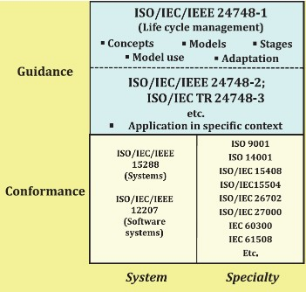
ISO/IEC/IEEE 15288 focuses on the processes that are applied within a life cycle. The processes can be used by acquirer organisations, suppliers (OEMs, system integrators, service providers) and management to fulfil their responsibilities pertaining to the system of interest. Processes are performed as required to achieve stated objectives within a lifecycle stage.
Organisations, when considering a new project, should select a life cycle model and the necessary life cycle processes to satisfy applicable life cycle stage entry or exit criteria. Decisions as to which processes to select should be based on cost-benefit or risk reduction.
ISO/IEC/IEEE 15288:2015 provides a specific example of four groups of system life cycle processes: Agreement, Organisational Project-enabling, Technical Management and Technical. The same is depicted in Figure 2-4, along with sub clause numbers of ISO/IEC/IEEE 15288:2015 in which the specific purpose, expected outcomes, activities and tasks of the processes are described.
Organisational Project-Enabling processes provide enabling resources and infrastructure that are used to create, support, and monitor projects and to assess project effectiveness. Technical Management processes provide requirements so that adequate planning, assessment, and control activities are performed to manage processes and life cycle stages. The role of these two groups of processes is to achieve the project goals within applicable life cycle stages to satisfy an agreement. The Technical Processes are used to perform life cycle related work related to engineering of systems.
Projects may need to establish relationships with other projects within the organisation, as well as those in other organisations. Such relationships are established through the Agreement processes of acquisition and supply. The degree of formality of the agreement is adapted to the internal or external business relationships between projects.
Architectural Description
One of the major challenges of large projects with multiple stakeholders is the documentation to help various stakeholders understand the characteristics, features and design of the system, and to establish a common reference among parties involved in the deployment, operation, maintenance and support of the system. The ISO/IEC/IEEE 42010:20221 Architecture Description (AD) international standard helps organisations to express and document architecture descriptions of large and complex systems in a standardised manner.
Every complex system has multiple stakeholders across the federated digital ecosystem. Expressing a system’s architecture using AD will help all the stakeholders to understand its evolution, composition, behaviour and maintainability. The AD methodology is useful to specify requirements of various entities, including software, systems, enterprises, systems of systems, families of systems, products (goods or services), product lines, service lines, technologies and business domains. The Architectural Description conceptual foundations2 are summarised below.
AD Concepts
A system is situated in an environment. The environment of a system may contain other systems. The system’s environment is bounded by and understood through the identification and analysis of the system’s stakeholders and their concerns. The environment determines the totality of influences upon the system throughout its life cycle, including its interactions with that environment.
Stakeholders have interests in a system, which are expressed as concerns. Concerns arise throughout the life cycle from system needs and requirements, from design choices and from implementation and operating considerations. A concern could manifest in many forms, such as in relation to one or more stakeholder needs, goals, expectations, responsibilities, requirements, design constraints, assumptions, dependencies, quality attributes, architecture decisions, risks or other issues pertaining to the system.
Architecture of a system constitutes what is essential about the system in relation to its environment (in an abstract form). The term system-of-interest is also used to refer to the system whose architecture is under consideration in the preparation of an AD.
Architecture descriptions (AD) are used to express architectures for systems of interest (in a documented form). They include one or more Architecture Views that address the concerns of stakeholders. AD may include information not part of any architecture view. Examples include system overview, architecture rationale etc.
An Architecture Viewpoint frames one or more concerns and a concern can be framed by more than one viewpoint. Examples of viewpoints are i) business/ mission viewpoint, ii) deployment viewpoint.
Each Architecture Viewpoint has exactly one Architecture View that expresses the architecture of the system of interest in accordance with the Architecture Viewpoint and addresses the concerns framed by the governing viewpoint. Thus, a viewpoint is a way of looking at systems and a view is a result of applying a viewpoint. Examples of views are i) business/ mission view, ii) deployment view, iii) operations view.
Architecture View is composed of one or more Architecture Models. Each architectural model is developed using the conventions and methods established by its associated viewpoint. An architectural model may participate in more than one view. Consistency between the views is maintained using correspondence rules.
Architecture decisions pertain to system concerns. Architecture rationale records explanations, justifications and reasoning about architectural decisions. The rationale for a decision may include the basis for the decision, alternatives and trade-offs considered, and potential consequences of the decision.
Execution views consist of a set of models that describe and document what a software system does at runtime and how it does it. The term runtime refers to the actual time that the software system is functioning during testing or in the field.
Architecting
Architecting is an activity that is performed throughout the system lifecycle within the context of a project and/ or organisation. An architecture description is a work product resulting from the execution of architecting activities within the lifecycle of the system of interest. Annexure C of ISO/IEC/IEEE 42010 demonstrates the use of architecting in the context of system and software lifecycle processes defined by ISO/IEC 15288 and ISO/IEC 12207 respectively.
Uses of Architectural Descriptions
Some of the uses of architecture description methodology by various stakeholders throughout the system life cycle are given below:
as basis for system design and development activities
as basis to analyse and evaluate alternative implementations of an architecture
as development and maintenance documentation
documenting essential aspects of a system, such as:
intended use and environment
principles, assumptions and constraints to guide future change
points of flexibility or limitations of the system with respect to future changes
architecture decisions, their rationales and implications
as input to automated tools for simulation, system generation and analysis
specifying a group of systems sharing common features
communicating among parties involved in the development, production, deployment, operation and maintenance of a system
as basis for preparation of acquisition documents (such as requests for proposal and statements of work)
communicating among clients, acquirers, suppliers and developers as a part of contract negotiations
documenting the characteristics, features and design of a system for potential clients, acquirers, owners, operators and integrators
planning for transition from a legacy architecture to a new architecture
as guide to operational and infrastructure support and configuration management
as support to system planning, scheduling and budgeting activities
establishing criteria for certifying implementations for compliance with an architecture
as compliance mechanism to external and project and/or organization-internal policies
as basis for review, analysis, and evaluation of the system across its life cycle
as basis to analyse and evaluate alternative architectures
sharing lessons learned and reusing architectural knowledge through viewpoints, patterns and styles
training and education of stakeholders and other parties on best practices in architecting and system evolution.
Example of Application of AD Concepts
Application of the Architectural Description concepts to a sample project is given below. Only a subset of the concepts and requirements from the standard is used in this document after due adaptation.
A sample project is conceptualised for a ‘National Cyber Defence System’ to enable CSEs and the national nodal agencies to exchange threat related information in near real-time. The NCD System has two parts: one which addressess the requirements of CSEs (Entity NCD System) and the other which addresses the requirements of central agencies (Central NCD System). The major stakeholders of NCD system are:
A. Acquirers/ Users - Critical Sector Entities, Central Agencies.
B. Suppliers & Service Providers - Product OEMs, System Integrators, support, maintenance and other service providers.
C. Development and Support Agencies - Custom application development and support organisations.
D. Program/ Project Owner
The NCD System stakeholder concerns are addressed using the Architecture Description approach to
help the stakeholders understand the characteristics, features and design of the system.
establish a common reference among parties involved in the deployment, operation and maintenance of the system.
Stakeholder Concerns
The major concerns of stakeholders of NCD System (system-of-interest) are identified and listed below:
A. Critical Sector Entities and Central Agencies
1. Business/ Mission Objectives
What purpose does the NCD System achieve towards the business/ mission objectives of the organisation?
What is the business architecture of the NCD System?
Do the capabilities of the NCD System align with the organisation’s business/ mission requirements? What are the challenges, risks and impact?
What alternative solutions equivalent to the NCD System are available in the market?
What is the investment required for prototype evaluation and production system?
2. Technology Implementation, Integration, Transition
What is the technical architecture of the NCD System? Is it appropriate to the business/ mission purpose, scope and constraints?
What are the deployment models of the NCD System?
What are the components (BoM) of the NCD System?
What are the infrastructure requirements and their sizing for implementation of the NCD System? How will they be sourced?
What are the integration requirements of the NCD System?
What teams and skill sets are required for implementation and integration activities? Are they available in-house or should the work be given to a SI?
What security aspects for protection of the NCD System should be considered in this phase?
What is the investment budget required for this phase?
3. Technology Operations and Support
How will the NCD System infrastructure’s operational status, performance and security be monitored during the operating phase?
What teams and skill sets are required for IT and Information Security operation activities of the NCD System? Are they available in-house or should the work be given to a service provider?
What is the product lifecycle support for the NCD System?
What is the investment budget required for this phase?
4. Business/ Mission Operations and Management
How should the NCD System capabilities be exploited during the operating phase?
How should the NCD System be configured for use by teams and groups based on their roles and responsibilities?
How will the NCD System business/ mission functions, performance and security be monitored during the operating phase?
What skill sets are required for carrying out business/ mission functions using the NCD System? Are they available in-house or should the work be given to a service provider?
How will the teams be trained to use the NCD System?
B. Suppliers and Service Providers
What products and services can be provided to critical sector entities and central agencies?
What open source software products and solutions are being used in the NCD System? How should their product lifecycle and security be handled?
What components of the NCD System can be sourced from Indian companies?
What are the integration requirements of the NCD System?
What skill sets are required of the teams providing services?
C. Development & Support Agencies
What is the scope of NCD software lifecycle support?
How should the software and AI/ML enhancement activities be handled and managed?
What are the teams and skill sets required?
What is the funding required and its management?
D. Program/ Project Owner
How should the NCD software lifecycle be implemented through two separate agencies, one for software design and development and the other for software sustenance support?
The artefacts of NCD software (architecture, design, code, documentation, test cases, reports, user documentation etc) will be stored by the development agency in various project repositories. How will these artefacts be handed over to a different software support agency for its maintenance?
How should the software and AI/ML enhancement activities be handled and managed?
What teams and skill sets are required during the lifecycle of the NCD Program?
What is the NCD Program funding requirement and its management?
Architectural Views
The following architectural views are envisaged to be documented:
Purpose View
Business purpose, capabilities and functions delivered by the NCD System. It captures the Cyber Defence Ecosystem (CDE) constituents and the expectations from the NCD System from the perspectives of critical sector entities and the central agencies.
The Purpose View represents a Concept of Operations (ConOps) perspective that gives the broad vision and objectives of the System (what and why) to the larger group of stakeholders.
Functional View
The functional or logical view is concerned with the functionality that the NCD System provides to acquirers and the end-users. It captures the functional (logical) and process views of the NCD System from the perspectives of critical sector entities and the central agencies.
The Functional View represents an Operational Concepts (OpsCon) perspective that gives a more detailed insight into the operation of the System (who and how), specifically to engineers and designers.
Mission Operations View (Use Cases)
The Mission operations view depicts the system from the Business User/ End User point of view. It captures the Mission Operations view of the NCD System from the perspectives of critical sector entities and the central agencies.
This view can be further utilised to develop use cases and scenarios to describe the outcomes expected from the NCD system, which will serve as a starting point for the acquirers to define NCD System user acceptance test cases.
Development View
The development view illustrates a system from a developer’s perspective.
Deployment View
The deployment or physical view depicts the system from a system engineer’s point of view. It is concerned with the topology of physical hardware, software and security components and the physical connections between these components. It captures the deployment (physical and structural) views of the NCD System from the perspectives of critical sector entities and the central agencies.
IT Operations View
The IT operations view depicts the system from an IT and Security Operations team point of view. It captures the IT and Security Operations view of the NCD System from the perspectives of critical sector entities and the central agencies.
Supply Chain View
This view depicts the system from the Suppliers and Service Providers point of view.
Program Management View
This view depicts the NCD system from the program management point of view.
Mapping of Stakeholder Concerns to Architecture Viewpoints and Views
In the table below, the stakeholder concerns are mapped to specific architecture viewpoints and views. The table also includes a mapping of the architecture views to ISO/IEC/IEEE 15288 system engineering lifecycle processes and NIST SP800-160 Vol 1 system security engineering lifecycle processes.
| # | Stakeholders and their Concerns | ACD System Architectural Viewpoint & View | ISO/IEC/IEEE 15288, Other Processes |
|---|---|---|---|
| A. | Critical Sector Entities and Central Agencies | ||
| 1 | Business/ Mission Objectives | ||
| a) | What purpose does the NCD System achieve towards the business/ mission objectives of the organisation? | Purpose View | SN-1, SN-2 |
| b) | What is the business architecture of the NCD System? | Functional View | BA-2, BA-3 |
| c) | Do the capabilities of the NCD System align with the organisation’s business/ mission requirements? What are the challenges, risks and impact? | Functional View | SR-1, SR-2 |
| d) | What alternative solutions equivalent to the NCD System are available in the market? | ||
| e) | What is the investment required for prototype evaluation and production system? | ||
| 2 | Technology Implementation, Integration, Transition | ||
| a) | What is the technical architecture of the NCD System? Is it appropriate to the business/ mission purpose, scope and constraints? | Deployment View | AR-1, AR-2, AR-3 |
| b) | What are the deployment models of the NCD System? | Deployment View | DE |
| c) | What are the components (BoM) of the NCD System? | Deployment View | DE |
| d) | What are the infrastructure requirements and their sizing for implementation of the NCD System? How will they be sourced? | Deployment View | IP |
| e) | What are the integration requirements of the NCD System? | Deployment View | IN |
| f) | What security aspects for protection of the NCD System should be considered in this phase? | Deployment View | NIST SP800-160 Vol 1 |
| g) | What teams and skill sets are required for implementation and integration activities? Are they available in-house or should the work be given to a SI? | ||
| h) | What is the investment budget required for this phase? | ||
| 3 | Technology Operations and Support | ||
| a) | How will the NCD System infrastructure’s operational status, performance and security be monitored during the operating phase? | IT Operations View | OP, Site Reliability Engineering |
| b) | What teams and skill sets are required for IT and Information Security operation activities of the NCD System? Are they available in-house or should the work be given to a service provider? | ||
| c) | What is the product lifecycle support for the NCD System? | IT Operations View | MA, DS, |
| d) | What is the investment budget required for this phase? | ||
| 4 | Business/ Mission Operations and Management | ||
| a) | How should the NCD System capabilities be exploited during the operating phase? | Mission Operations View | |
| b) | How should the NCD System be configured for use by teams and groups based on their roles and responsibilities? | Mission Operations View | |
| c) | How will the NCD System business/ mission functions, performance and security be monitored during the operating phase? | Mission Operations View | |
| d) | What skill sets are required for carrying out business/ mission functions using the NCD System? Are they available in-house or should the work be given to a service provider? | Mission Operations View | |
| e) | How will the teams be trained to use the NCD System? | Mission Operations View | |
| B. | Suppliers and Service Providers | ||
| a) | What products and services can be provided to critical sector entities and central agencies? | Supply Chain View | |
| b) | What open source software products and solutions are being used in the NCD System? How should their product lifecycle and security be handled? | Supply Chain View | |
| c) | What components of the NCD System can be sourced from Indian companies? | Supply Chain View | |
| d) | What are the integration requirements of the NCD System? | Supply Chain View | |
| e) | What skill sets are required of the teams providing services? | ||
| C. | Development & Support Agencies | ||
| a) | What is the scope of NCD software lifecycle support? | Development View | |
| b) | How should the software and AI/ML enhancement activities be handled and managed? | Development View | |
| c) | What are the teams and skill sets required? | ||
| d) | What is the funding required and its management? | ||
| D. | Program/ Project Owner | ||
| a) | How should the NCD software lifecycle support be implemented through two separate agencies, one for software design and development and the other for software sustenance support? | Program Management View | |
| b) | The artefacts of NCD software (architecture, design, code, documentation, test cases, reports, user documentation etc) will be stored by the development agency in various project repositories. How will these artefacts be handed over to a different software support agency for its maintenance? | Program Management View | |
| c) | How should the software and AI/ML enhancement development and AI/ML research work enhancement activities be handled and managed? | Program Management View | |
| d) | What teams and skill sets are required during the lifecycle of the NCD Program? | ||
| e) | What is the NCD Program funding requirement and its management? | Program Management View |
Systems Security Engineering Framework
NIST SP 800-160 Vol 1
Systems engineering provides a foundation for a disciplined and structured approach to building assured, trustworthy secure systems. Systems security engineering is a subdiscipline of systems engineering that addresses security-relevant considerations intended to produce secure outcomes.
In recent years there is a clear recognition that “Systems security engineering must be fundamental to systems engineering. Security fundamentals must be clearly understood by stakeholders and effectively evaluated in a way that considers broad goals with security functions and outcomes.”1
NIST SP 800-160 Vol 1r1 (Nov 2022) recognises that “building trustworthy, secure systems cannot occur in a vacuum with stovepipes for software, hardware, information technology, and the human element (e.g., designers, operators, users, attackers of these systems). Rather, it requires a transdisciplinary approach to protection, a determination across all assets where loss could occur, and an understanding of adversity, including how adversaries attack and compromise systems. It addresses security issues from the perspective of stakeholder requirements and protection needs and the use of established engineering processes to ensure that such requirements and needs are addressed with appropriate fidelity and rigor across the entire life cycle of the system.”
This publication describes the security design principles, concepts, and techniques that are part of a trustworthy secure design approach. These can be applied in the development of new capabilities or systems, modification of existing capabilities or systems, and development of system of systems. It is intended to be used by:
Systems engineers, security engineers, and other engineering professionals.
Professionals and teams, who perform other system life cycle activities or tasks, such as those listed below
Security governance, risk management, and oversight
Security verification, validation, testing, evaluation, auditing, assessment, inspection, and monitoring
Acquisition, budgeting, and project management
Operations, maintenance, sustainment, logistics, and support
Providers of technology-related products, systems, or services
The core objective of the publication is to be engineering-based, not operations- or technology-based. Organisations can adapt the concepts and principles for trustworthy secure design, the systems life cycle processes and security-relevant activities and tasks described in the publication to achieve consistent security outcomes in the capabilities delivered by their systems.
System Security Viewpoints
The publication defines three predominant viewpoints of system security, viz i) system function, ii) security function, and iii) life cycle assets.
System function is the system’s purpose or role as fulfilled by the totality of the capability it delivers combined with its intended use. Every system is required to satisfy all the stakeholder capability needs.
Security function is the system’s fulfilment of the stakeholder’s protection capability needs.
Life cycle assets are associated with the system but are not engineered into or delivered with the system. Life cycle assets typically include intellectual property, data and information associated with the system, and supporting assets for development, production and sustenance of the system. The association of lifecycle assets with the system means that they can be the direct cause of loss or a conduit/means through which a loss can occur.
The system function is the predominant viewpoint and establishes the context for the security function and the associated system life cycle assets.
Systems Security Engineering Framework
The systems security engineering framework provides a conceptual view of the key contexts within which systems security engineering activities are conducted. It defines three contexts for conducting activities and tasks:
The problem context to help ensure that the engineering is driven by a sufficiently complete understanding of the problem.
The solution context to drive the effort to provide the solution, supported by a set of activities to design and realize the solution.
The trustworthiness context is a decision-making context that provides an evidence-based demonstration – through reasoning – that the system of interest is deemed trustworthy (or not) based on a set of claims derived from security objectives.
NIST SP 800-160 Vol 2
Cyber resiliency for systems that include or depend on cyber resources is a part of operational resilience but needs specific guidance due to its distinctive characteristics. The publication provides guidance on how to apply cyber resiliency concepts, constructs, and engineering practices to systems security engineering and risk management. It is to be used by systems security engineering and other professionals, who are responsible for activities and tasks related to system life cycle and risk management processes within and external to the organisation.
While much of the cyber resiliency analysis in the publication uses the MITRE Adversarial Tactics, Techniques, and Common Knowledge (ATT&CK™) framework, organisations are not constrained to use only the MITRE ATT&CK framework but can use other frameworks too.
Useful concepts from the publication are described below. Readers are advised to consult the publication for detailed information and guidance on cyber resiliency.
Cyber-resilient systems are systems that have security measures or safeguards “built in” as a foundational part of the architecture and design and that display a high level of resiliency to withstand cyber-attacks, faults, and failures and continue to operate in a degraded or debilitated state to carry out the mission-essential functions of the organisation.
Cyber resiliency engineering practices are the methods, processes, modelling, and analytical techniques used to identify and analyse proposed solutions. These practices are applied in system life cycle processes so that the resultant cyber resiliency solutions are aligned with the stakeholder requirements and protection needs.
Cyber resiliency engineering framework provides constructs that include cyber resiliency goals, objectives, techniques, implementation approaches, and design principles. While these constructs are applied at the system level in the publication, they can also be applied beyond the system level to mission and business function level, organisational level and sector level. The framework is based on Cyber Resiliency Engineering Framework developed by the MITRE Corporation2,3.
Cyber resiliency goals and objectives provide a vocabulary for describing what properties and capabilities are needed. Cyber resiliency techniques, approaches, and design principles provide a vocabulary for discussing how a system can achieve its cyber resiliency goals and objectives.
Four cyber resiliency goals, namely Anticipate, Withstand, Recover and Adapt, eight cyber resiliency objectives and 14 cyber resiliency techniques are part of the cyber resiliency engineering framework.
Cyber resiliency solutions are relevant only if they have some effect on risk. Hence their primary focus is to reduce the risk by reducing the three core factors
- the likelihood of occurrence of threat events,
- the ability of threat events to cause harm, i.e., the likelihood of impact,
- the extent of harm from threat events, i.e., the level of impact.
The publication describes three models, namely the risk model, threat model and consequence (impact) model for cyber resiliency. It further identifies controls from NIST SP 800-53, Rev. 5 that directly support cyber resiliency. The principle applied for associating controls with cyber resiliency is that “cyber resiliency is about ensuring continued mission operations despite the fact that an adversary has established a foothold in the organisation’s systems and cyber infrastructure”. It also provides guidance on adversary-oriented analysis for achieving cyber resiliency, specifically the perspective of protecting systems against adversarial threats using MITRE ATT&CK™ for Enterprise4 and ATT&CK™ for Industrial Control Systems (ICS)5 frameworks. Supporting perspectives are separately available as MITRE Defend6 and MITRE Engage7 frameworks.
Security in the Future of Systems Engineering (FuSE), a Roadmap of Foundational Concepts, INCOSE International Symposium, July 2021. ↩︎
https://www.mitre.org/news-insights/publication/cyber-resiliency-engineering-framework ↩︎
https://www.mitre.org/news-insights/publication/cyber-resiliency-engineering-aid-updated-cyber-resiliency-engineering ↩︎
Formats and Protocols
This compendium of IT and Information Security formats and protocols is summarised from the original sources for information only. Readers must consult the authoritative sources for the actual guidelines.
Open automation formats and protocols are essential tools that facilitate interoperability and integration among various systems, devices, and software applications. Designed to enable standardised communication, these formats and protocols provide a common language for systems in industries such as cyber security, telecommunications, and IT, allowing for seamless automation processes across diverse platforms. Some of these relevant for cyber security are referred in subsequent paras with purpose and usage.
STIX
Overview: To share CTI, it is imperative that the underlying platform converts the data into a form that is ready for being sent through the network. To that end a process is required to convert the data-object (a combination of code and data) in a form so that the state of the object is saved in a transmittable format. This is known as Serialization . Once the data is received at the destination in a Serialized form, it is Deserialized before further processing. STIX stands for Structured Threat Information Expression. It is an open source, XML based “language and serialization format used to exchange” CTI. STIX is a standardized language for representing and sharing cyber threat intelligence (CTI) in a consistent, machine-readable format. Developed by MITRE and now managed by OASIS, STIX enables organisations to share detailed threat information, including attack patterns, tactics, techniques, and procedures (TTPs), indicators of compromise (IOCs), and threat actor profiles. The structured nature of STIX allows cybersecurity tools to process threat data automatically, enhancing detection, analysis, and response capabilities across systems
Purpose: Leveraging STIX, organisations can collaborate effectively while exchanging CTI because of the consistency and machine readability that STIX provides. Consequently, security communities benefit as anticipation to attacks improve and agility in response mechanisms is enhanced. Further, its design is such that it augments capabilities, such as “collaborative threat analysis, automated threat exchange, automated detection and response” .
Usage: STIX at its core architectural layer contains “observables” that it refers to as “stateful properties or measurable events”, pertaining to the “operation of computers and networks”. For example, it could be stopping a service, reboot of a system or establishing a connection. Storage of these “observables” is done in XML using “CybOX language, another MITRE project”. Further, as a part of the framework, these “observables can be linked to indicators, incidents, TTPs, specific threat actors, adversary campaigns, specific targets, data markings, and courses of action” - that it evolves into a “complete threat intelligence management system”.
TAXII
Overview: TAXII stands for Trusted Automated Exchange of Intelligence Information. It is an “application protocol for exchanging CTI over HTTPS, defining “a RESTful API (a set of services and message exchanges) and a set of requirements for TAXII Clients and Servers” . An API, or an Application Programming Interface plays the role of a mediator between the Client and the Web Service. The advantage here is that information sharing is done “maintaining security, control, and authentication—determining who gets access to what”. A RESTful (or REST - representational state transfer) API “conforms to the constraints of REST architectural style and allows for interaction with RESTful web services”. For an API to be a RESTful API, it needs to comply with certain criteria like “Client-server architecture”, with HTTP based requests, “Stateless Client-Server communication”, “Cacheable data” etc.
Purpose: It enables sharing CTI “across product, service and organisational boundaries” and acts as a “transport vehicle for STIX structured threat information”.
Usage: The two primary services TAXII provides are: (a) Collection and (b) Channel. The TAXII server has a repository of CTI objects that it allows its Users to host, which can be accessed by consumers. Collection is an interface to this repository. A Channel can be viewed as a many to many interface - that allows a producer to push data to many consumers and a consumer to receive data from many producers.
Traffic Light Protocol (TLP)
Information Sharing
The critical success factors for cyber resilience and sustenance of a digital ecosystem are: a) The speed and quality of detection of compromise and cyber-attacks within the entities. b) The rapidity by which information and guidance is disseminated to all the actual and potential targets. c) The speed and effectiveness of response within entities as well as across sectors and cross-sectors.
Conventional paper-based and email-based methods of sharing are not capable of achieving the required speed in information sharing amongst all the stakeholders and participants, since they are less amenable for automated processing. Traffic Light Protocol is a standardised mechanism for sharing information. TLP version 2.0 is the current version of TLP standardized by FIRST. The Traffic Light Protocol (TLP) was created to facilitate greater sharing of potentially sensitive information and more effective collaboration. Information sharing happens from an information source, towards one or more recipients. TLP is a set of four labels used to indicate the sharing boundaries to be applied by the recipients.
TLP definitions
Community: Under TLP, a community is a group who share common goals, practices, and informal trust relationships. A community can be as broad as all cybersecurity practitioners in a country (or in a sector or region).
Organisation: Under TLP, an organisation is a group who share a common affiliation by formal membership and are bound by common policies set by the organisation. An organisation can be as broad as all members of an information sharing organisation, but rarely broader.
Clients: Under TLP, clients are those people or entities that receive cybersecurity services from an organisation. Clients are by default included in TLP:AMBER so that the recipients may share information further downstream in order for clients to take action to protect themselves. For teams with national responsibility this definition includes stakeholders and constituents.
TLP Labels
TLP:RED = For the eyes and ears of individual recipients only, no further disclosure. Sources may use TLP:RED when information cannot be effectively acted upon without significant risk for the privacy, reputation, or operations of the organisations involved. Recipients may therefore not share TLP:RED information with anyone else. In the context of a meeting, for example, TLP:RED information is limited to those present at the meeting.
TLP:AMBER = Limited disclosure, recipients can only spread this on a need-to-know basis within their organisation and its clients. Note that TLP:AMBER+STRICT restricts sharing to the organisation only. Sources may use TLP:AMBER when information requires support to be effectively acted upon, yet carries risk to privacy, reputation, or operations if shared outside of the organisations involved. Recipients may share TLP:AMBER information with members of their own organisation and its clients, but only on a need-to-know basis to protect their organisation and its clients and prevent further harm. Note: if the source wants to restrict sharing to the organisation only, they must specify TLP:AMBER+STRICT.
TLP:GREEN = Limited disclosure, recipients can spread this within their community. Sources may use TLP:GREEN when information is useful to increase awareness within their wider community. Recipients may share TLP:GREEN information with peers and partner organisations within their community, but not via publicly accessible channels. TLP:GREEN information may not be shared outside of the community. Note: when “community” is not defined, assume the cybersecurity/defence community.
TLP:CLEAR = Recipients can spread this to the world, there is no limit on disclosure. Sources may use TLP:CLEAR when information carries minimal or no foreseeable risk of misuse, in accordance with applicable rules and procedures for public release. Subject to standard copyright rules, TLP:CLEAR information may be shared without restriction.
OSCAL
Overview: In the context of NIST, an ATO or an Authorization (to operate) is defined as “The official management decision given by a senior organisational official to authorize operation of an information system and to explicitly accept the risk to organisational operations (including mission, functions, image, or reputation), organisational assets, individuals, other organisations, and the Nation based on the implementation of an agreed-upon set of security controls” . In essence there has to be a formal declaration by a designated authority that authorises operation of an IT product, which includes all the caveats around Risk. Apart from the inherent complexity in handling cyber threats, addressing ATO requirements coupled with the extensive manual processes in handling Risk Management increases the challenges of an Entity’s Information Security Team. The four key challenges in this regard stated by NIST are: - (a) Complexity of Information Technology (b) Omnipresent Vulnerabilities (c) Burdensome nature of Regulatory Frameworks (d) Esoteric nature of Risk Management (e) Accelerated rate of obsolescence of Documentation .
Purpose: The open source, Open Security Controls Assessment Language - or OSCAL, was developed by NIST in collaboration with industry to address the concerns around this space. To overcome the challenges around usage of word processing and spread sheet utilities to handle RMF requirements, improved automation was an imperative. There was a need, therefore, to evolve “a shared language for authorization systems to communicate”.
Usage: OSCAL uses XML, JSON, and YAML formats, providing “machine-readable representations of control catalogs, control baselines, system security plans, and assessment plans and results”. The advantages of OSCAL formats as stated by NIST are: - “Easily access control information from security and privacy control catalogs, Establish and share machine-readable control baselines, Maintain and share actionable, up-to-date information about how controls are implemented in your systems, Automate the monitoring and assessment of your system control implementation effectiveness” .
OpenSCAP
Overview: In any enterprise, the IT systems deployed need to be constantly monitored for vulnerabilities so that remediation measures in terms of configuration changes, patch updates and / or application of upgrades are done in a timely manner. This minimizes risk exposure of the assets within, and the enterprise is better guarded against security threats. The Security Content Automation Protocol - SCAP, is a collection of “number of open standards that are widely used to enumerate software flaws and configuration issues related to security”. In order to associate a metric or measure the possible impact due to the vulnerabilities within the system, applications written for security monitoring leverage these standards. Thus the “SCAP suite of specifications standardize the nomenclature and formats”, that is leveraged by these vulnerability management tools.
Purpose: OpenSCAP is an auditing tool that utilizes security check-list content in a defined format called the Extensible Configuration Checklist Description Format (XCCDF). Combing with other specifications it creates a SCAP-expressed checklist that can be processed by SCAP-validated products.
Audience: IT / IT Security Administrators, Auditors
Usage: The OpenSCAP stack consists of different products that can help with “assessment, measurement, and enforcement of security baselines”, maintaining “flexibility and interoperability” and “reducing the costs of performing security audits” . A few of the Tools in the stack include: - (a) OpenSCAP Base: A Command line tool for performing configuration & vulnerability scanning (b) OpenSCAP Daemon: Evaluating Infrastructure’s compliance to SCAP Policy (c) SCAP Workbench: Helps create a custom security profile and facilitates remote scanning.
Open Command & Control (OpenC2)
Overview: Attackers are in a position to conduct and coordinate various stages of an attack with remarkable sophistication and speed. If Defenders are to sustain their operations, they need to respond with equal alacrity; plan and conduct defense operations in a timeframe that matches the adversary so as to ensure that the latter fails to attain their objectives. But the penetrability of an attack surface is determined by a range of factors that include “complexity, functionality, connectivity” etc. Further, most enterprises do not have an integrated cyber defense implementation; the systems operate in siloes and generally have static configurations. This results in very inefficient cybersecurity operations. Such an environment, by default creates a lag in incident-response-remediation, which gives an adversary “asymmetric time advantage”, to ensure the success of their attack. In a large enterprise there would be number of heterogenous platforms, technologies, devices, and systems. Effective incident response, getting into the root cause, assessing remediation measures, and mitigating them etc. become complex. In such a context, few challenges of integrating the various components of cyber defense include: - (a) Prohibitive costs (b) Tailored Communication Interfaces” (c) Extent of tight-coupling and cohesiveness of the chosen products for integration (d) Need for a middleware etc. As a consequence, scaling of such a solution would depend on ability to get suitable interfaces written or easily available APIs for the different products in use. Paradoxically though, while OEM diversity of solutions do provide an additional layer of security - as attack on one system does not guarantee attack on another, achieving cyber defense integration becomes complex and prohibitive in terms of costs. From an attack perspective, when an attacker penetrates a system and installs a malware which is leveraged to send remote commands from a C2 (Command & Control) Server to infected devices, it is termed a C2 attack. In other words, “command and control infrastructure” is used by attackers to issue “command and control instructions” to their victims. From a cyber-defense viewpoint, an assessment of the C2 approach and methods that an attacker uses could be leveraged to identify and associate attackers and attacks, and disrupt malicious activity that are ongoing.
Purpose: The limitations in integrating cyber defense solutions, stated earlier was the trigger for development of Open Command and Control (OpenC2) . It “is a suite of specifications that enable command and control of cyber defense systems and components” - facilitating “machine to machine communication”, through a “common language”. More important, it does it at very high speeds and in such a way “that is agnostic of the overall underlying technologies utilized”. But for this standard, every new device would need manual configuration or individual commands sent in real time, which apart from increasing the lag in incident response times, would also have human intervention, making it error prone.
Software Bill of Materials (SBOM)
Overview: The entire source code of a software is referred to as its codebase. It is a common practice for developers to integrate with their code, third party components that are licensed and either commercially available or are open source. A SBOM or software Bill of Materials is an inventory of all the “open source and third-party components” that are present, providing details of their versions and status of the patches within the codebase of a software application / product. Information security teams can use this information to assess security & license related risks. Akin to the Manufacturing industry’s Bill of Material (from where SBOM has been derived) where the codification schemes of the parts provided by OEM and Suppliers are distinct, based on which a successful trace to the correct supplier happens when a part goes defective; here too a trail to the accurate third party is established by virtue of the SBOM. There are four stages of an SBOM life cycle. They are: (a) Produce SBOM - Collating the information required for an SBOM at each stage of the software lifecycle from existing tools and solutions. Such solutions normally include: - “intellectual property review”, “license management workflow tools”, “version control systems” etc. (b) Deliver - In the case of opensource tools, the SBOM information can be held as metadata, while for compiled versions the SBOM and the software product are bundled together. (c) Update - If the software is updated in any manner, then any changes in SBOM too needs to be recorded. (d) Consume - In order to utilise SBOM, the SBOM data should be in a machine readable format. However, the decision on choosing the appropriate format that should be adopted for SBOM needs to be taken. The three standard and common formats in use are CycloneDX, SWID and SPDX.
CycloneDX
Purpose: “OWASP CycloneDX is a lightweight” SBOM specification “designed for use in application security contexts and supply chain component analysis”, created in 2017 . The intent was to create a “fully automatable, security-focused SBOM standard”. Existing specifications like Package URL, CPE, SWID etc., have been incorporated into CycloneDX. Each such SBOM can have (a) Bill of Material Metadata (supplier, manufacturer, firmware etc. that it describes), (b) Components - detailed inventory of the software components, which includes type, identity, license etc. (c) Services - description of external APIs, that the utility may invoke (d) Dependencies - interrelationship between components (e) Compositions - that describes the ‘completeness’ of the SBOM. (f) Extensions - For building rapid prototyping of enhancements.
Usage: Software Inventory description, Analysis, Analysis of vulnerabilities and their mitigation, Supply Chain (Software) risk assessments, Compliance of License requirements, Traceability of updates and modifications, Integrity checks of signed components etc.
SWID
Purpose: To enhance transparency in monitoring Software installed within the enterprise, Software Identification (SWID) tags were conceptualised and defined originally by ISO (2012) and later updated as ISO/IEC standard (2015). Description of a specific software release is held in the SWID Tag files. The standard further “defines a lifecycle where a SWID Tag is added to an endpoint as part of the software product’s installation process and deleted by the product’s uninstall process”. In order to capture the lifecycle of a software component, the SWID specification defines following types of Tags: (a) Primary Tag (b) Patch Tag (c) Corpus Tag and (d) Supplemental Tag. SWID Tag that identifies and describes: - (a) a software product installed on a computing device is called a Patch Tag (b) a patch that was installed for making a change of the software installed on the device is referred to as a Patch Tag (c) the pre-installation state of a software product is called a Corpus tag and finally a SWID Tag that permits “additional information to be associated with any referenced SWID tag” is referred to as a Supplemental tag.
Usage: Few use cases are: (a) It can be used as Software Bill of Material for the software products and applications installed (b) Inventory of installed software can be regularly monitored (c) Software vulnerability identification at end points can be carried out (d) Ensures proper patch management (e) Detects unauthorized or corrupt software prior to their installation and prevents their installation.
SPDX
Purpose: SPDX or Software Package Data Exchange , is an ISO /IEC standard. It is used for communicating software bill of material information that includes components, licenses, copyright and security information. It is an evolving “set of data exchange standards” that would assist enterprises with their software supply chain ecosystem by allowing each of them “to share human-readable and machine-processable software metadata” with one another. Like in the case of SWID, stated earlier, work here too began because of limitations that existed in the earlier days of sharing opensource components, resulting in duplication of efforts. Also, collaboration was difficult then. SPDX project created “a common metadata exchange format” which allowed details about software packages and associated content to be collected, shared and made effective automation of the related tasks, feasible. The file formats used here include JSON, XML and YAML. A valid SPDX document has a defined structure with defined sections as stated in the SPDX specification. The section that is mandatory is the “Creation Information’ (version numbers, license of data etc.) - primarily provided for forward and backward compatibility of the tools. The others include “Package Information”, “File Information”, “Snippet Information” and “Other Licensing Information.
Usage: Description of software components and their interrelationships; Tracking licensing, copyright information related to IP; Tracking executables to the source files etc.
OpenIOC
Overview: Like in the case of collating evidence, analyzing them and then weaving it together to reconstruct a crime scene, a cybersecurity analyst too as a part of her function tries to gather data around different events related to new and emerging threats. The nature of this data could be “metadata elements or much more complex malicious code and content samples that require advanced reverse engineering”. The final output of this action is what is generally referred to as IOC or Indicators of compromise. In other words, IOC can be defined as “a forensic artifact or remnant of an intrusion that can be identified on a host or network”.
Purpose: OpenIOC is an XML based open framework used for sharing CTI.
Usage: The format used is machine-readable and assists sharing threats related to the latest IOCs, with other enterprises, helping achieve real-time protection. OpenIoc provides a pre-defined set of indicators as a part of the framework. The extensible nature of the base schema allows add on indicators from different sources. The IOC use cases include: (a) Finding Malware - Used to find known malware (b) Methodology - These IOCs help find suspicious utilities that are unknown. For instance, writing an IOC for a specific condition of an unsigned dll that was loaded from a folder that did not have “windows32system” in its path (c) Bulk - Used for exact matches (d) Investigative - Tracking information like, metadata related to “installation of backdoors”, “execution of tools” etc. in an IOC and using that to prioritise the systems that would be taken up to be analysed.
OpenEDR
Overview: Endpoint detection and response or EDR is a technology that focuses on endpoints and network related events. The agent on the host system helps log the information generated and stores it in a database. This repository is what is leveraged for event monitoring and generating reports. Different EDR solutions package their functions and features differently. Some focus more at the agent level, some have different way of handling schedules for collection and analysis, some others carry out integration tasks with a difference. Functions of EDR are: (a) Traffic and data monitoring from endpoints and checking for anomalies hinting a breach. (b) Automated responses - Removal of malicious files and alerts to information security teams. (c) Search for threats and their signatures through analytics. The core functions of all tools in this space are the same - “continuous monitoring and analysis” for being proactive to respond to threats.
Purpose: OpenEDR is an EDR tool that is both free and its source code available in public domain. It consists of the following components: - (a) Core Library (b) Service (c) Process Monitoring (d) System Monitor (e) File-System Mini-Filter (f) Network Monitor (g) Low-Level Registry Monitoring Component (h) Self-Protection Provider (i) Low-Level Process Monitoring Component.
Usage: One of OpenEDR’s strengths is to enable a user to affect an accurate RCA. Without a clear understanding of root cause, mitigation measures would prove inadequate. The output from the tool provides “actionable knowledge” which helps speed up response. Further its, “Integrated Security Architecture” helps deliver a “Full Attack Vector Visibility including MITRE Framework”.
OpenDXL
Overview: Proliferation of different technologies from various IT Infra and Security Vendors over time, with different upgrade paths, coupled with several home-grown initiatives – all, connected through an underlying network, has made IT Security Management a complex task. Achieving seamless integration between security products from different Vendors has been a constant challenge. API driven integration comes with major maintenance issues. Integration of products from different Vendors also has administrative overheads that includes external dependencies. For instance, getting a buy in from each of the Vendors, their prioritization, commercial interests etc. An application’s limitations for easily accessing emerging CTI data becomes an impediment for each, to apply the insights on emerging threats, making the environment vulnerability prone. As a result, the cyber resilience posture is affected adversely. The mechanism through which security solutions are connected and integration of disparate security systems are achieved is termed as Orchestration. Since substantial volume of output logs are created by security tools currently, SOCs tend to miss intrusions. Security Orchestration addresses this concern.
Purpose: Open Data Exchange Layer or OpenDXL has been developed with the intent of enabling “security devices to share intelligence and orchestrate security operations in real time”. It facilitates the developer community to establish handshakes between security products and minimize lead times of threat defense, by improving “context of analysis”, shortening “workflows of the threat defense lifecycle” etc. The key goals of OpenDXL can be summarized as follows: (a) Enhance flexibility (b) Make integration easier (c) Accelerate development by providing appropriate toolsets (d) Increase Sec Ops ability in creating “cross-product, cross-vendor security automation” and (e) Ensure that API changes by Vendors do not adversely impact integration.
Usage: Use Cases include: “Deception threat events, File and application reputation changes, Mobile devices and assets discovered, Network and user behavior changes, High-fidelity alerts, Vulnerability and indicator of compromise (IoC) data”.
Infrastructure as Code (IaC)
Overview: Like all disciplines in IT, managing IT Infrastructure has gone through its own evolution process. In the past it was customary for manually addressing all aspects of configuration, whether it was hardware or software over which the applications were required to run on. Costs, scalability, availability were all challenges that the organisations had to surmount. Monitoring performance of IT Infra or pinpointing the problem during troubleshooting continued to be an Achilles heel for the IT Infra team. Due to the human intensive nature of deploying configurations, inconsistencies crept in. Therefore, there was a need to explore the possibility of automating configuration management and thereby managing and provisioning IT Infrastructure through code. In that context, two file formats are defined here: (a) JSON: JSON or JavaScript Object Notation originated as a page scripting language in the Netscape Navigator era, for its web browser. It is a format with a defined set of rules that is “text-based, human-readable”, leveraged for data exchange between “web clients and web servers”, sometimes used as an alternative to XML. (b) YAML: YAML or yet another markup language (referred to also as, ain’t another markup language) - A human readable, easily comprehensible language, used for data and not documents is a “data serialization language” which is regularly leveraged while writing configuration files.
Purpose: Infrastructure as Code or IaC, is defined as “The process of managing and provisioning computer data centers through machine-readable definition files, rather than physical hardware configuration or interactive configuration tools”. In effect it leverages a DevOps approach to deploy IT infrastructure - networks, VMs etc. Akin to a codebase generating identical binary every time, here too the same environment is generated during every deployment. There are two approaches to IaC: (a) Declarative - Where the required state of the system is defined. An environment would need a tailored definition with regards its components and configuration. The definition file describes that. Depending on the kind file formats that the Platform supports - be they JSON, YAML or XML, syntax for describing IaC can be decided. (b) Imperative - “defines the specific commands needed to achieve the desired configuration”.
Usage: Some of the advantages of using IaC are: (a) Reduce Cost (b) Accelerate deployment (c) Less Errors (d) Enhance consistency (e) “Eliminate configuration drift”. More insights can be gleaned from studying Server automation and config management tools like Chef, Puppet, Saltstack etc.
Policy-as-Code
Overview: In a growing tech landscape, it is inevitable not to think of automation when rolling out policies. As proliferation of IT driven solutions take place, protecting the systems from threats is an imperative. For which, rules and procedures are defined as a part of security policy formulation - be it, access control, authorization, network security etc. In essence, a policy is a rule that stipulates the criteria for code deployment against the backdrop of the security control implemented or a set of steps to be executed automatically when there is a particular security event.
Purpose: Policy-as-code is the use of a high-level declarative language to automate managing rules and policies centrally. Leveraging this approach, users write the policies using Python, YAML or Rego - a high-level declarative language “built for expressing policies over complex hierarchical data structures”, depending on the kind of policy-as-code tool that is being used. While IaC benefits the IT operations team where automated provisioning of Infrastructure is involved, policy-as-code focuses on security operations and compliance management. To leverage policy-as-code the user may choose to use a tool like Open Policy Agent or OPA, purpose of which is to provide a common framework while applying policy-as-code to any domain. OPA is a “general-purpose policy engine that enables unified, context-aware policy enforcement across the entire stack”. It allows authoring of policies through Rego. OPA can be leveraged to outsource policy decisions from the relevant service. Eg: Boolean decisions of whether an API call should be allowed, Quota left for a user, the updates to be applied for a particular resource etc.
Usage: The advantages of using policy-as-code are: (a) Enhanced efficiency of enforcement and sharing of policies vis-a-vis the manual route (b) Accelerated operations because of automated policy enforcement (c) Swifter reviewing of policies as there is no requirement for engineers to discuss, they need to only examine the code (d) Improved collaboration within and across teams (e) Accuracy (f) Well defined version controlling of the policies and ability to roll back to the previous version (g) Helps reduce critical errors in production environments.
OMG Requirements Interchange Format (ReqIF)
Overview: Requirements management has been in vogue across different industries for a while. The collaboration requirements in the manufacturing industry – car manufacturing, for instance, uses dedicated authoring tools for their requirement management. Since collaboration requirements are intense, requirements management cross organisational boundaries - and different entities using different authoring tools find it a challenge to work on the same requirements repository. There was a compelling case, therefore, for a “generic, non-proprietary format” for information exchange. Hence, The Requirements Interchange Format or ReqIF was created for enterprises to exchange requirements data, by transferring XML documents that comply to the ReqIF format.
Purpose: Any product development during the initial stages has a requirement gathering phase. This is where ReqIF finds a key use, as multiple entities could be involved. ReqIF facilitates seamless sharing of requirements between agencies, even if each uses a different tool. It is far more efficient than formats like Word, Excel or PDF as it “allows for a loss-free exchange”.
Usage: Few of the advantages of using this format are: Improved collaboration between entities; Obviates the need to use the same authoring tools, Agencies interacting with multiple entities (eg: Suppliers) do not need stack up authoring tools that their respective Customers use.
OASIS CACAO for Cybersecurity
Overview: It is apparent that in order to defend against cybersecurity threats, a structured set of rules need to be defined. A cybersecurity playbook is generally considered to be a comprehensive manual that spells out actions to be taken when there is theft or loss of data. To that end, enterprises need to “identify, create, and document the prevention, mitigation, and remediation steps”, currently in most cases done manually. These steps considered together, constitute a course of action playbook. Like in other areas of the cybersecurity domain, here too lack of a standard mechanism to “document and share these playbooks across organisational boundaries” compounded with inadequate automation, proves to be a challenge.
Purpose: OASIS Collaborative Automated Course of Action Operations (or CACAO) for Cyber Security Technical Committee (TC), tackles this challenge by “defining a sequence of cyber defense actions that can be executed for each type of playbook”.
Usage: This will help entities to: (a) “create course of action playbooks in a structured machine-readable format” (b) “digitally sign course of action playbooks” (c) “securely share course of action playbooks across organisational boundaries and technological solutions” and (d) “document processing instructions for course of action playbooks in a machine-readable format”.
People related Frameworks
This section summarises content from QCI and other frameworks that are related to individual and organisational competencies. Readers must consult the authoritative sources for the actual guidelines.
Subsections of People
Workforce Competencies
The digital ecosystems of modern enterprises are large and complex, usually spread geographically across the country and the world. The ecosystems encompass a large number and variety of technologies, products, platforms, systems, networks, applications, databases and services, which may be deployed on-premises, on cloud (IaaS, PaaS, SaaS) or in hybrid mode.
Enterprises usually have multiple teams of IT, OT, IIoT, information security and cybersecurity professionals and managers, who are responsible to carry out the organisations’ functions, activities and tasks related to the digital ecosystem of the organisation. CSEs and other organisations would derive significant benefits by establishing a strategic program and structured approach to ensure that their workforce and teams managing the digital ecosystem have the requisite cybersecurity competence (knowledge, skills and levels of expertise) to be effective in handling the entire gamut of work and responsibilities of IT, OT, IIoT, information security and cybersecurity.
Workforce Composition
Given the size and complexity of digital ecosystem, it may be impractical for most CSEs and other organisations to depend solely upon their internal workforce to acquire, implement, engineer, operate, manage and sustain the ecosystem. In practice, the organisations have a composite workforce that has a mix of own employees, hired manpower, specialist (OEM, ISV, SI, SaaS) teams and resources of managed services providers (MSPs), who work together to carry out the functions, activities and tasks related to the digital ecosystem.
Workforce Hierarchy
At an organisational level the digital ecosystem workforce can be divided into multiple levels of hierarchy, as given below. Typical job titles in each level indicate the associated job functions, tasks, and responsibilities.
Senior management level – Vice Presidents, CTO, CIO, CISO, CSO, Heads of Business Units, Divisions, Departments.
Middle and lower management level – Project Managers, Technology Managers, Operations Managers, Security Managers, Cyber Defence Team Leads, NOC and SOC Team Leads, GRC Managers, Workforce Development Managers etc.
Individual Contributor level – Operators, Analysts, Administrators, Engineers, Specialists, Technicians, Architects, Developers, Testers, Quality Testers, Apprentices, Associates, Interns.
Senior and middle level managerial roles are always assigned to employees of the organisations. Technical work and its deliverables could be assigned to external teams from OEMs, SIs, MSPs and other service providers, as long as the overall supervision and oversight is handled by designated senior and middle level managers of the organisation. The middle and lower management levels, and individual contributors, are accountable and responsible for day-to-day operational activities and tasks.
Note
The concept of “virtual managers” or “external advisors with C-level access” is gaining acceptance amongst many organisations, who need such services in a more flexible, scalable and cost-effective manner. The virtual manager, for example, a virtual chief information security officer (vCISO) performs most of the core functions as a traditional, full-time manager. They just differ in terms of their engagement model (part time) and presence (non-physical) in the organisation.
Workforce Specialisations
The sheer breadth and variety of the digital ecosystem technologies, products, deployment models, processes and practices in an organisation makes it impossible for any professional to develop competency in every area. Organisations therefore require professionals with different specialisations to work together in teams. An illustrative list of knowledge and skill specialisation areas for the composite workforce is given below. Source: NCIIPC-QCI Scheme for Cybersecurity Professionals.
| . | Knowledge and Skills Specialisation Areas |
|---|---|
| Knowledge Area | |
| 1 | Network Infrastructure & Network Security |
| 2 | Systems (HW, VM, Firmware, OS) Security |
| 3 | Software and Platform Operations Security |
| 4 | Secure Systems Engineering |
| 5 | Secure Software Design & Development |
| 6 | Enterprise Governance, Risk and Compliance |
| 7 | Enterprise Supply Chain |
| 8 | Enterprise IT and Information Security |
| 9 | Enterprise Cyber Defence and Security Operations |
| 10 | Data Analytics |
| 11 | Cyber Forensics |
| 12 | Cyber Security Training & Awareness |
| 13 | ICS Cyber Security |
| Skills | |
| 1 | Programming & Scripting |
| 2 | Managing and Securing Systems, Networks, Applications |
| 3 | Managing and Securing Information, Data And Identities |
| 4 | Custom Software Development and Management |
| 5 | Cyber Defence and Security Operations |
| 6 | Others (OEM/ ISV Technologies and Products) |
Each knowledge and skill area also has an expertise level (basic, intermediate, expert) associated with it. The expertise levels should generally be mapped to the workforce hierarchy, keeping in view the functions executed by a particular hierarchy of the workforce, the size of organisation and the complexity of their digital ecosystem. For example, junior levels are expected to acquire at least the basic level of expertise, while middle and senior levels are expected to acquire intermediate or expert level of expertise. Professionals working with the OEMs, ISVs, SIs, MSPs and other service providers are expected to have intermediate or expert level of expertise in their respective areas of specialisation.
Tip
CSEs are advised to refer Appendix 1A of NCIIPC-QCI Scheme for Cybersecurity Professionals, which has a comprehensive and detailed table of knowledge, skills and expertise for each specialisation area of an organisation.
Functions
The composite workforce of CSEs and other organisations carry out the five technical and five management functions on a daily or periodic basis. In practice, to enable proper distribution of work and responsibilities, the ten functions are sub-divided into different domains.
Domains
A domain in the context of workforce specialisations is a distinct technical/ organisational capability of processes, people and technology that a CSE must have to meet its IT and cyber security objectives successfully. Each domain typically has an organisational hierarchy associated with it that is designed to handle different levels of work and responsibilities. An illustrative diagram of IT and cybersecurity domains mapped to organisational teams is given below.
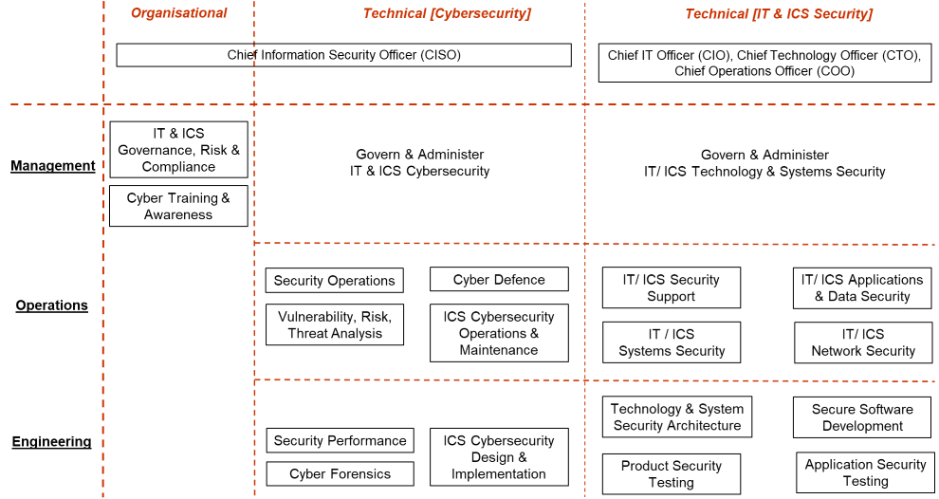
Job Roles and associated Competencies
An illustrative list of IT and cybersecurity job roles and job descriptions in an entity is given below. The knowledge, skills and expertise level required for each of the job roles is mentioned against each role in the form of codes that are taken from Appendix 1A of NCIIPC-QCI Scheme for Cybersecurity Professionals.
| . | Organisation Job Role (Job Title) | Work, activities and tasks required to be done as part of the Job Role (Job Description) | Knowledge, Skills & Expertise |
|---|---|---|---|
| 1 | Information Security Specialist | Conduct risk assessment to help identify cybersecurity risks and determine appropriate controls to ensure that IT and ICS systems perform within acceptable limits of risks. Monitor, track and manage risk mitigations and exceptions to ensure compliance with cybersecurity standards and policies. | KM-0601F SM-0602F |
| 2 | Information Security Officer (ISO) Chief Info Security Officer (CISO) | Drive cybersecurity policies, standards and guidelines aligned to the organisation’s risk management framework, legislation and regulation. Responsible for establishing and approving ISMS policies, standards and guidelines to effectively manage cybersecurity risks, integrate and align the cyber risk management framework in the organisation’s context. | KM-0601A, KM-0701F SM-0602A, SM-0603A |
| 3 | IT GRC Strategist | Strategise, design IT GRC framework and ISMS for organisations and drive projects and investments for cybersecurity of the organisation. | KM-0601M, KM-0701A SM-0602A, SM-0603A |
| 4 | Field Security Engineer | Provide engineering support in the field for security and security management of in-production/ in-use IT and ICS systems of both on-premises and cloud infrastructure of organisations. | KM-0401F, KM-0801F, KM-0802F, KM-0803F SM-0301F, SM-0602F |
| 5 | Technology & Systems Security Team Leader Chief Technology Officer (CTO) Chief IT Officer (CIO) | Conceptualise, design, engineer, integrate and implement the security and security management aspects in IT and ICS systems of both on-premises and cloud infrastructure of organisations. | KM-0401A, KM-0801A, KM-0802A, KM-0803A SM-0301A, SM-0602A |
| 6 | Technology &System Security Architect Technology Strategist | Strategise, conceptualise, design, engineer, integrate the security and security management aspects of large, complex IT and ICS systems of both on-premises and cloud infrastructure of organisations. Identify IT and ICS cybersecurity needs of the organisation and translate them into security designs and principles. Recommend and lead the adoption of new technological advances and best practices in IT and ICS systems to mitigate security risks. | KM-0401A, KM-0801A, KM-0802A, KM-0803A SM-0301A, SM-0602A, SM-0603A |
| 7 | Apps & Data Security Engineer | Configure, operate, administer the day to day security aspects of both on-premises and cloud software platforms (including SaaS) of organisations. Provide security engineering support for development of secure software (Dev-Sec-Ops, secure CI/CD and AI/ML pipelines). Work to be done using enterprise platforms for identity, role-based access management, LDAP, zero-trust infrastructure, IT and ICS asset management, EMS (application management), ITSM and ISMS platforms for patch management, configuration management (CMDB), ticketing and incident management, compliance management, reporting. | KM-0301F, KM-0302F, KM-0501F SM-0101F, SM-0301F, SM-0401F |
| 8 | Apps & Data Security Administrator | Design, oversee and manage secure software design and engineering, including secure software supply chain management. Plan, design, engineer, analyse, oversee the security and security management aspects of software platforms of both on-premises and cloud infrastructure (including SaaS) of organisations. | KM-0301A, KM-0302A, KM-0401A, KM-0501A SM-0301A |
| 9 | Software Security Tester | Security testing of software platforms and applications prior to use in production environment and prior to upgrades. | KM-0502F SM-0401F |
| 10 | Software Security Analyst/ Administrator | Oversee and manage the security testing of software platforms and applications. | KM-0502A SM-0401A |
| 11 | Product Security Tester | Security testing of hardware, devices and appliances prior to use in production environment and prior to upgrades. | KM-0201F, KM-0202F SM-0401F |
| 12 | Product Security Analyst/ Administrator | Oversee and manage the security testing of hardware, devices and appliances. | KM-0201A, KM-0202A SM-0401A |
| 13 | Network Security Engineer | Configure, operate, administer the day to day security aspects of telecom, IT and ICS networks of organisations. Work to be done using enterprise platforms for patch management, configuration management (CMDB), ticketing and incident management, NMS (network management), reporting. | KM-0101F, KM-0102F SM-0101F, SM-0201F, SM-0601F |
| 14 | Network Security Administrator | Plan, design, engineer, analyse, oversee the security and security management aspects of telecom, IT and ICS networks of organisations. | KM-0101A, KM-0102A, KM-0201F, KM-0202F SM-0201A, SM-0601F |
| 15 | System Security Engineer | Configure, operate, administer the day to day security aspects of systems of both on-premises and cloud infrastructure of organisations. Work to be done using enterprise platforms for patch management, configuration management (CMDB), ticketing and incident management, EMS (systems management), reporting. | KM-0201F, KM-0202F SM-0101F, SM-0201F, SM-0601F |
| 16 | System Security Administrator | Plan, design, engineer, analyse, oversee the security and security management aspects of systems of both on-premises and cloud infrastructure of organisations. | KM-0101F, KM-0102F, KM-0201A, KM-0202A SM-0201A, SM-0601F |
| 17 | Security Support Operator | Operate and support the day to day security issues of end user systems and devices. | KM-0201F, KM-0202F, KM-0803F SM-0101F |
| 18 | System Security Administrator | Plan, design, engineer, analyse, oversee the security and security management aspects of end user systems and devices. | KM-0201A, KM-0202A, KM-0803A SM-0101F |
| 19 | Security Performance Junior Analyst | Collect, collate, normalise, analyse cybersecurity related data for assessing performance of cybersecurity functions | KM-1001F SM-0101F |
| 20 | Security Performance Senior Analyst | Plan, design, engineer, oversee the cybersecurity performance analysis to derive insights and identify areas of improvement. | KM-0101F, KM-0102F, KM-0201F, KM-0202F, KM-1001A SM-0101F |
| 21 | ICS Cybersecurity Operator | Operate, administer the day to day security aspects of ICS environment of organisations. | KM-1301F |
| 22 | ICS Cybersecurity Analyst ICS Security Manager | Plan, design, engineer, analyse, oversee the security and security management aspects of ICS environment of organisations. | KM-1301A |
| 23 | ICS Cyber Defence Strategist | Develop frameworks, strategies and processes for vulnerability management, protection, cyber incident detection, response, recovery, investigation and cyber forensics in the ICS environment. | KM-1301M SM-0602F, SM-0602A, SM-0603A |
| 24 | IT Cyber Defence Operator | Operate, carry out the day to day cyber defence functions like rogue asset discovery, vulnerability tracking, cyber threat intelligence (CTI) analysis. | KM-0804F, KM-0901F SM-0101F, SM-0501F |
| 25 | IT Cyber Defence Analyst Cyber Defence Manager | Plan, design, engineer, analyse, oversee the security and security management aspects of cyber defence. May include cybersecurity management of outsourced and third-party service providers like MSPs and MSSPs. | KM-0804A, KM-0901A SM-0101F, SM-0501F, SM-0501A |
| 26 | IT Cyber Defence Strategist | Develop frameworks, strategies and processes for protection, threat and cyber incident detection, response, recovery in the IT environment. | KM-0804A, KM-0901M SM-0101F, SM-0501A, SM-0601F, SM-0603A |
| 27 | Vulnerability, Threat, Risk Operator | Carry out the day to day vulnerability and risk assessment, threat hunting activities, technical audits. Proactively scan logs, network traffic, SIEMs and other channels for suspicious behaviours and indicators of compromise. Identify IT and ICS assets prone to cyber threats and attacks, monitor for potential threats actors/ groups/ individuals attempting cyber-attacks. | KM-0804F SM-0602F |
| 28 | Vulnerability, Threat, Risk Analyst Risk Manager | Plan, design, engineer, oversee, manage the vulnerability and risk assessment, threat hunting activities, technical audits. Derive deep insights for providing strategic direction and investments. | KM-0804A SM-0602A, SM-0603A |
| 29 | Security Operations Operator | Carry out the day to day security operations activities in the SOC, like surveillance and monitoring of IT and ICS systems and assets, support the identification of threats and vulnerabilities, provide incident response and remediation support. | KM-0201F, KM-0803F SM-0101F |
| 30 | Security Operations Analyst Security Operations Manager | Plan, design, engineer, oversee, manage the security operations in the SOC. Respond to cyber incidents, coordinate for containment and mitigation of incidents and recovery. | KM-0201A, KM-0803A SM-0101F |
| 31 | Cyber Forensics Junior Analyst Incident Response Operator | Analyse and investigate cyber incidents to identify breaches, loopholes, process deviations, failures. | KM-1101F SM-0101F, SM-0501F |
| 32 | Cyber Forensics Senior Analyst Incident Response Manager | Plan, direct, oversee, monitor and manage the cyber forensic analysis and investigation activities into the cause and impact of incidents, develop detailed reports on incident timeline, evidence, findings, conclusions and recommendations. | KM-1101A SM-0101F, SM-0501A |
| 33 | Cyber Defence Architect Incident Response Strategist | Strategise, design, engineer, integrate cyber forensics and investigation processes into the security management of large, complex IT and ICS systems of both on-premises and cloud infrastructure of organisations. | KM-1101M SM-0101F, SM-0501A |
| 34 | Cyber Training & Awareness Assistant | Operate the routine cybersecurity training and awareness programmes. | KM-1201F SM-0601F, SM-0602F |
| 35 | Cyber Training & Curriculum Manager | Design and manage cybersecurity curriculum for end users, IT and ICS specialists and managers. | KM-1201A SM-0601A, SM-0602F |
An illustrative reporting hierarchy for different job roles is given in the diagram below.
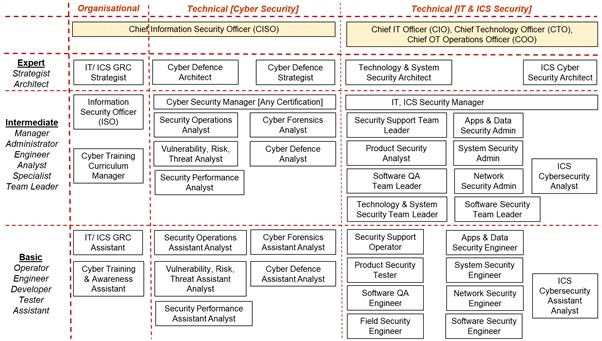
The generic top-most positions for different reporting hierarchies are described as under:
- Chief Technology Officer (CTO) – Oversees the overall technology strategy, large project implementations and engineering functions.
- Chief Information Officer (CIO) – Oversees the IT operations and IT security functions.
- Chief Operations Officer (COO) - Many organisations with large OT/ ICS segments typically have separate COOs for overseeing the OT operations and OT security functions.
- Chief Information Security Officer (CISO) – Oversees the IT Governance (Policies), Risk & Compliance (GRC) functions and information security (IS) operations.
Highly specialised job roles like IT/ ICS GRC Strategist, Technology & System Security Architect, ICS Cyber Security Architect, Cyber Defence Strategist and Cyber Defence Architect are typically required in very large entities and consultancy organisations. Mid-sized and smaller CSEs may choose to contract their services on need- basis from consultancy organisations.
Competency Profiles and Certifications
The Government has embarked upon capacity building of cybersecurity workforce through mechanisms such as academic and education programs and certification of competency profiles by internationally recognised accreditation and certification bodies. A number of academic programs for cybersecurity are already being conducted by leading universities. In addition, there are many global and national level certification programs that are run by different private bodies.
An indicative list of major international certifications is collated here. The list has been prepared, based on publicly available information, and has not been vetted for correctness and completeness. Suggestions for improvements and rectification of errors are welcome.
Guidance on Workforce Capabilities
Organisations are advised to adopt the following steps to align workforce competencies and certifications to different IT and cyberseecurity job roles:
Categorise the organisation’s cyber security workforce requirements for different IT and cybersecurity domains and job roles, using the information of the work, activities and tasks that are listed against the job roles.
Map the knowledge and skills specialisation areas and expertise levels that are considered essential for the job roles. Identify the appropriate set of competency certifications and/ or academic programs that cover the knowledge, skills and expertise requirements for the job roles.
Choose a workforce composition mix that is most appropriate to achieve the IT and cybersecurity objectives of the organisation. The small and medium sized CSEs can club some of the job roles within Technical (Cybersecurity) vertical and the Technical (IT & ICS Security) vertical and assign it to one person with appropriate knowledge and skillsets. The clubbing of job roles across the above mentioned two verticals shall not be done.
Use the job roles, job descriptions, knowledge and skills specialisation areas, expertise levels, competency certifications and academic programs to create appropriate job profiles for internal and/ or external hiring and/or for sourcing of competent workforce from service providers and consultancy organisations.
Use the competency profiles (knowledge, skills and expertise levels) for different job roles to design training programs and if required for hiring training bodies to train the workforce in different cyber security domains, as part of capability and capacity development programs.
Use the competency profile certifications provided by accredited bodies recommended by the government/national nodal agencies as a basis for selection.
Use the competency profile certifications to demonstrate to the regulators and national agencies that cyber security personnel employed in critical IT & ICS domains have the required competence to carry out the respective job role responsibilities.
Consultancy Organisations
The NCIIPC-QCI Scheme for accreditation of IT and ICS Consultancy Organisations (COs) is an initiative of the Government to develop a pool of specialist organisations that can help CSEs in handling the different dimensions of work related to the digital ecosystem.
‘Consultancy’ is the act of providing technical expertise, by an individual or an organisation deemed competent in delivering services as per the defined scope in exchange for a fee. The nature of such expertise may be technical, thematical, procedural or managerial.
Domains
Organisations can usually group their work of handling their digital infrastructure into multiple domains as given here and also tabulated below. Each of these domains are inherently complex and dynamic and require a substantial depth and breadth of knowledge, expertise and skills to do the work.
| . | Domain Type | Domain Title |
|---|---|---|
| 1 | Organisational | Governance, Risk and Compliance |
| 2 | Technical | Technology & System Security Architecture |
| 3 | Technical | Secure Software Development |
| 4 | Technical | Application Security Testing |
| 5 | Technical | Security Product Testing |
| 6 | Technical | Network Security Administration |
| 7 | Technical | System Security Administration |
| 8 | Technical | Applications & Data Security Administration |
| 9 | Technical | Security Support Services |
| 10 | Technical | Security Performance Management |
| 11 | Technical | ICS Cyber Security |
| 12 | Technical | ICS Cyber Risk Assessor |
| 13 | Technical | ICS Cybersecurity Design, & Implementation |
| 14 | Technical | ICS Cybersecurity Operations & Maintenance |
| 15 | Technical | Cyber Defence |
| 16 | Technical | Cyber Vulnerability, Threat & Risk Management |
| 17 | Technical | Security Operations |
| 18 | Technical | Cyber Forensics & Investigation |
| 19 | Organisational | Cyber Training & Awareness |
Typical domain ownership and responsibility is described below.
Domain 1 is related to IT/ ICS GRC under the CISO.
Domains 2 to 5 & 13 are related to design, engineering and implementation of IT/ ICS systems by project engineering teams, under the project management organisation.
Domains 6 to 11 & 14 are related to cyber security aspects for consideration by the IT & ICS teams under the CIO/ OT Head.
Domains 12, 15 to 18 are exclusively related to cyber security functions by the IS & SOC teams under the IT / OT CISO.
Domain 19 is related to training under Head HR.
Work Heads
CSEs find it a challenge to hire sufficient in-house resources for all the domains and functions. Hence, they look for competent, capable and trustworthy Consultancy Organisations, who can do some of the work for them.
The Scheme has defined 11 Work Heads for COs, which are aligned to the work domains within organisations as shown in the table below.
| WH-Id | Title of Consultancy Service (Work Head) | Related Domain (indicative) |
|---|---|---|
| WH-1 | Designing and facilitation of implementation of CSMS (L1/L2/L3) with focus on Governance, Risk and Compliance Requirements | Domain 1 (Governance, Risk and Compliance) |
| WH-2 | IT Cyber Security, Architecture, Design, Engineering and Implementation | Domain 2 (Technology & System Security Architecture) Domain 3 (Secure Software Development) Domain 4 (Application Security Testing) Domain 5 (Product Security Testing) |
| WH-3 | IT Cyber Security Administration and Management | Domain 6 (Network Security Administration) Domain 7 (System Security Administration) Domain 8 (Applications & Data Security Administration) Domain 9 (Security Support Services) Domain 10 (Security Performance Management) |
| WH-4 | ICS Cybersecurity Risk Assessment | Domain 12 (ICS Cyber Risk Assessor) |
| WH-5 | ICS Cybersecurity Architecture, Design, Engineering and Implementation | Domain 13 (ICS Cybersecurity Design, & Implementation) |
| WH-6 | ICS Cybersecurity Operations & Maintenance | Domain 14 (ICS Cybersecurity Operations & Maintenance) |
| WH-7 | Cyber Defence | Domain 15 (Cyber Defence) |
| WH-8 | Cyber Security Monitoring and Assessment | Domain 16 (Cyber Vulnerability, Threat & Risk Management) |
| WH-9 | Cyber Security Operations | Domain 17 (Security Operations) |
| WH-10 | Cyber Security Forensics & Investigation | Domain 18 (Cyber Forensics & Investigation) |
| WH-11 | Cyber Training & Skill Gap Assessments | Domain 19 (Cyber Training & Awareness) |
CXOs can use the mapping of domains to each WH Id to identify who can do what work.
The detailed scope of consultancy work/ services is described in a separate table in the Scheme. This table can be used by the stakeholders in the manner given below:
- CSEs can use the table to describe the work/ services sought from the consultancy organisations in different domains. Contents of the table can be suitably adapted for inclusion in the RFPs.
- COs can use the table to identify what work/ services they can do/ want to do. This activity will be done at the time of applying for accreditation and during the accreditation process.
- ABs can use the table to validate that the COs have the capability to deliver all of the work/ service described under the Work Heads for which they have sougt accreditation.
- Regulators and nodal agencies can use the table to review the capability of COs hired by the regulated entities. This activity is usually required when there are serious lapses in the quality of work done by the COs for the entities.
Note
Lapses in the quality of work/ services of COs is often due to lack of competence in the professionals provided by the COs to the entities. It may also be due to gaps in the work package given to the COs.
The Scheme has a well-defined redressal process to address the issues related to capabilities and competencies of COs.
Accreditation of COs
Accreditation Bodies (AB) are responsible for accreditation of COs under the Scheme. During the accreditation process, the CO shall be attested for their capability, competence and level of expertise to provide consultancy service as per the detailed scope of work/ services tabulated above.
The accreditation process requires the CO to demonstrate to the AB that their consultants/ professionals have the required competency (knowledge, skills and advanced/ master level expertise) to deliver the services. The Scheme tabulates the knowledge and skill requirements for the consultants/ professionals, which is derived from the Scheme for Cybersecurity Professionals.
The evidence of competency is usually demonstrated through global certifications and documented work experience of the professionals.
Once accredited, the CO can offer their services as a whole package or parts of it, depending on the scope chosen and the services sought by the client.
Guidance
CSEs must leverage the robust mechanism of the NCIIPC-QCI Scheme to accredit skilled consultancy organisations. The CSEs can hire COs to become a part of their composite workforce and handle portions of the work of conceptualisation, design, engineering, acquisition, operation and management of their digital infrastructure.
Training Bodies
The NCIIPC-QCI Scheme for accreditation of IT and ICS Training Bodies (TBs) is an initiative of the Government to develop a pool of specialist organisations that can help CSEs in training their workforce to handle the different dimensions of work related to the digital ecosystem. The TBs can also offer training services to individual professionals, who are desirous of enhancing their competencies and obtaining certifications.
The core objective of the Scheme is to put in place a robust system of oversight and due diligence to accredit bonafide TBs, with an assurance that they can impart high quality training to the organisation’s workforce and individual professionals.
Alignment with Domains
Training offered by the TBs to CSEs and individuals are aligned to the 19 domains of the CSEs that are defined under the Scheme and tabulated below. This alignment will help the CSEs to easily map the training objectives and outcomes to their domain requirements.
| . | Domain Type | Domain Title |
|---|---|---|
| 1 | Organisational | Governance, Risk and Compliance |
| 2 | Technical | Technology & System Security Architecture |
| 3 | Technical | Secure Software Development |
| 4 | Technical | Application Security Testing |
| 5 | Technical | Security Product Testing |
| 6 | Technical | Network Security Administration |
| 7 | Technical | System Security Administration |
| 8 | Technical | Applications & Data Security Administration |
| 9 | Technical | Security Support Services |
| 10 | Technical | Security Performance Management |
| 11 | Technical | ICS Cyber Security |
| 12 | Technical | ICS Cyber Risk Assessor |
| 13 | Technical | ICS Cybersecurity Design, & Implementation |
| 14 | Technical | ICS Cybersecurity Operations & Maintenance |
| 15 | Technical | Cyber Defence |
| 16 | Technical | Cyber Vulnerability, Threat & Risk Management |
| 17 | Technical | Security Operations |
| 18 | Technical | Cyber Forensics & Investigation |
| 19 | Organisational | Cyber Training & Awareness |
Scope of Training
Annexures 1A, 1B and 1C of the Scheme document provides a detailed view of the expected offering from the TBs. The details are given under the following heads:
- Domain
- Knowledge and Skill modules
- Number of days for training
- Training objectives
- Training outcomes
- Mode of delivery (online/ face-to-face/ hybrid)
Readers are advised to consult the Scheme documents for further details.
Accreditation of TBs
Accreditation Bodies (AB) are responsible for accreditation of TBs under the Scheme. During the accreditation process, the TB shall be attested for their capability, competence and level of expertise to provide training service as per the detailed scope of work/ services tabulated in the Scheme document.
The accreditation process requires the TB to demonstrate to the AB that their trainers have the required competency (knowledge, skills and advanced/ master level expertise) to deliver the training. The Scheme tabulates the knowledge and skill requirements for the trainers, which is derived from the Scheme for Cybersecurity Professionals.
The evidence of competency is usually demonstrated through global certifications and documented work experience of the trainers.
Once accredited, the TB can offer their training services as a whole package or parts of it, depending on the scope chosen and the services sought by the client.
Guidance
CSEs must leverage the robust mechanism of the NCIIPC-QCI Scheme to accredit skilled training bodies. The CSEs can hire TBs to train their composite workforce to handle portions of the work of conceptualisation, design, engineering, acquisition, operation and management of their digital infrastructure.
The Scheme documentation will also be useful to the internal training teams of organsiations. They can use the structure and content to devise their training packages just like the accredited TBs.
Global Certifications
NCIIPC-QCI Conformity Assessment Framework for Cybersecurity of CSEs
The implementation, operation and management of cyber security in CSEs requires to be assessed by independent accredited Certification Bodies (CBs) and Inspection Bodies (IBs) for compliance with prescribed standards for the sectors. Further, the CSEs require competent cyber security professionals, who are assessed and certified by independent accredited Personnel Certification Bodies (PrCBs). The CSEs also require competent consultancy organisations (COs) and training bodies (TBs), whose expertise and competence is assessed and certified by independent Accreditation Bodies (ABs).
NCIIPC and Quality Council of India (QCI) have formulated and designed a comprehensive Scheme for “Conformity Assessment Framework for Cybersecurity of Critical Sector Entities”. The objective of the Scheme is to establish robust cybersecurity accreditation, certification and inspection processes for
- critical sector entities (CSEs)
- cybersecurity professionals
- consulting organisations (COs)
- training bodies (TBs)
The Scheme incorporates the international framework for accreditation of conformity assessment bodies, viz, CBs, IBs and PrCBs, which is the most appropriate mechanism to ensure quality, integrity, consistency and standardisation.
The CAF for cyber security of CSEs comprises of the following Schemes:
- Certification Scheme for Cyber Security Management System (CSMS) at Levels 1,2 and 3.
- Inspection Scheme for Information Technology and Industrial Control Systems (IT/ICS).
- Personnel Certification Scheme for Cyber Security Professionals.
- Accreditation Scheme for IT/ICS Consultancy Organisations (COs).
- Accreditation Scheme for IT/ICS Training Bodies (TBs).
Details of the Scheme are available on NCIIPC and QCI websites.
The outcomes delivered by the Schemes are as under:
Pool of accredited CBs & IBs: The Government, Regulators, NCIIPC, CSEs and other organisations will have a pool of accredited CBs and IBs for carrying out conformity assessment and/ or inspection of an organisation’s information infrastructure and information security/ cybersecurity management system (ISMS/ CSMS).
Pool of accredited PrCBs and certified Cyber Security Professionals: All organisations will have an indigenous pool of certified cybersecurity professionals, who are assessed and certified by accredited PrCBs for their competence (knowledge, skills, expertise) to implement and ensure IT and OT cyber resilience. The competency certification of cybersecurity professionals is closely aligned with the workforce competency described here.
Pool of accredited COs and TBs: All organisations will have an indigenous pool of accredited COs and TBs with independently certified expertise and competence, to provide them cybersecurity consultancy services and train their workforce. The COs and TBs themselves will leverage the established pool of CSPs for delivering their services.
The Scheme as a whole is adapted to the cybersecurity requirements of CSEs and other organisations of the Indian ecosystem. It is expected to contribute to building national capacity in the cybersecurity domain.
Global Certifications
An illustrative list of cybersecurity certifications offered by global certifying bodies has been compiled from publicly available information and is given below. It also gives a generic mapping of the certifications to the domains defined here. The list has not been vetted for correctness and completeness. Suggestions for improvements and rectification of errors are welcome.
| . | Issuing Body | Certification | Description | Indicative Domain(s) |
|---|---|---|---|---|
| 1 | ISACA | CISA | Certified Information Security Auditor | Governance, Risk and Compliance |
| 2 | ISACA | CRISC | Certified in Risk and Information Systems Control | Governance, Risk and Compliance |
| 3 | ISACA | CISM | Certified Information Security Manager | Cyber Defence |
| 4 | ISACA | CGEIT | Certified in the Governance of Enterprise IT | Governance, Risk and Compliance |
| 5 | ISACA | CSX–P | Cybersecurity Practitioner Certification | Cyber Defence |
| 6 | ISACA | CDPSE | Certified Data Privacy Solutions Engineer | Applications & Data Security Administration |
| 7 | ISACA | ITCA | Information Technology Certified Associate | Cyber Defence |
| 8 | ISACA | CET | Certified in Emerging Technology Certification | Technology & System Security Architecture |
| 9 | ISACA | COBIT Foundation | COBIT Foundation Certificates | Governance, Risk and Compliance |
| 10 | ISACA | COBIT Design | COBIT Design and Implementation | Governance, Risk and Compliance |
| 11 | ISACA | COBIT and NIST | Implementing the NIST Cybersecurity Framework Using COBIT 2019 | Governance, Risk and Compliance |
| 12 | ISACA | IT RISK | IT Risk Fundamentals Certificate | Governance, Risk and Compliance |
| 13 | ISACA | CCAK | Certificate in Cloud Auditing Knowledge | Governance, Risk and Compliance |
| 14 | ISACA | CSX NEXUS | CSX Nexus Cybersecurity Certificates | Governance, Risk and Compliance |
| 15 | ISACA | CYBERSECURITY AUDIT | Cybersecurity Audit Certificate Program | Governance, Risk and Compliance |
| 16 | ISACA | COMPUTING | Computing Fundamentals Certificate | Security Support Services |
| 17 | ISACA | NETWORKS AND INFRA | Networks and Infrastructure Fundamentals Certificate | Network & Systems Security Administration |
| 18 | ISACA | CYBERSECURITY | Cybersecurity Fundamentals Certificate | Security Support Services |
| 19 | ISACA | S/W DEVELOPMENT | Software Development Fundamentals Certificate | Secure Software Development |
| 20 | ISACA | CLOUD | Cloud Fundamentals Certificate | Technology & System Security Architecture |
| 21 | ISACA | BLOCKCHAIN | Blockchain Fundamentals Certificate | Technology & System Security Architecture |
| 22 | ISACA | IOT | IoT Fundamentals Certificate | ICS Cybersecurity |
| 23 | ISACA | AI | Artificial Intelligence Fundamentals Certificate | Technology & System Security Architecture |
| 24 | ISC2 | CISSP | Certified Information Systems Security Professional | Cyber Defence |
| 25 | ISC2 | SSCP | System Security Certified Practitioner | System Security Administration |
| 26 | ISC2 | CCSP | Certified Cloud Security Professional | System Security Administration |
| 27 | ISC2 | CAP | Certified Authorisation Professional | Governance, Risk and Compliance |
| 28 | ISC2 | CSSLP | Certified Secure Software Lifecycle Professional | Secure Software Development |
| 29 | ISC2 | HCISSP | Healthcare Information Systems Security Professional | Cyber Defence |
| 30 | ISC2 | CISSP ISAP | Information System Security Engineering Professional | Technology & System Security Architecture |
| 31 | ISC2 | CISSP ISEP | Information System Security Management Professional | System Security Administration |
| 32 | ISC2 | CISSP ISMP | Information System Security Architecture Professional | Technology and System Security Architecture |
| 33 | GIAC | GSEC | GIAC Security Essentials (GSEC) | Cyber Defence |
| 34 | GIAC | GCIA | GIAC Certified Intrusion Analyst (GCIA) | Cyber Defence |
| 35 | GIAC | GMON | GIAC Continuous Monitoring Certification (GMON) | Cyber Defence |
| 36 | GIAC | GCPM | GIAC Certified Project Manager (GCPM) | Cybersecurity Training & Awareness |
| 37 | GIAC | GPEN | GIAC Penetration Tester (GPEN) | Cyber Defence |
| 38 | GIAC | GSOM | GIAC Security Operations Manager (GSOM) | Security Operations |
| 39 | GIAC | GOSI | GIAC Open Source Intelligence (GOSI) | Cyber Vulnerability, Threat and Risk Management |
| 40 | GIAC | GNFA | GIAC Network Forensic Analyst (GNFA) | Cyber Defence |
| 41 | GIAC | GXPN | GIAC Exploit Researcher and Advanced Penetration Tester (GXPN) | Cyber Defence |
| 42 | GIAC | GWAPT | GIAC Web Application Penetration Tester (GWAPT) | Cyber Defence |
| 43 | GIAC | GREM | GIAC Reverse Engineering Malware (GREM) | Cyber Defence |
| 44 | GIAC | GCIH | GIAC Certified Incident Handler (GCIH) | Cyber Vulnerability, Threat and Risk Management |
| 45 | GIAC | GCCC | GIAC Critical Controls Certification (GCCC) | Cyber Vulnerability, Threat and Risk Management |
| 46 | GIAC | GCFA | GIAC Certified Forensic Analyst (GCFA) | Cyber Forensics and Investigation |
| 47 | GIAC | GCFS | GIAC Certified Forensic Examiner (GCFE) | Cyber Forensics and Investigation |
| 48 | GIAC | GSTRT | GIAC Strategic Planning, Policy, and Leadership (GSTRT) | Governance, Risk and Compliance |
| 49 | GIAC | GISP | GIAC Information Security Professional (GISP) | |
| 50 | GIAC | GLEG | GIAC Law of Data Security & Investigations (GLEG) | Governance, Risk and Compliance |
| 51 | GIAC | GWEB | GIAC Certified Web Application Defender (GWEB) | Applications and Data Security Administration |
| 52 | GIAC | GSOC | GIAC Security Operations Certified (GSOC) | Security Operations |
| 53 | GIAC | GSNA | GIAC Systems and Network Auditor (GSNA) | System Security Administration, Network Security Administration |
| 54 | GIAC | GSLC | GIAC Security Leadership (GSLC) | Governance, Risk & Compliance |
| 55 | GIAC | GRID | GIAC Response and Industrial Defence (GRID) | Cyber Vulnerability, Threat and Risk Management |
| 56 | GIAC | GPYC | GIAC Python Coder (GPYC) | Multiple domains |
| 57 | GIAC | GPCS | GIAC Public Cloud Security (GPCS) | System Security Administration |
| 58 | GIAC | GMOB | GIAC Mobile Device Security Analyst (GMOB) | System Security Administration |
| 59 | GIAC | GISF | GIAC Information Security Fundamentals (GISF) | Cyber Defence |
| 60 | GIAC | GICSP | Global Industrial CSP (GICSP) | Cyber Vulnerability, Threat and Risk Management |
| 61 | GIAC | GFACT | GIAC Foundational Cybersecurity Technologies (GFACT) | Cyber Vulnerability, Threat and Risk Management |
| 62 | GIAC | GEVA | GIAC Enterprise Vulnerability Assessor (GEVA) | Cyber Defence |
| 63 | GIAC | GDSA | GIAC Defensible Security Architecture (GDSA) | Cyber Defence |
| 64 | GIAC | GDAT | GIAC Defending Advanced Threats (GDAT) | Cyber Defence |
| 65 | GIAC | GCWN | GIAC Certified Windows Security Administrator (GCWN) | System Security Administration |
| 66 | GIAC | GCTI | GIAC Cyber Threat Intelligence (GCTI) | Cyber Vulnerability, Threat and Risk Management |
| 67 | GIAC | GCSA | GIAC Cloud Security Automation (GCSA) | Cyber Vulnerability, Threat and Risk Management |
| 68 | GIAC | GCPN | GIAC Cloud Penetration Tester (GCPN) | Cyber Defence |
| 69 | GIAC | GCLD | GIAC Cloud Security Essentials (GCLD) | Cyber Vulnerability, Threat and Risk Management |
| 70 | GIAC | GCIP | GIAC Critical Infrastructure Protection (GCIP) | Cyber Defence |
| 71 | GIAC | GCED | GIAC Certified Enterprise Defender (GCED) | Cyber Vulnerability, Threat and Risk Management |
| 72 | GIAC | GCDA | GIAC Certified Detection Analyst (GCDA) | Cyber Forensics and Investigation |
| 73 | GIAC | GAWN | GIAC Assessing and Auditing Wireless Networks (GAWN) | Governance, Risk & Compliance |
| 74 | GIAC | GBFA | GIAC Battlefield Forensics and Acquisition (GBFA) | Cyber Forensics and Investigation |
| 75 | GIAC | GASF | GIAC Advanced Smartphone Forensics (GASF) | Cyber Forensics and Investigation |
| 76 | GIAC | GIME | GIAC iOS and MacOS Examiner (GIME) | Cyber Forensics and Investigation |
| 77 | CompTIA | N/A | CompTIA IT Fundamentals | Cyber Defence |
| 78 | CompTIA | N/A | CompTIA A+ | Cyber Defence |
| 79 | CompTIA | N/A | CompTIA Network+ | Network Security Administration |
| 80 | CompTIA | N/A | CompTIA Security+ | System Security Administration |
| 81 | CompTIA | N/A | CompTIA Cloud+ | System Security Administration |
| 82 | CompTIA | N/A | CompTIA Linux+ | System Security Administration |
| 83 | CompTIA | N/A | CompTIA Server+ | System Security Administration |
| 84 | CompTIA | N/A | CompTIA CySA+ | Cyber Vulnerability, Threat and Risk Management |
| 85 | CompTIA | N/A | CompTIA CASP+ | Cyber Vulnerability, Threat and Risk Management |
| 86 | CompTIA | N/A | CompTIA Pen Test+ | Cyber Defence |
| 87 | CompTIA | N/A | CompTIA Data+ | Cyber Defence |
| 88 | CompTIA | N/A | CompTIA Project+ | Cyber Defence |
| 89 | CompTIA | N/A | CompTIA CTT+ | Cyber Defence |
| 90 | CompTIA | N/A | CompTIA Cloud Essentials+ | Cyber Defence |
| 91 | AccreditedBodies | N/A | Business Continuity Professional Certification | Cyber Defence |
| 92 | AccreditedBodies | N/A | Lead Auditor in ISO 27001 | Governance, Risk & Compliance |
| 93 | AccreditedBodies | N/A | Lead Implementor in ISO 27001 | Governance, Risk & Compliance |