Lifecycle management of systems and software
The ISO/IEC/IEEE 24748-1:2024 - Systems and software engineering — Life cycle management — Part 1 publication provides unified and consolidated guidance on life cycle management of systems and software, complementing the processes described in ISO/IEC/IEEE 15288 and ISO/IEC/IEEE 12207.
The standard defines a number of terms that are useful to establish a common understanding amongst the stakeholders responsible for the life cycle management of systems and software. It also defines a representative system lifecycle model that comprises of the following stages:
Concept – Development – Production – Utilisation – Support – Retirement.
Note: Each domain of a system-of-interest should be considered as a separate entity that can have a series of stages through which it goes, forming a life cycle model for that domain. When a system has elements that span multiple domains, every domain’s life cycle model should be thought through individually. Also, all the life cycle models and their stages should be considered holistically and care taken that they work in concert.
ISO/IEC/IEEE 24748-1 relationship to detailed process standards is given below.
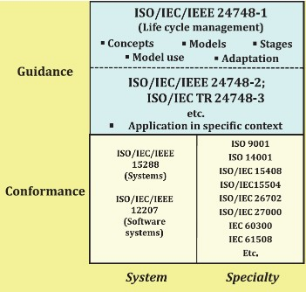
ISO/IEC/IEEE 15288 focuses on the processes that are applied within a life cycle. The processes can be used by acquirer organisations, suppliers (OEMs, system integrators, service providers) and management to fulfil their responsibilities pertaining to the system of interest. Processes are performed as required to achieve stated objectives within a lifecycle stage.
Organisations, when considering a new project, should select a life cycle model and the necessary life cycle processes to satisfy applicable life cycle stage entry or exit criteria. Decisions as to which processes to select should be based on cost-benefit or risk reduction.
ISO/IEC/IEEE 15288:2015 provides a specific example of four groups of system life cycle processes: Agreement, Organisational Project-enabling, Technical Management and Technical. The same is depicted in Figure 2-4, along with sub clause numbers of ISO/IEC/IEEE 15288:2015 in which the specific purpose, expected outcomes, activities and tasks of the processes are described.
Organisational Project-Enabling processes provide enabling resources and infrastructure that are used to create, support, and monitor projects and to assess project effectiveness. Technical Management processes provide requirements so that adequate planning, assessment, and control activities are performed to manage processes and life cycle stages. The role of these two groups of processes is to achieve the project goals within applicable life cycle stages to satisfy an agreement. The Technical Processes are used to perform life cycle related work related to engineering of systems.
Projects may need to establish relationships with other projects within the organisation, as well as those in other organisations. Such relationships are established through the Agreement processes of acquisition and supply. The degree of formality of the agreement is adapted to the internal or external business relationships between projects.